
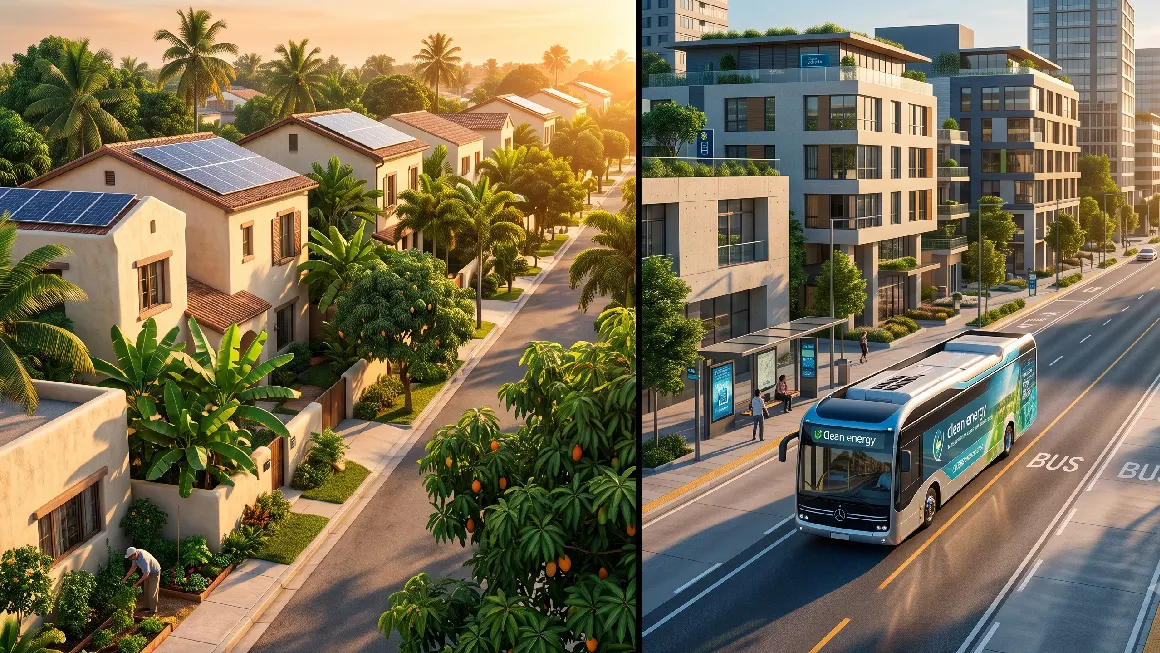
Climate change is affecting daily life, from rising food prices and high electricity bills to new health risks. While these changes force communities to adapt, affordable solar power and smarter designs offer hope. Use this audio for English listening and Shadowing practice to improve your English pronunciation while understanding these vital real-world challenges.
For a long time, people talked about the weather because there was nothing important to say. That has changed. In many countries, the forecast is now the first thing families check in the morning, and not because they are curious. Climate change has left the science pages and moved into kitchens, schools, and supermarkets.
The Cost of a Hotter Year
The clearest effects are not far-away ice sheets. They appear on paper, in bills and receipts. Hot summers push up the price of electricity, because millions of air conditioners run for longer hours. Long dry periods take the water out of the soil, so farmers grow less wheat, coffee, and rice, and those shortages reach the store shelf within months. In parts of Florida, Australia, and southern Europe, insurance has become so expensive that some families can no longer afford to protect their homes against storms and floods.
Health has changed too. Doctors have noticed that very hot weeks are dangerous for older people and for anyone whose job is outdoors. Warm springs arrive earlier, so plants produce pollen for more weeks of the year, and people with allergies suffer for longer. Pharmacies now sell allergy medicine earlier in the year than they used to. Mosquitoes that carry disease have moved north into places that were once too cold for them; therefore, hospitals in those regions now treat illnesses their doctors rarely saw twenty years ago.
A Different Kind of Normal
The future will probably feel ordinary rather than dramatic. Schools may close in extreme heat, in the same way they once closed for heavy snow. Builders may start work at five in the morning and stop at noon. Some coastal towns will move their roads, and a few will move their houses. Governments have already begun this planning, quietly, in documents most people never read.
There is a second story, though, and it is a more hopeful one. Solar power costs a small fraction of what it cost fifteen years ago, and in sunny countries it is now the cheapest electricity ever built. Cities that had no electric buses in 2010 run thousands of them today. Engineers have also returned to old ideas: thick walls, light-colored roofs, and trees planted to make shade, all of which keep a building cool without machines.
Scientists warn that the size of future warming depends mostly on the choices made in this decade. That sounds heavy, but it also means nothing is fixed yet. If countries cut pollution quickly, life will be uncomfortable but possible to manage. If they wait, the bill will be much larger, and the people who pay it are children today. Nobody can promise a reliable climate anymore, because the seasons that farms and cities were built around have already shifted.
Perhaps that is the real change. Climate change used to be an argument about polar bears and dates far in the future. Now it is about the price of bread, whether a child can play outside safely in July, and what kind of ordinary life the next generation will inherit.
Vocabulary · Key Words from the Article
| # | Word | Definition | Example Sentence |
|---|---|---|---|
| 1 | soil noun | the top layer of the earth that plants grow in | “After weeks without rain, the soil in the garden was too dry and hard to dig.” |
| 2 | afford verb | to have enough money to pay for something | “We cannot afford a new car this year, so we will repair the old one.” |
| 3 | suffer verb | to experience pain, illness or something unpleasant over a period of time | “My brother suffers from headaches whenever the air quality gets worse.” |
| 4 | therefore adverb | for that reason; as a result of the fact just mentioned | “The train was cancelled; therefore, we had to take the bus.” |
| 5 | decade noun | a period of ten years | “The city has doubled in size over the past decade.” |
| 6 | reliable adjective | able to be trusted to work well or to behave in the way you expect | “She is a reliable colleague; if she promises something, she does it.” |
|
Tip: Click any vocabulary row to find the word in the article. Export this list to your favorite flashcard apps like Quizlet or Anki. |
|||
Usage Notes & Synonyms
Use 'soil' for the material that plants need, and 'ground' for the surface you stand on. Common partners: dry soil, rich soil, poor soil.
Synonym: earth, ground
'Afford' is almost always used with can, cannot, could or could not: 'I can't afford it.' It is followed by a noun or by 'to + verb': afford a house, afford to travel.
Synonym: pay for, manage
With an illness, use 'suffer from': suffer from asthma, suffer from stress. Without 'from', it means to experience something bad in general: 'Small farms suffered badly last summer.'
Synonym: hurt, struggle
'Therefore' is more formal than 'so' and is common in written English. It usually begins a new sentence or follows a semicolon, and it is normally separated by commas.
Synonym: so, as a result
Frequent partners: this decade, the last decade, for decades. Remember 'a decade ago' means ten years ago, and the stress falls on the first syllable: DEC-ade.
Synonym: ten years
Use it for people, machines, and information: a reliable friend, a reliable car, a reliable source. The opposite is 'unreliable'.
Synonym: dependable, steady
Grammar in Context
Grammar in Context
This article uses the present perfect again and again: 'That has changed', 'Climate change has left the science pages', 'insurance has become so expensive', 'Doctors have noticed', 'Mosquitoes have moved north', 'Governments have already begun', and 'the seasons have already shifted'. We choose this tense when the exact time of the action is not important, but the result is still true now. Compare two sentences: 'Insurance became expensive in 2019' simply reports a finished event in the past, while 'Insurance has become expensive' tells us that the situation continues today. That is exactly the writer's point, so the present perfect does the work. Notice also the common partners of this tense: 'already', 'now', 'too', and time phrases with 'for' and 'since'. The past simple still appears in the article, but only for finished moments ('doctors rarely saw twenty years ago', 'people talked about the weather'). Later in the text, first conditional sentences ('If countries cut pollution quickly, life will be uncomfortable but possible to manage') move the same idea into the future.
Listening Comprehension Questions
Listening Comprehension Questions
What does the writer suggest by saying that the weather is now 'the first thing families check in the morning, and not because they are curious'?
The phrase 'not because they are curious' removes the idea of simple interest and replaces it with need. The rest of the article supports this reading: heat is 'dangerous for older people', schools 'may close in extreme heat', and parents wonder 'whether a child can play outside safely in July'. So the weather is checked for practical reasons, not for pleasure or curiosity.
According to the article, why do supermarket prices rise?
The second section explains the chain clearly: 'Long dry periods take the water out of the soil, so farmers grow less wheat, coffee, and rice, and those shortages reach the store shelf within months.' Insurance is mentioned in the same paragraph, but it is connected to protecting homes, not to shop prices, so option A confuses two separate ideas.
In the sentence 'The future will probably feel ordinary rather than dramatic', what does the writer mean by 'ordinary'?
The examples that follow are all everyday adjustments: schools closing 'in the same way they once closed for heavy snow', builders starting work at five in the morning, towns moving roads. None of these is exciting or violent, which is why 'ordinary' is contrasted with 'dramatic'. The word describes normal daily life, not something unimportant.
Why does the writer include the paragraph about solar power, electric buses and thick walls?
The paragraph opens with a clear signal: 'There is a second story, though, and it is a more hopeful one.' The word 'though' marks a contrast with the earlier paragraphs about costs and health. The writer does not say the problem is solved or unimportant, because the next paragraph returns to warnings, so the purpose is balance rather than comfort.
The writer says that 'nothing is fixed yet'. Explain what this means in the context of the article, and say why the writer places this idea near the end.
Sample Answer
It means that the future amount of warming has not been decided, so human choices can still change the result. The writer connects this directly to time: scientists 'warn that the size of future warming depends mostly on the choices made in this decade'. The two conditional sentences that follow show the two possible paths, one where countries cut pollution quickly and life stays uncomfortable but possible to manage, and one where they wait and 'the bill will be much larger'. Placing this near the end changes the effect of the whole article. The earlier paragraphs describe problems that already exist and cannot be undone, which could leave the reader feeling helpless. By finishing with a choice rather than a disaster, the writer turns the article from a report into an invitation to act, and the final mention of children makes that choice feel personal.
Teacher's Note
A strong answer must (1) explain 'nothing is fixed yet' as future outcomes still being open to change, not as a claim that current damage is reversible; (2) quote or paraphrase the two conditional sentences as evidence of alternative futures; (3) comment on structure, explaining that the position near the end shifts the tone from problem to responsibility; and (4) use accurate present perfect and first conditional forms. Answers that only repeat the sentence, or that claim the writer thinks climate change is not serious, should lose marks.
The article says the cost of waiting 'will be paid by people who are children today'. How fair is it to ask one generation to change its habits for another? Support your view with reasons.
Sample Answer
I think it is fair, but only if the effort is shared honestly. Adults today enjoy cheap flights, large cars and cheap electricity, and those habits created much of the problem, so it seems reasonable that the people who received the benefit also pay part of the cost. Children have no vote and no income, therefore they cannot protect themselves through politics or money, and that lack of power is exactly why adults have a duty to act. However, fairness also works in the other direction. A poor family that cannot afford a new heating system should not be blamed in the same way as a large company. If governments simply raise taxes and leave people to manage alone, the policy will fail, because people will feel punished rather than included. A fair answer, in my opinion, is to expect changes from everyone but to place the largest cost on those with the largest incomes and the largest emissions.
Teacher's Note
Look for (1) a clear position stated early and kept consistently; (2) at least two developed reasons, ideally one about responsibility for past benefits and one about political power or vulnerability; (3) a genuine counter-argument, for example differences in income or the difference between individuals and companies, followed by a response; (4) accurate use of B1 linking words such as 'however', 'therefore', 'because' and 'if'; and (5) use of at least one idea from the text rather than general opinion only. Answers with no counter-argument, or with unsupported claims about statistics, should score lower.
Speaking Practice & Discussion Questions
Speaking Practice & Discussion Questions
Discussion Questions
-
1
According to the article, what happens to the price of electricity during very hot summers?
-
2
Have you noticed any changes in the weather where you live compared with when you were a child?
-
3
If your local schools closed for a week every summer because of extreme heat, how would that change life for families in your area?
-
4
Some people say climate change is mainly a problem for governments and companies, not for individuals. What do you think?
-
5
Which do you think will change life more in the next twenty years: new technology such as solar power and electric transport, or the effects of a warmer climate? Explain your view.
Further Discussion
-
1
Do people generally act to prevent problems they cannot see yet, or do they wait until the problem touches their own life? Why?
-
2
Imagine a government must choose between cheap energy that helps poor families today and clean energy that helps everyone in thirty years. Which choice would you defend, and how would you answer the people who disagree?
-
3
In a hundred years, do you think people will remember this decade as the moment humans finally changed direction, or as the moment they were too late? What would need to happen for the first answer to be true?
Download the Worksheet for Offline Practice
Download the official B1 Intermediate English worksheet (PDF). Review key vocabulary such as ‘soil’ and ‘afford’, answer selected comprehension questions, and check your answers with the included answer key.
Leave a Reply