
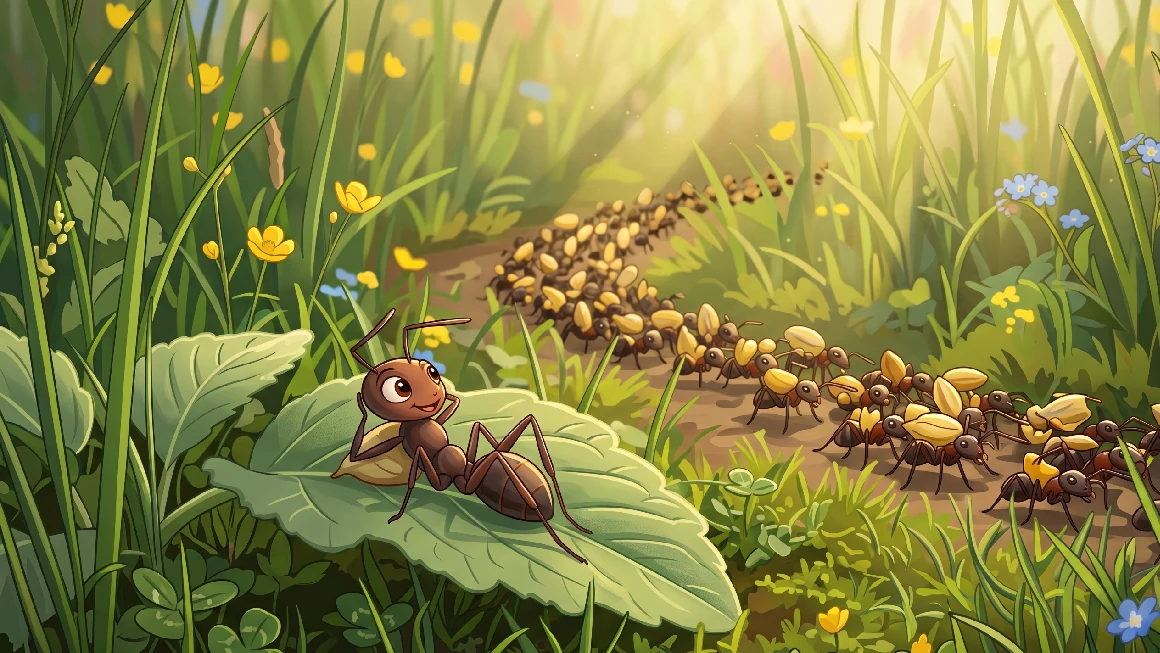
Tom the ant plays all summer while his family gathers food, leaving him cold and hungry when winter arrives. Fortunately, his kind family saves him, and he learns an important lesson about hard work. You can master this beginner listening practice by combining A2 English listening and Shadowing with a simple listen and repeat routine.
In a green field near a small hill, there lived a family of ants. Every summer morning, the ants woke up early. They walked in a long line to collect seeds and grain. They carried the food back to their home under the ground. All day, they worked hard together.
But one ant was different. His name was Tom, and he was very lazy. Tom did not like to work. He liked the warm sun and the soft grass. While the other ants carried food, Tom sang songs. He danced on the flowers. He slept in the shade of a big leaf.
“Tom, come and help us,” his sister said. “Winter is coming soon. We need food for the cold days.”
Tom only laughed. “Winter is far away,” he said. “The sun is warm now. I want to enjoy it. There is no danger today!”
The First Cold Wind
The summer days passed quickly. The other ants filled their home with food. They were careful and put every seed in a dry, safe place. Tom watched them, but he did not join them. He still played in the field.
Then, one morning, everything changed. The sun was not warm. The wind was cold and strong. The green grass turned brown. The flowers died. Grey clouds came, and the first rain fell. Tom was wet and cold. He looked for food, but the field was empty now. There were no seeds. There was no grain.
Tom felt very hungry. He was also very worried. “What can I do?” he thought. “I have no home for winter, and I have no food.”
A Kind Family
Tom walked slowly to his family’s home under the ground. He stood at the door. He felt afraid, and he was ashamed of his lazy summer.
“I am sorry,” Tom said sadly. “You worked, but I played and sang. Now winter is here, and I have nothing.”
His sister looked at him. She was quiet for a moment. Then she opened the door wide. “Come inside, Tom,” she said. “You are our family. We have enough food for you too. But next summer, you must work with us.”
Tom came inside, warm and safe at last. He was so happy that he almost cried. That winter, he watched the snow and the ice from a small window. He remembered his easy summer days, and he understood his big mistake.
When spring came again, Tom was the first ant to wake up. He walked in the line with his family. He carried seeds and grain all day. He still loved the sun, but now he loved his work too. Tom was not lazy again.
Vocabulary · Key Words from the Article
| # | Word | Definition | Example Sentence |
|---|---|---|---|
| 1 | hill noun | a small area of high land, like a very small mountain | “We walked up the hill to see the whole town below us.” |
| 2 | collect verb | to bring things together from different places into one place | “The children like to collect small stones on the beach.” |
| 3 | lazy adjective | not wanting to work or do any activity | “On a hot Sunday, I feel lazy and just want to sleep.” |
| 4 | danger noun | a situation where something bad or harmful can happen | “The sign said the old bridge was full of danger, so we did not cross it.” |
| 5 | careful adjective | giving a lot of attention to what you do so you do not make a mistake | “Please be careful with the hot cup of tea.” |
| 6 | worried adjective | feeling unhappy because you think something bad may happen | “She was worried about her exam results all week.” |
Tip: Click any vocabulary row to find the word in the article. Export this list to your favorite flashcard apps like Quizlet or Anki. | |||
Usage Notes & Synonyms
Use 'on the hill' or 'up the hill'. A hill is smaller than a mountain.
Synonym: mound
Common phrases: 'collect information', 'collect stamps'. Do not confuse it with 'correct', which means true or right.
Synonym: gather
We often say 'a lazy day' for a relaxing day, or 'a lazy person' for someone who avoids work.
Synonym: idle
Common phrases: 'in danger', 'out of danger'. The adjective form is 'dangerous'.
Synonym: risk
We often say 'be careful' as a warning. The opposite is 'careless'. The adverb form is 'carefully'.
Synonym: cautious
Use 'worried about' something or someone. The verb form is 'worry'.
Synonym: anxious
Grammar in Context
Grammar in Context
This story tells about things that happened before, so it uses the simple past tense. Regular verbs add -ed, like 'walked', 'worked', 'played', and 'looked'. Many common verbs are irregular and change their form, like 'woke' (wake), 'sang' (sing), 'felt' (feel), 'came' (come), and 'stood' (stand). We use the simple past to talk about finished actions in the past. For example, 'The ants woke up early' and 'Tom sang songs' both describe completed actions. When you read a story about the past, look for these -ed endings and remember the common irregular verbs, because they appear again and again.
Listening Comprehension Questions
Listening Comprehension Questions
Why did the other ants work so hard every summer day?
The text says the ants collected seeds and grain, and Tom's sister explains: 'Winter is coming soon. We need food for the cold days.' This shows the reason for their hard work was to prepare food for winter, not for fun or because of the sun.
What did Tom do while his family worked?
The story clearly says: 'Tom sang songs. He danced on the flowers. He slept in the shade of a big leaf.' These actions show he was enjoying himself instead of helping the other ants collect food.
In the story, the word 'worried' shows that Tom felt:
Right after the word 'worried', Tom thinks: 'What can I do? I have no home for winter, and I have no food.' This shows 'worried' means he felt unhappy and afraid because something bad might happen to him.
What is the main lesson (message) of this story?
The whole story shows that the hard-working ants had food and were safe, but lazy Tom had nothing. At the end, Tom 'understood his big mistake' and started to work. This teaches readers that preparing for the future is important.
How did Tom change from the beginning to the end of the story? Use your own words.
Sample Answer
At the beginning, Tom was lazy. He did not work and only played, sang, and slept in the sun. He did not think about winter. But after the cold came and he had no food, he felt sorry and worried. His family helped him. At the end, Tom changed completely. In spring, he was the first ant to wake up, and he worked hard with his family every day. He learned that work is important.
Teacher's Note
A good answer should describe Tom's behaviour at the start (lazy, playing, not working) and at the end (hard-working, waking up first, helping the family). Strong answers will also mention why he changed: he suffered in winter and learned from his mistake. The student should use their own words, not copy full sentences from the text.
Tom's sister let him come inside, even though he did not work. Do you think this was a good choice? Why or why not?
Sample Answer
I think it was a good choice because Tom is her family, and family should help each other in hard times. He was cold, hungry, and sorry for his mistake. If she said no, he could be in real danger. She was also clever because she told him he must work next summer. So she was kind, but she also taught him a lesson.
Teacher's Note
There is no single correct answer, so the student can say yes or no. A good answer must give a clear opinion and support it with a reason. Strong answers may mention ideas like family, kindness, second chances, or fairness, and may refer to the sister's rule that Tom must work next summer. The answer should show personal thinking, not just repeat the story.
Speaking Practice & Discussion Questions
Speaking Practice & Discussion Questions
Discussion Questions
-
1
What food did the ants collect in the summer?
-
2
In your daily life, are you more like the busy ants or more like lazy Tom? Why?
-
3
What if winter came very early one year? What could the ants do?
-
4
Is it always bad to relax and enjoy the sun, or do people also need rest? What do you think?
-
5
Some people prepare for the future, and some people only think about today. Which way is better, and why?
Further Discussion
-
1
Why do you think many cultures tell stories about hard work and lazy behaviour to children?
-
2
Imagine a friend never plans for the future and one day has a big problem. Should you help them, or should they learn from their own mistake? Explain your choice.
-
3
In the future, do you think people will work more or relax more than they do today? What could change our lives?
Download the Worksheet for Offline Practice
Download the official A2 Elementary English worksheet (PDF). Review key vocabulary such as ‘collect’ and ‘careful’, answer selected comprehension questions, and check your answers with the included answer key.
Leave a Reply