
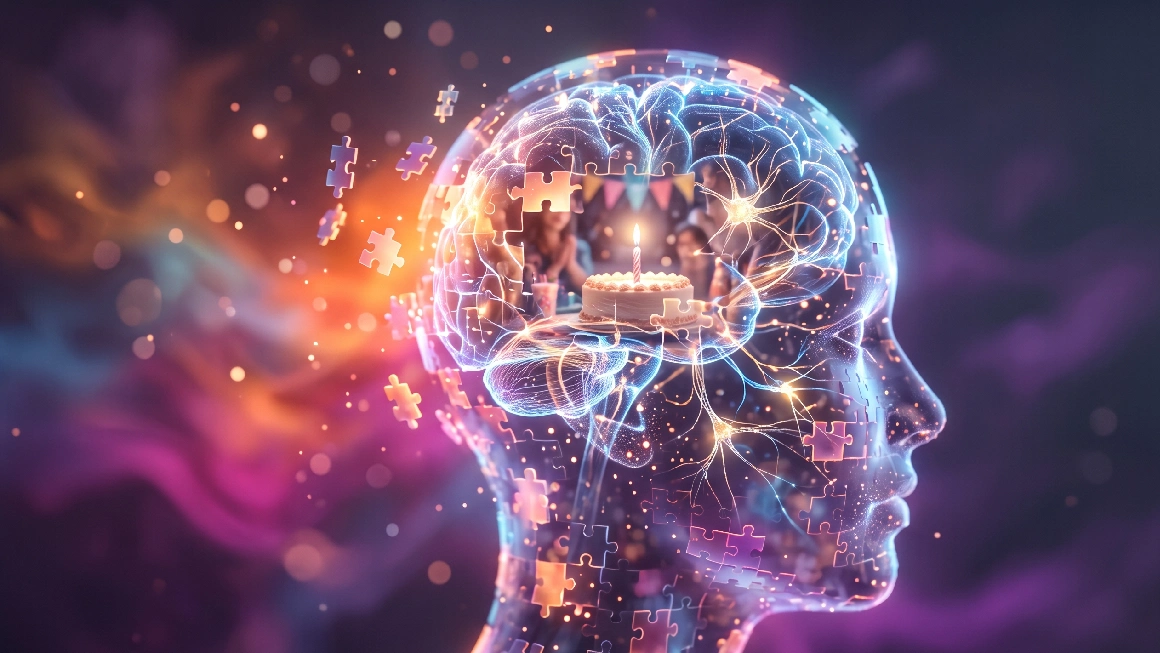
Scientists reveal that memory acts dynamically rather than like a camera, reshaping past events continuously. Strong emotions and adequate sleep significantly strengthen these mental connections. Enhance your english listening comprehension by exploring this engaging audio, and use Shadowing to reinforce key vocabulary and concepts for lasting progress.
Think about your last birthday. Maybe you can see the cake, hear a song, or feel how happy you were. This picture in your head feels real and complete. But scientists say your memory does not work like a camera. It does not save a perfect copy of that day. Instead, your brain keeps small pieces of the event and builds the rest again each time you remember it.
This is one of the most surprising ideas in modern science. For a long time, people thought the brain was like a library full of fixed books. Now researchers believe it is far more active and creative than that.
Three Steps to a Memory
Memory happens in three main stages. First, your brain takes in new information through your senses. Second, it stores that information for later. Third, it brings the information back when you need it. If any step goes wrong, you forget. You have all felt this. A name sits on the tip of your tongue, but you cannot reach it. The memory is there, but your brain cannot open the right door.
Not everything you experience becomes a lasting memory. Your brain is clever, so it throws away most small details. Can you remember what you ate for lunch two weeks ago? Probably not, and that is normal. Your brain saves space for things that matter more.
Why Feelings Make Memories Stronger
Here is something interesting. Strong feelings help you remember. When you feel a powerful emotion, your brain marks that moment as important. This is why you can easily remember a scary accident or a wonderful surprise, but you forget an ordinary Tuesday. Fear, joy, and love all act like bright colours on a grey page.
Sleep also does secret work. While you rest, your brain reviews the day and moves important memories into long-term storage. This is why students who sleep well often do better in exams. If you stay up all night before a test, you make it harder for your brain to keep what you studied.
How to Help Your Memory
The good news is that you can train this mental skill. Teachers often encourage students to test themselves instead of only reading their notes. Trying to remember something makes the memory stronger than reading it ten times.
You can also imagine a strange picture to help you remember a fact. If you connect new information to something silly or familiar, it sticks better. People who review their notes regularly, in short sessions across several days, remember far more than people who study everything at once.
Perhaps the strangest fact is this: every time you remember something, you change it a little. A story you have told many times may not match what really happened. Your memory is not a recording of the past. It is a living thing that grows and changes with you, quietly shaping who you are today.
Vocabulary · Key Words from the Article
| # | Word | Definition | Example Sentence |
|---|---|---|---|
| 1 | event noun | something that happens, especially something important or planned. | “The wedding was the biggest event of the whole year for our family.” |
| 2 | emotion noun | a strong feeling such as love, fear, anger, or joy. | “She could not hide her emotion when she saw her old friend at the airport.” |
| 3 | mental adjective | connected with or happening in the mind. | “Doing puzzles every day is good mental exercise for older people.” |
| 4 | encourage verb | to give someone confidence or support to do something. | “Good coaches encourage their players to keep trying after a mistake.” |
| 5 | imagine verb | to form a picture or idea of something in your mind. | “Close your eyes and imagine a quiet beach at sunset.” |
| 6 | regularly adverb | often and in a repeated, usually equal, way. | “If you water the plants regularly, they will grow much faster.” |
|
Tip: Click any vocabulary row to find the word in the article. Export this list to your favorite flashcard apps like Quizlet or Anki. |
|||
Usage Notes & Synonyms
Common collocations: a major event, a special event, a current event. Do not confuse 'event' with 'accident'; an event can be positive or planned.
Synonym: occasion, happening
Often used with 'show', 'hide', or 'express': to show emotion. The adjective form is 'emotional', as in 'an emotional moment'.
Synonym: feeling
Frequent pairings: mental health, mental skill, mental effort. The opposite in many contexts is 'physical'.
Synonym: cognitive
Followed by 'someone to do something': encourage students to read. The opposite is 'discourage'.
Synonym: support, motivate
Often followed by an -ing form ('imagine living abroad') or a 'that' clause. Do not follow it with a to-infinitive.
Synonym: picture, visualise
Describes how often an action repeats. The adjective form is 'regular', as in 'a regular routine'. The opposite is 'rarely'.
Synonym: often, frequently
Grammar in Context
Grammar in Context
The zero conditional describes general truths and facts that are always true when a condition is met. It uses the present simple tense in both parts of the sentence: 'if' + present simple, followed by present simple. In the article, sentences like 'If any step goes wrong, you forget' and 'If you connect new information to something familiar, it sticks better' show this pattern. This structure fits the topic perfectly because the article explains how memory always behaves, not one single event in the past or future. When you want to state a scientific rule or something that happens every time, the zero conditional is the natural choice. Note that you can replace 'if' with 'when' with almost no change in meaning, because both point to a reliable result.
Listening Comprehension Questions
Listening Comprehension Questions
What is the main idea the writer wants readers to understand about memory?
The article states directly that 'your brain keeps small pieces of the event and builds the rest again each time you remember it', and it contrasts this with the old idea of the brain as a camera or a library of fixed books. The other options are ideas the writer actually argues against.
According to the text, why does the brain throw away most small details?
The paragraph about lunch two weeks ago explains that 'Your brain saves space for things that matter more.' The writer presents forgetting small details as a clever, useful action, not a fault, which rules out the other choices.
In the sentence 'Fear, joy, and love all act like bright colours on a grey page', what does the writer suggest?
This is a comparison. The 'grey page' represents ordinary, forgettable days, while the 'bright colours' represent strong emotions that make a memory easy to recall. It supports the earlier point that 'Strong feelings help you remember.'
What does the article suggest is the best way to make a memory stronger when studying?
The final section says trying to remember 'makes the memory stronger than reading it ten times', and that people who review 'regularly, in short sessions across several days, remember far more'. The other options are described as less effective or even harmful.
The writer says that 'every time you remember something, you change it a little.' In your own words, explain what this means and why it might be important in real life.
Sample Answer
It means that memories are not fixed and permanent. Each time we bring a memory back, our brain can add, remove, or slightly change small parts of it, so the memory slowly moves away from what truly happened. This matters in real life because it shows we should not always fully trust our own memories. For example, two people at the same party might remember it in different ways, and a story we have told many times may no longer be completely accurate. Understanding this can make us more careful and more open-minded when we disagree with others about the past.
Teacher's Note
A strong answer should show understanding that memory is active and changeable rather than a fixed recording. It should restate the idea in the student's own words and give at least one realistic example (such as disagreements between people, or a story that changes over time). Higher-level answers will connect the idea to trust, honesty, or being open-minded.
The article explains that sleep helps the brain store memories. Based on this, what advice would you give to a student preparing for an important exam, and why?
Sample Answer
I would tell the student to study in short sessions over several days rather than in one long night, and to get enough sleep before the exam. The article explains that while we rest, the brain 'reviews the day and moves important memories into long-term storage', so good sleep actually helps us keep what we have learned. Staying up all night is a mistake because it makes it harder for the brain to hold the information. I would also suggest testing themselves instead of only reading, because trying to remember makes memories stronger.
Teacher's Note
A good answer must use evidence from the text (the role of sleep and long-term storage, and the warning about staying up all night). It should give clear, logical advice and explain the reason behind it. The best answers combine two ideas from the article, such as sleep plus self-testing or spaced study, showing the student can connect different parts of the text.
Speaking Practice & Discussion Questions
Speaking Practice & Discussion Questions
Discussion Questions
-
1
According to the article, what are the three main stages of memory?
-
2
What is something from your own childhood that you remember very clearly, and why do you think you still remember it?
-
3
If you could delete one bad memory from your mind forever, would you do it? Why or why not?
-
4
Do you think schools should teach students how memory works and how to study better? Explain your opinion.
-
5
Some people say that phones and computers are making our memories weaker because we no longer need to remember things ourselves. Do you agree?
Further Discussion
-
1
If human memory is not a perfect recording of the past, how much can we really trust history, personal stories, or even our own sense of who we are?
-
2
Imagine a future where scientists could copy, save, and share human memories like computer files. Would this be a wonderful gift or a dangerous idea? Defend your position.
-
3
As technology continues to store more of our information for us, do you think future generations will lose important mental skills, or simply develop new ones? Explain your prediction.
Download the Worksheet for Offline Practice
Download the official B1 Intermediate English worksheet (PDF). Review key vocabulary such as ‘event’ and ‘mental’, answer selected comprehension questions, and check your answers with the included answer key.
Leave a Reply