
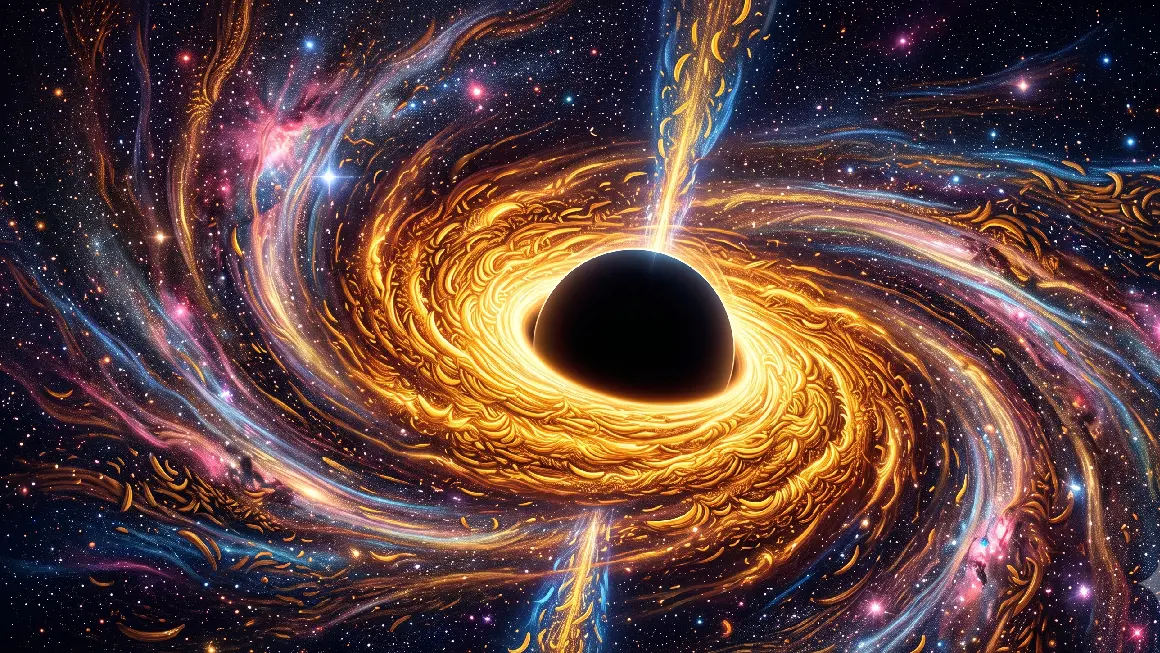
Sagittarius A* sits at the heart of our galaxy, challenging our basic understanding of physics. The information paradox and Hawking radiation show how quantum mechanics conflicts with general relativity near the event horizon. Enhance your native English listening through Shadowing, using this fascinating scientific audio to build deeper insight into space mysteries.
Somewhere near the center of our galaxy, an object weighing four million times more than the Sun sits in perfect darkness. It produces no light of its own. Yet astronomers know exactly where it is, because everything around it behaves as if it were being pulled toward an invisible drain. This is Sagittarius A*, the supermassive black hole at the heart of the Milky Way, and understanding it has become one of the strangest puzzles in modern science.
A black hole forms when a giant star runs out of fuel and cannot support its own weight. The core caves in on itself, and gravity wins completely. What remains is a region of space so dense that nothing which crosses a certain boundary can ever come back, not even light. Physicists call that boundary the event horizon, and it marks the threshold between the universe we can observe and a place we can never see.
Where Ordinary Rules Break Down
What makes black holes so troubling is not simply that they are powerful. It is that they seem to contradict two of our best scientific theories at once. Einstein’s general relativity describes how enormous masses bend space and time, and it predicts the event horizon beautifully. Quantum mechanics, meanwhile, governs the tiny world of particles. When physicists try to apply both theories to the same point at the very center, where a collapsed star has been squeezed into something almost infinitely small, the mathematics stops making sense.
This is where the famous paradoxes appear. According to quantum theory, information about anything cannot simply disappear from the universe. But according to relativity, once matter falls past the event horizon, it is lost forever. Both statements cannot be true. This tension, known as the information paradox, has occupied brilliant minds for fifty years and still has no agreed solution.
Stephen Hawking added another twist. He argued that black holes are not entirely black. Near the event horizon, they should slowly emit a very weak stream of particles now called Hawking radiation. Over unimaginable spans of time, this means a black hole could gradually evaporate and vanish. If that happens, what becomes of everything it once swallowed?
Seeing the Invisible
For decades, all of this remained theory. Then, in 2019, a global team using a faint signal collected from telescopes across several continents produced the first real image of a black hole, revealing a bright ring of hot gas circling a dark center. It was the closest anyone had come to lifting the veil on these objects. The picture matched Einstein’s predictions with remarkable precision.
Even so, the deepest questions stay open. We can photograph the shadow, measure the gas, and calculate the pull, but the interior remains beyond our reach. Black holes may be telling us that our current picture of reality is incomplete. Somewhere in that darkness, physicists believe, lies a clue that could finally join gravity and the quantum world into a single, unified description of the cosmos.
Vocabulary · Key Words from the Article
| # | Word | Definition | Example Sentence |
|---|---|---|---|
| 1 | threshold noun | The level or point at which something starts to happen, or a boundary that separates one state or situation from another. | “Scientists reached a new threshold in the treatment once the drug proved effective in human trials.” |
| 2 | contradict verb | To state the opposite of something, or to be so different from another statement or fact that both cannot be true. | “The witness's second account seemed to contradict everything she had said the day before.” |
| 3 | emit verb | To send out or give off something such as light, heat, sound, gas, or radiation. | “Older factories still emit large amounts of carbon dioxide into the atmosphere.” |
| 4 | evaporate verb | To change from a liquid into a gas, or, used figuratively, to disappear gradually and completely. | “As the sun rose, the morning mist began to evaporate from the fields.” |
| 5 | faint adjective | Not strong or clear; difficult to see, hear, feel, or notice. | “From the top of the hill we could hear the faint sound of church bells in the distance.” |
| 6 | veil noun | A thin covering of cloth, or, used figuratively, something that hides or conceals the truth about something. | “The company tried to keep a veil of secrecy over its plans until the launch date.” |
|
Tip: Click any vocabulary row to find the word in the article. Export this list to your favorite flashcard apps like Quizlet or Anki. |
|||
Usage Notes & Synonyms
Often used figuratively in phrases such as 'on the threshold of' a discovery or a new era; also has a literal meaning of the doorway into a room.
Synonym: boundary, limit
You can contradict a person, a statement, or a claim. Be careful: 'contradict' takes a direct object with no preposition, so say 'contradict the theory', not 'contradict with the theory'.
Synonym: conflict with, oppose
A fairly formal, technical verb often used in science and environmental contexts. The related noun is 'emission', as in 'carbon emissions'.
Synonym: give off, release
Beyond its scientific meaning, it is common in a figurative sense: hopes, support, or savings can all 'evaporate'. The related noun is 'evaporation'.
Synonym: vanish, disappear
Common collocations include 'a faint smell', 'a faint hope', and 'a faint idea'. As a verb, 'to faint' means to lose consciousness briefly, so context matters.
Synonym: weak, slight
Frequently used in figurative phrases such as 'lift the veil on', 'draw a veil over', and 'a veil of secrecy'. It can also refer literally to a covering worn over the face or head.
Synonym: cover, screen
Grammar in Context
Grammar in Context
This article relies heavily on the passive voice, which is formed with the verb 'to be' plus a past participle, for example 'is lost', 'has been squeezed', and 'were being pulled'. The passive is chosen deliberately here because scientific writing often cares more about the process or the affected object than about who performs the action. When we say matter 'is lost forever' or a star 'has been squeezed', the identity of any 'doer' is either unknown, irrelevant, or simply nature itself. Using the passive lets the writer keep the reader's attention on the phenomenon being described and maintain the objective, impersonal tone expected in academic and scientific texts. Notice how it also allows sentences to open with the most important idea rather than a subject that acts.
Listening Comprehension Questions
Listening Comprehension Questions
According to the article, why can astronomers locate Sagittarius A* despite the fact that it emits no light?
The opening paragraph states that astronomers know where it is 'because everything around it behaves as if it were being pulled toward an invisible drain.' The black hole itself is invisible, so its location is inferred from how nearby material moves, not from any light it gives off.
What does the article identify as the central reason black holes are so troubling to physicists?
The section 'Where Ordinary Rules Break Down' explicitly says the trouble is 'not simply that they are powerful' but that 'they seem to contradict two of our best scientific theories at once,' namely general relativity and quantum mechanics. The other options are either untrue or minor details.
In the sentence describing Hawking radiation, the word 'emit' most nearly means:
The text says black holes 'should slowly emit a very weak stream of particles.' The idea of a stream being produced and moving outward matches 'to send out or release.' The opposite notion of pulling inward would contradict the description of radiation leaving the black hole.
Which statement best captures the overall message of the final section of the article?
The final section reports that the 2019 image 'matched Einstein's predictions with remarkable precision' but then states that 'the deepest questions stay open' and 'the interior remains beyond our reach.' This balance of confirmation and continuing mystery is the section's main point.
In your own words, explain the 'information paradox' and why the author presents it as a genuine problem rather than a simple misunderstanding.
Sample Answer
The information paradox arises from a direct clash between two reliable theories. Quantum mechanics insists that information about matter can never be entirely erased from the universe, while general relativity holds that anything falling past the event horizon is lost permanently. The author frames this as a real problem because both theories are extraordinarily well tested and successful in their own domains, so neither can be casually dismissed. The paradox is not caused by faulty reasoning or missing data; rather, two trustworthy descriptions of reality produce logically incompatible conclusions about the same event. This is why the article notes it has 'occupied brilliant minds for fifty years and still has no agreed solution.'
Teacher's Note
A strong answer must (1) accurately restate both sides of the contradiction, information cannot be destroyed versus matter is lost forever; (2) explain that the difficulty comes from two respected theories clashing, not from human error; and (3) ideally reference textual evidence, such as the fifty-year timeframe or the phrase 'both statements cannot be true.' Depth is shown by recognising why two 'correct' theories creating a conflict is philosophically significant.
The article suggests that black holes may reveal that 'our current picture of reality is incomplete.' Discuss what this implies about the nature of scientific progress.
Sample Answer
This statement implies that scientific knowledge is provisional rather than final, and that even our most celebrated theories may be approximations awaiting a deeper explanation. Black holes act as a kind of test case where relativity and quantum mechanics both break down, exposing the limits of each. Rather than treating this as a failure, the article presents it as an opportunity, since 'a clue' hidden in that darkness could unify the two frameworks. This reflects how science advances: not by proving old ideas simply wrong, but by finding the boundaries where they no longer work and building a broader theory that contains them. Progress, then, is driven as much by identifying what we cannot yet explain as by celebrating what we can.
Teacher's Note
A high-quality response should (1) recognise that the quote points to the limits and incompleteness of current theories; (2) connect this to the wider idea that science is self-correcting and provisional; and (3) show analytical depth by explaining that anomalies and unsolved problems are engines of discovery, not merely embarrassments. Referencing the article's hopeful framing of a unifying 'clue' strengthens the answer.
Speaking Practice & Discussion Questions
Speaking Practice & Discussion Questions
Discussion Questions
-
1
According to the article, what is the name of the boundary that surrounds a black hole and marks the point where nothing can escape?
-
2
Have you ever read a book, watched a film, or seen a documentary about space or black holes? What do you remember most about it?
-
3
If you could send a probe safely toward a black hole to study it, what one question would you most want it to answer?
-
4
Some people find the idea that information could be lost forever deeply unsettling. Do you think it matters whether such 'lost' knowledge could ever be recovered?
-
5
Do you believe humanity will one day fully understand black holes, or are some parts of the universe likely to stay permanently beyond our reach? Explain your view.
Further Discussion
-
1
How much of the universe do you think human beings are truly capable of understanding, and are there limits set by our biology, our tools, or the nature of reality itself?
-
2
If a scientific discovery had no practical use whatsoever and existed only to satisfy curiosity, how much money and effort do you believe a society should be willing to spend on it?
-
3
As our instruments grow more powerful, do you think the greatest future breakthroughs will come from observing the universe more precisely, or from rethinking the theories we already have?
Download the Worksheet for Offline Practice
Download the official C1 Advanced English worksheet (PDF). Review key vocabulary such as ‘emit’ and ‘veil’, answer selected comprehension questions, and check your answers with the included answer key.
Leave a Reply