
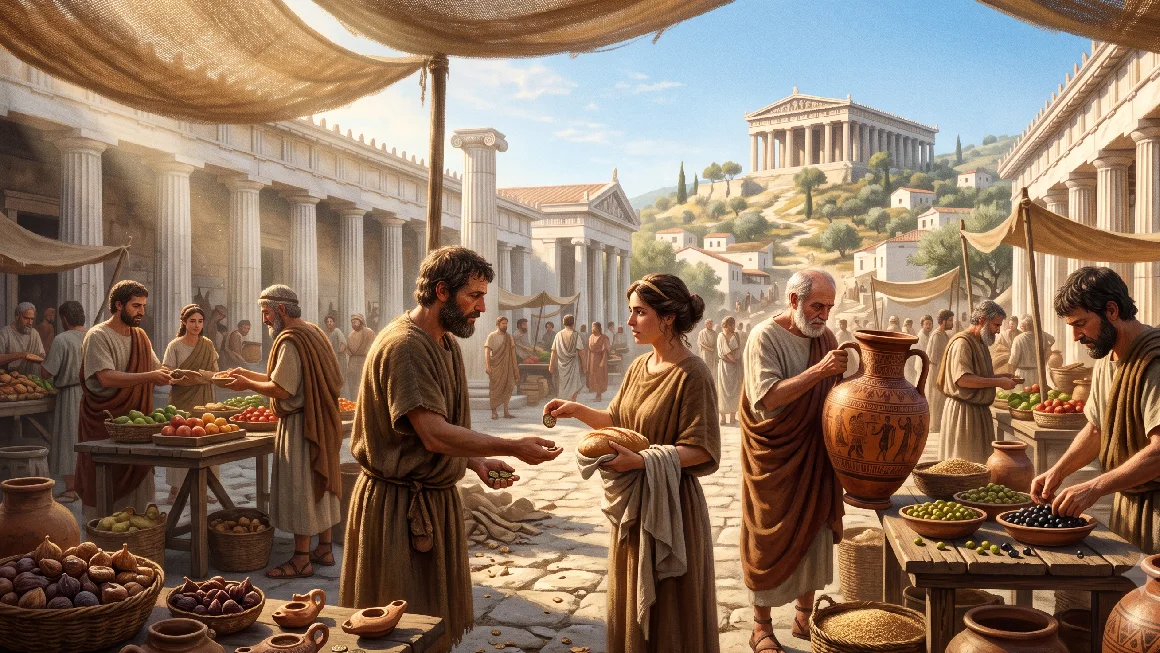
Ancient Greek life was defined by busy markets, family traditions, and public debates. Most people were farmers or sellers working hard for their daily living. Practice your English listening with this engaging audio about history, and use Shadowing to improve your English pronunciation while building strong comprehension step by step.
When we think about ancient Greece, we often picture white temples, marble statues, and clever men in long robes talking about big ideas. But most Greeks were not philosophers or kings. They were farmers, sellers, and workers who woke up early and worried about food, money, and family, just as people do today.
The busiest place in any Greek city was the agora, the open market at the centre of town. Every morning it filled with noise and life. Sellers shouted about their goods, and buyers argued about the price of fish, olives, and cloth. People used small metal coins to pay, and this simple system of trade helped the city grow rich. If you had lost a friend in the crowd, the agora was the first place you would look.
Home and family life
Greek houses were often small and built around a quiet open yard. Rich families owned many rooms and had servants to cook and clean, while poorer families lived in just one or two rooms. Men usually spent their days outside, working or meeting friends. Women were expected to stay at home, look after the children, and make cloth. Life for a woman was not easy, and history books have long tried to show how hard and closed her world could be.
Food was simple but fresh. Most families ate bread, cheese, olives, and vegetables, and they drank wine mixed with water. Meat was expensive, so ordinary people ate it only on special days, often after a religious festival.
Ideas, gods, and games
Religion touched every part of daily life. The Greeks believed in many gods, and a priest would offer gifts at the temple to keep them happy. Before a long journey or an important decision, people asked the gods for help. Nobody could prove that the gods were listening, but few people ever thought to argue against these old beliefs.
The Greeks also loved to think and talk. In cities like Athens, free men met in public to discuss how their city should be ruled. This early idea of shared power slowly grew into what we now call democracy. Public speaking was a real skill, and a good speech could change people’s minds and even shape the future of the city.
Sport and theatre mattered too. Thousands of people travelled to Olympia every four years to watch the games, and huge crowds sat in open-air theatres to enjoy plays about heroes and gods.
Today, when we visit the broken columns and quiet ruins of Greece, it is easy to forget the noise. But once, these silent stones were full of ordinary people, living their ordinary and very human lives.
Vocabulary · Key Words from the Article
| # | Word | Definition | Example Sentence |
|---|---|---|---|
| 1 | goods noun | things that are made or grown in order to be sold. | “The shop sells electrical goods such as televisions and phones.” |
| 2 | coin noun | a small, flat, round piece of metal used as money. | “She dropped a coin into the machine and pressed the button.” |
| 3 | trade noun | the activity of buying and selling goods, often between people or countries. | “Trade between the two countries has grown quickly in recent years.” |
| 4 | prove verb | to show that something is true using facts or clear reasons. | “The scientist could not prove that the new medicine was safe.” |
| 5 | argue verb | to give reasons for or against an idea, or to disagree with someone. | “Many people argue that homework should be much shorter.” |
| 6 | speech noun | a formal talk that someone gives to a group of people. | “The president gave a short speech to thank the workers.” |
|
Tip: Click any vocabulary row to find the word in the article. Export this list to your favorite flashcard apps like Quizlet or Anki. |
|||
Usage Notes & Synonyms
'Goods' is almost always plural and takes a plural verb: 'The goods are ready.' Common phrases include 'buy goods' and 'sell goods'.
Synonym: products
We say 'a gold/silver coin' and 'toss a coin' to make a quick decision. Do not confuse 'coin' (metal) with 'note' or 'bill' (paper money).
Synonym: piece of money
Often used with 'with' (trade with China) and in phrases like 'free trade'. It can also be a verb: 'They trade in fruit and vegetables.'
Synonym: business, commerce
The past forms are 'proved' and 'proven'. A useful phrase is 'prove someone wrong'. Be careful: 'prove' means to show truth, not simply to 'try'.
Synonym: show, confirm
'Argue with someone' means to have a disagreement, while 'argue that...' means to give an opinion with reasons. The noun is 'argument'.
Synonym: disagree, claim
We usually say 'give' or 'make a speech', not 'do a speech'. 'Speech' can also mean the general ability to speak.
Synonym: talk, address
Grammar in Context
Grammar in Context
This text uses the past simple tense again and again to describe what people regularly did in ancient Greece: sellers 'shouted', buyers 'argued', families 'ate' bread, and people 'used' coins. At B1 level, the past simple is the main tool for talking about finished actions and past routines. Notice that regular verbs usually add '-ed' (shouted, argued, travelled), while many common verbs are irregular and must be learned separately (eat/ate, drink/drank, build/built, spend/spent). Because the whole article looks back at a world that no longer exists, the past simple gives the story a clear and steady sense of history. You will also see the past continuous ('the gods were listening') to describe a longer background action, which is a natural next step from the basic past simple.
Listening Comprehension Questions
Listening Comprehension Questions
What is the main point the writer makes in the first paragraph?
The writer says most Greeks 'were not philosophers or kings' but were 'farmers, sellers, and workers' who 'worried about food, money, and family, just as people do today.' This directly connects ordinary ancient life to modern life, which is the paragraph's main idea. The other options focus on small details or ideas the text does not support.
According to the text, why did ordinary people eat meat only on special days?
The text states clearly: 'Meat was expensive, so ordinary people ate it only on special days.' The word 'so' shows that the high price was the reason. The other options are not mentioned and cannot be found in the passage.
In the sentence 'few people ever thought to argue against these old beliefs', what does the word 'argue' suggest people did NOT do?
Here 'argue against' means to speak or think in disagreement. The sentence says few people did this, which shows that most people accepted their religious beliefs without question. The other choices describe actions that are either mentioned elsewhere or unrelated to the meaning of 'argue'.
What is the writer's main purpose in the final paragraph?
The final paragraph contrasts the 'quiet ruins' and 'silent stones' of today with the 'noise' and 'ordinary people' of the past. The writer's goal is to help readers imagine the real, busy human life behind the ruins, not to explain destruction, tourism, or to make a comparison of which age was 'better'.
Using information from the text, explain how life was different for men and women in ancient Greece.
Sample Answer
In ancient Greece, men and women lived quite separate lives. Men usually spent their days outside the home, working, meeting friends, and in some cities taking part in public discussions about how the city should be ruled. Women, on the other hand, were expected to stay at home, look after the children, and make cloth. The text also suggests that a woman's world was 'hard and closed', which means she had far less freedom than a man. So the main difference was that men had a public, social life, while women were mostly limited to private life inside the home.
Teacher's Note
A strong answer should clearly contrast the public role of men (working, meeting friends, joining public discussion) with the private, domestic role of women (staying home, raising children, making cloth). It should use specific details from the text and ideally note that women had less freedom. Good answers use the learner's own words rather than copying whole sentences.
The writer connects ancient Greek life to modern life several times. Why do you think this comparison is useful for readers today?
Sample Answer
The comparison is useful because it makes a very old and distant world feel closer and easier to understand. When the writer shows that the Greeks worried about food, money, and family, readers can see that people thousands of years ago were not so different from us. This helps modern readers feel a personal connection to history instead of seeing it as just facts and dates. It also reminds us that behind famous temples and great ideas there were normal people with normal problems, which makes history more human and more interesting.
Teacher's Note
A good answer should explain that the comparison makes history feel relatable and human, not just a list of facts. Strong responses will mention that shared worries (food, money, family) build a bridge between past and present, and may add that this approach makes readers more interested or more emotionally connected. The learner should give reasons, not only repeat that a comparison exists.
Speaking Practice & Discussion Questions
Speaking Practice & Discussion Questions
Discussion Questions
-
1
According to the article, what kinds of everyday food did most Greek families eat?
-
2
Which part of daily life in ancient Greece is most similar to your own daily life?
-
3
If you could spend one morning in the ancient Greek agora, what would you most want to see, buy, or do?
-
4
The Greeks began the idea of ordinary people sharing power in their city. Why do you think this idea became so important around the world?
-
5
Do you think people today are really that different from the ancient Greeks, or are our basic worries and hopes still the same? Explain your opinion.
Further Discussion
-
1
How much can old buildings, coins, and ruins really tell us about how ordinary people once lived and felt?
-
2
If future people studied only the objects we leave behind, what might they wrongly believe about our daily lives today?
-
3
Many ideas from ancient Greece, such as sharing power and public debate, are still with us. Which of today's ideas do you think people will still be using in two thousand years?
Download the Worksheet for Offline Practice
Download the official B1 Intermediate English worksheet (PDF). Review key vocabulary such as ‘prove’ and ‘argue’, answer selected comprehension questions, and check your answers with the included answer key.
Leave a Reply