

The 2026 NATO summit in Ankara addressed urgent European defense budgets, lasting support for Ukraine, and internal alliance unity. By analyzing these complex themes, you can significantly enhance your English listening. Consistent Shadowing allows you to acquire perfect English intonation and natural English rhythm while studying global security matters.
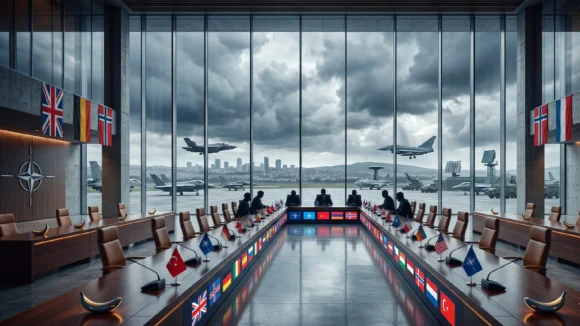
The 2026 NATO summit in Ankara opened under a sky heavy with unresolved questions. For an alliance that has endured for more than seventy years, the gathering at the Bestepe complex was never going to be a routine exercise in diplomacy. Delegations from thirty-two member states arrived aware that the decisions taken here would shape European security for a generation, and that the usual language of unity would have to be matched by something more concrete.
At the centre of the discussions stood the familiar but increasingly urgent problem of how much each country should spend on its own defence. Washington, under President Trump, has pressed its European partners with unusual bluntness, arguing that the burden of protecting the continent has fallen too heavily on American shoulders. The proposal on the table, raising defence spending toward five percent of national output by 2035, would have seemed impossible only a few years ago. Now it is discussed as a serious, if painful, ambition.
Ukraine remained the moral and strategic core of the summit. Allies moved to confirm a long-term package of military equipment and training worth roughly seventy billion euros for 2026, much of it drawn from a European credit facility. President Zelensky, seated among leaders rather than pleading from outside the room, embodied how far the war has reshaped the alliance. What began in 2022 as an emergency response has hardened into a sustained commitment, and few delegates spoke as though it might soon end.
Yet unity, however loudly proclaimed, is never guaranteed. Analysts have long warned that internal disagreements could slowly erode the collective resolve on which the alliance depends. Some governments remain anxious about the economic cost; others question how long American attention will hold as Washington looks increasingly toward the Pacific. Building genuine consensus among thirty-two democracies, each answerable to its own voters, is a slower and more delicate process than the confident group photographs suggest.
For Turkey, the summit carried particular weight. As host, Ankara used the occasion to display the growing strength of its domestic defence industry and to press for the removal of trade restrictions among allies. President Erdogan was also expected to raise the question of American sanctions and access to the F-35 programme in his meeting with President Trump, matters that touch directly on Turkey’s standing within the alliance.
Beyond the immediate agenda lay a larger and more difficult argument about what NATO is now for. The organisation was founded in 1949 to deter a Soviet threat that no longer exists in its original form, yet Russia’s actions since 2014 have returned the alliance to something close to its founding purpose. To uphold the principle of collective defence, members must persuade both their rivals and themselves that the promise still carries force.
The Ankara summit produced no single dramatic breakthrough, and perhaps none was possible. Its real test will unfold in the months ahead, in defence budgets, in factories, and in the quieter negotiations that rarely reach the cameras. Whether the alliance can turn its declarations into durable strength remains, as ever, an open question.
Vocabulary · Key Words from the Article
| # | Word | Definition | Example Sentence |
|---|---|---|---|
| 1 | alliance noun | A formal agreement between countries or groups to work together, especially for defence or a shared goal. | “The two nations formed a defensive alliance to protect their shared borders.” |
| 2 | burden noun | A heavy load of duty, cost, or responsibility that is difficult to carry or bear. | “Rising fuel prices placed a heavy financial burden on ordinary families.” |
| 3 | strategic adjective | Relating to a long-term plan designed to achieve an important overall aim, especially in politics, business, or the military. | “The company made a strategic decision to enter the Asian market first.” |
| 4 | erode verb | To gradually destroy, weaken, or wear away something over a period of time. | “Repeated scandals slowly eroded public trust in the government.” |
| 5 | consensus noun | General agreement reached by most members of a group after discussion. | “After hours of debate, the committee finally reached a consensus.” |
| 6 | uphold verb | To support or maintain a principle, law, or decision, and prevent it from being weakened or ignored. | “Judges have a duty to uphold the law without personal bias.” |
Tip: Click any vocabulary row to find the word in the article. Export this list to your favorite flashcard apps like Quizlet or Anki. | |||
Usage Notes & Synonyms
Common collocations: 'form/build an alliance', 'a military alliance', 'strengthen an alliance'. Note the phrase 'in alliance with' someone.
Synonym: coalition, partnership
Frequent collocations: 'bear/carry the burden', 'a financial burden', 'the burden falls on someone'. It can be literal or, more often, figurative.
Synonym: load, weight
Common collocations: 'a strategic decision/goal', 'strategic importance', 'strategically located'. The adverb form is 'strategically'.
Synonym: tactical, planned
Used both literally (wind erodes rock) and figuratively (erode confidence, support, or rights). Note the noun form 'erosion'.
Synonym: weaken, wear away
Key collocations: 'reach/build/achieve consensus', 'broad consensus', 'a consensus on something'. It is uncountable, so avoid 'a consensuses'.
Synonym: agreement, accord
Common collocations: 'uphold the law/a principle/a tradition', 'uphold a decision'. It is an irregular verb: uphold, upheld, upheld.
Synonym: maintain, defend
Grammar in Context
Grammar in Context
The text repeatedly uses the present perfect (for example, 'that has endured for more than seventy years', 'Washington has pressed its European partners', and 'Russia's actions since 2014 have returned the alliance') to link past developments directly to the present moment of the summit. In analytical writing, this tense is powerful because it frames ongoing conditions rather than closed, finished events: the alliance is still enduring, the pressure is still being applied, and the consequences of past actions are still being felt now. Notice how it often pairs with 'for' and 'since' to mark duration ('for more than seventy years', 'since 2014') and with 'increasingly' or 'long' to stress continuity. Choosing the present perfect instead of the simple past signals to the reader that these are living, unresolved forces shaping the events described, which is exactly the effect a commentary on current affairs seeks to create.
Listening Comprehension Questions
Listening Comprehension Questions
What does the phrase 'the usual language of unity would have to be matched by something more concrete' suggest about the summit?
The word 'concrete' here means real, practical, and specific, in contrast to abstract talk. The sentence positions 'language of unity' (words) against 'something more concrete' (action), implying that this summit demanded measurable commitments rather than familiar reassurances. This reading is reinforced later by references to actual defence budgets, spending targets, and equipment packages.
According to the text, why does the United States argue that European partners should spend more on defence?
The second paragraph states that Washington argues 'the burden of protecting the continent has fallen too heavily on American shoulders.' The word 'burden' signals cost and responsibility, and the metaphor of it resting on 'American shoulders' directly supports the idea of an unfair distribution of effort. The five percent figure is presented as a proposed ambition, not an existing automatic rule.
In the sentence 'internal disagreements could slowly erode the collective resolve', the word 'erode' most nearly means:
The adverb 'slowly' immediately before 'erode' is a strong contextual clue pointing to a gradual process. 'Resolve' means firm determination, and the sentence warns that disagreements could wear this determination away over time. The surrounding context, listing anxieties about cost and doubts about American attention, confirms a meaning of gradual weakening rather than sudden change or measurement.
Which statement best captures the overall main idea of the article?
The article consistently balances declared unity against underlying strain, noting disputes over spending, doubts about consensus, and questions about NATO's purpose. The final paragraph makes the main idea explicit: the summit 'produced no single dramatic breakthrough' and its 'real test will unfold in the months ahead.' The other options overstate success, misrepresent the agenda, or reduce the whole event to a single minor theme.
The writer describes building consensus among thirty-two democracies as 'a slower and more delicate process than the confident group photographs suggest.' Explain what this contrast reveals about the gap between appearance and reality at such summits.
Sample Answer
The contrast highlights a tension between the public image of an alliance and its private complexity. The 'confident group photographs' represent a carefully staged appearance of unity, designed for cameras and voters, while the phrase 'slower and more delicate process' points to the difficult, unglamorous reality of negotiation. Because each of the thirty-two members is 'answerable to its own voters', every leader must balance collective goals against domestic political pressures, which makes genuine agreement fragile and time-consuming. The writer therefore implies that visible symbols of solidarity should not be mistaken for actual, durable consensus; the smiling photograph may conceal serious unresolved disagreement beneath it.
Teacher's Note
A strong answer must identify the deliberate contrast between image (photographs, confidence) and process (slow, delicate negotiation). It should reference the detail that members are answerable to their own voters as the reason agreement is hard, and it should draw the inference that outward unity can mask inner division. Higher-level responses will use precise abstract vocabulary (appearance, symbolism, domestic pressure, fragility) and connect the point to the article's wider scepticism about declared unity.
The article claims NATO was founded in 1949 to deter a threat that 'no longer exists in its original form', yet has returned to 'something close to its founding purpose'. Discuss the real-world implications of an alliance rediscovering an old mission in a new era.
Sample Answer
An alliance that rediscovers an old mission faces both an advantage and a danger. The advantage is clarity of purpose: collective defence against a state rival gives NATO a concrete, familiar rationale, which can justify higher spending, closer coordination, and the inclusion of formerly neutral states. The danger is that the world has changed since 1949, so applying an old framework risks ignoring newer challenges such as cyber threats, competition in the Pacific, and internal political division within member states. In practice, this means NATO must adapt rather than simply revive: it has to convince rivals that its guarantees are credible while persuading its own citizens that the costs are worth bearing. The implication is that historical continuity offers legitimacy, but only if the alliance updates its tools and reasoning for present conditions rather than assuming the past can be repeated unchanged.
Teacher's Note
A good response should recognise both benefits (clear purpose, justification for unity and spending, enlargement) and risks (an outdated framework, neglect of new threats, the challenge of credibility). It should engage with the tension between continuity and change, ideally referencing the text's own mention of Russia since 2014 and the shift of attention toward the Pacific. The strongest answers will move beyond summary to genuine evaluation, weighing why reviving an old mission is not the same as merely repeating history.
Speaking Practice & Discussion Questions
Speaking Practice & Discussion Questions
Discussion Questions
-
1
In which city and country was the 2026 NATO summit held, and who hosted it?
-
2
Have you ever followed news about an international summit or meeting between world leaders? What do you remember about it?
-
3
If you were a leader attending this summit, which single issue would you argue was most urgent, and why?
-
4
Do you think countries have a genuine responsibility to help defend their allies, or should each nation focus mainly on itself?
-
5
The article suggests that visible unity can hide real disagreement. In your view, is this true of large international organisations in general, and can such alliances remain strong in the long term?
Further Discussion
-
1
To what extent can any long-standing institution stay true to its original purpose while adapting to a completely different world, and where should the line between continuity and reinvention be drawn?
-
2
Imagine a wealthy country is asked to spend heavily to defend a distant ally that offers it little direct benefit. Is it ethically justified to demand such sacrifice from its citizens, and how would you defend your position?
-
3
As global power shifts and new technologies reshape conflict, how do you predict the very idea of a military alliance will change over the next fifty years?
Download the Worksheet for Offline Practice
Download the official C1 Advanced English worksheet (PDF). Review key vocabulary such as ‘burden’ and ‘uphold’, answer selected comprehension questions, and check your answers with the included answer key.
Leave a Reply