
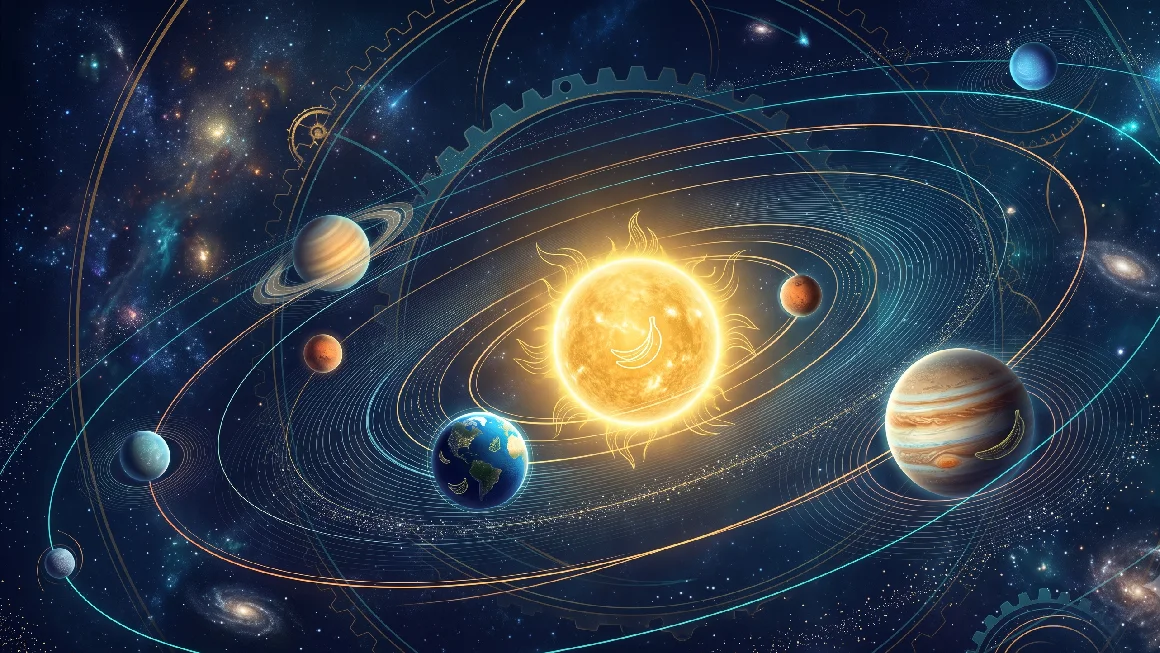
Gravity and celestial mechanics govern the orderly motion of planets, moons, and comets around the Sun. Over time, subtle gravitational pulls from nearby worlds shift these orbits, creating a delicate balance. Explore this silent cosmic harmony while building advanced English listening skills through Shadowing practice with our structured audio lesson.
Look up on a clear night and the sky seems perfectly still. Yet nothing above us is truly at rest. Every planet, moon, and drifting speck of rock is racing through space, held on its path by forces we cannot see. The study of how these bodies move, and why they keep moving in such orderly patterns, is known as celestial mechanics. It is one of the oldest sciences, and also one of the most surprising, because it reveals a universe that behaves less like chaos and more like a vast piece of clockwork.
The single force that governs almost everything in our solar system is gravity. The Sun, containing more than ninety-nine percent of all the matter around us, pulls on every object nearby. This pull is what bends a planet’s path into a smooth curve rather than a straight line. Isaac Newton first explained this relationship in the seventeenth century, and his equations were so powerful that scientists could calculate the position of a planet years, even centuries, before a telescope ever confirmed it. From a few careful measurements, they could deduce exactly where a world would appear in the night sky.
A Dance of Many Partners
Reality, of course, is rarely simple. A planet does not feel only the Sun’s pull; it also feels the gentle tug of every other body in the system. Jupiter, the largest planet, disturbs the orbits of its neighbors in ways that are small but real. These subtle effects build up over thousands of years and slowly reshape the whole arrangement. When astronomers noticed that Uranus was not moving quite as predicted, they reasoned that an unseen companion must be pulling on it. That reasoning led directly to the discovery of Neptune in 1846, a triumph of mathematics over observation.
Beyond the eight planets lies a wide cluster of icy worlds and countless smaller fragments. Comets sweep in from the edges on long, stretched orbits, sometimes taking thousands of years to complete a single loop. Asteroids drift between Mars and Jupiter in a broad belt, occasionally nudged onto new paths that can bring them close to Earth. Nothing here is fixed forever.
An Orderly but Delicate Balance
What makes the solar system so remarkable is that its motion is both predictable and, in the very long run, surprisingly fragile. Over millions of years, small pulls can add together and shift an orbit noticeably. Scientists who model these changes describe a system that is stable enough to trust for human lifetimes, yet delicate enough that its distant future cannot be known with complete certainty.
This is the quiet wonder of celestial mechanics. The same laws that keep an apple falling to the ground also keep entire worlds circling the Sun. When we trace the paths of the planets, we are reading the language of gravity itself, written across the sky in silent, endless motion, waiting for anyone patient enough to look up and follow it.
Vocabulary · Key Words from the Article
| # | Word | Definition | Example Sentence |
|---|---|---|---|
| 1 | calculate verb | to work out an amount, position, or result using numbers, measurements, or logical reasoning | “Engineers had to calculate the exact angle of the ramp before construction could begin.” |
| 2 | deduce verb | to reach a conclusion about something by thinking carefully about the facts you already know | “From the muddy footprints, the detective was able to deduce that the visitor had come in through the garden.” |
| 3 | subtle adjective | so small or delicate that it is not easy to notice or describe | “There was a subtle change in her tone that told me she was no longer convinced.” |
| 4 | companion noun | a person, animal, or object that is with another, often as a partner or match to it | “The old lighthouse keeper's only companion during the long winters was his dog.” |
| 5 | cluster noun | a group of similar things that are close together | “A small cluster of houses stood at the far end of the valley.” |
| 6 | fragile adjective | easily broken, damaged, or upset, and needing careful handling | “The peace between the two regions remained fragile for many years.” |
|
Tip: Click any vocabulary row to find the word in the article. Export this list to your favorite flashcard apps like Quizlet or Anki. |
|||
Usage Notes & Synonyms
Often followed by a noun ('calculate the cost') or a 'that'-clause ('calculate that it would take two hours'). Do not confuse with 'guess', which involves no reasoning.
Synonym: compute, work out
Commonly used as 'deduce (something) from (evidence)'. It suggests a logical, evidence-based conclusion rather than a wild guess.
Synonym: conclude, infer
The 'b' is silent, so it sounds like 'suttle'. Frequent collocations include 'a subtle difference' and 'subtle effects'.
Synonym: faint, slight
In science it can describe a paired object, such as a 'companion star'. In everyday use it often means someone you spend time with.
Synonym: partner, associate
Often used as 'a cluster of' + plural noun. It also works as a verb: 'People clustered around the notice board.'
Synonym: group, bunch
Used for physical objects ('fragile glass') and abstract things ('a fragile agreement'). The parcel label 'Fragile' warns handlers to be careful.
Synonym: delicate, unstable
Grammar in Context
Grammar in Context
The article relies heavily on 'could' to express past ability and reasoned conclusion, as in 'scientists could calculate the position of a planet' and 'they could deduce exactly where a world would appear.' At C1, 'can' and 'could' do more than describe simple ability: they express what is logically possible given available evidence. Here the writer uses 'could' to show that once Newton's laws existed, a certain outcome became achievable through reasoning rather than direct observation. This modal choice lets the text describe intellectual achievement, prediction, and inference in a compact, natural way, which is central to a story about how scientists work out things they cannot see directly.
Listening Comprehension Questions
Listening Comprehension Questions
What is the main idea the writer uses the image of 'clockwork' to express?
The opening paragraph contrasts 'chaos' with 'a vast piece of clockwork' and says the universe 'behaves less like chaos and more like a vast piece of clockwork.' The comparison highlights order and predictability, not sound, age, or a preference for machines.
According to the article, how did the discovery of Neptune come about?
The text states that astronomers 'noticed that Uranus was not moving quite as predicted' and 'reasoned that an unseen companion must be pulling on it,' which 'led directly to the discovery of Neptune in 1846.' This shows discovery through mathematical reasoning, not chance or direct sighting.
In the final section, the word 'fragile' is used to suggest that the solar system is:
The passage pairs 'fragile' with the idea that the system is 'stable enough to trust for human lifetimes, yet delicate enough that its distant future cannot be known with complete certainty.' The fragility is about long-term uncertainty, not immediate collapse or weak materials.
Which statement best captures how the article is structured overall?
The article first presents gravity and the Sun as the single governing force, then introduces the 'gentle tug of every other body,' Jupiter's disturbances, and long-term instability. This progression from a simple model to a more complex, realistic one shapes the whole piece.
Explain in your own words why the writer describes celestial mechanics as both 'predictable' and 'fragile'. How can a system be both at once?
Sample Answer
The writer calls the system predictable because gravity follows exact laws, allowing scientists to calculate and even predict the positions of planets far in advance, as Newton's equations did. At the same time it is fragile because the countless small pulls between bodies gradually add up over millions of years, slowly reshaping orbits in ways that cannot be forecast with certainty. The two ideas fit together across different timescales: over human lifetimes the motion is reliable and trustworthy, but over vast stretches of time these tiny, accumulating influences make the distant future genuinely uncertain. So the system is not contradictory; it is simply stable in the short term and unpredictable in the very long term.
Teacher's Note
A strong answer must recognise the role of timescale, linking 'predictable' to gravity's exact laws and short-term reliability, and 'fragile' to the slow build-up of small gravitational effects over millions of years. It should show that the two qualities are not a contradiction but apply over different lengths of time, and ideally reference textual evidence such as the modelling of long-term change.
The article shows scientists discovering Neptune through reasoning rather than direct observation. What does this suggest about how scientific knowledge can advance, and can you think of a wider real-world example of the same approach?
Sample Answer
The Neptune example suggests that scientific knowledge can advance through careful reasoning from indirect evidence, not only through seeing something with our own eyes. Because Uranus behaved unexpectedly, astronomers used mathematics to conclude that a hidden planet must exist, and observation later confirmed what reasoning had already predicted. This shows that a well-tested theory can point researchers toward discoveries before any instrument detects them. A wider example is the way scientists infer the existence of things they cannot see directly, such as diagnosing an illness from its symptoms and test results, or detecting unseen particles in physics from the effects they leave behind. In each case, reliable conclusions are drawn from evidence and logic rather than from direct sight.
Teacher's Note
A good response should identify that knowledge can grow through inference from indirect evidence supported by a reliable theory, using the Uranus-Neptune case as support. It should then offer a relevant real-world parallel where conclusions are drawn from effects rather than direct observation, and explain the reasoning link clearly rather than simply naming an example.
Speaking Practice & Discussion Questions
Speaking Practice & Discussion Questions
Discussion Questions
-
1
According to the article, which force governs the movement of almost everything in our solar system?
-
2
Have you ever spent time looking at the night sky? What did you notice, and how did it make you feel?
-
3
If you could travel to any planet or moon in the solar system, which one would you choose, and what would you hope to see there?
-
4
Do you think governments should spend large amounts of money on space research, or should those funds be used for problems here on Earth?
-
5
The article suggests the very distant future of the solar system cannot be known with certainty. How comfortable are you with the idea that some things simply cannot be predicted?
Further Discussion
-
1
Why do you think humans across so many cultures and centuries have felt driven to understand and map the sky, even when it offered no immediate practical benefit?
-
2
If we one day discovered that another star system contained a planet capable of supporting life, what responsibilities, if any, would we have toward it before ever going there?
-
3
As our ability to predict and even alter the paths of objects in space improves, how might that power reshape humanity's sense of its place in the universe over the coming centuries?
Download the Worksheet for Offline Practice
Download the official C1 Advanced English worksheet (PDF). Review key vocabulary such as ‘companion’ and ‘cluster’, answer selected comprehension questions, and check your answers with the included answer key.
Leave a Reply