
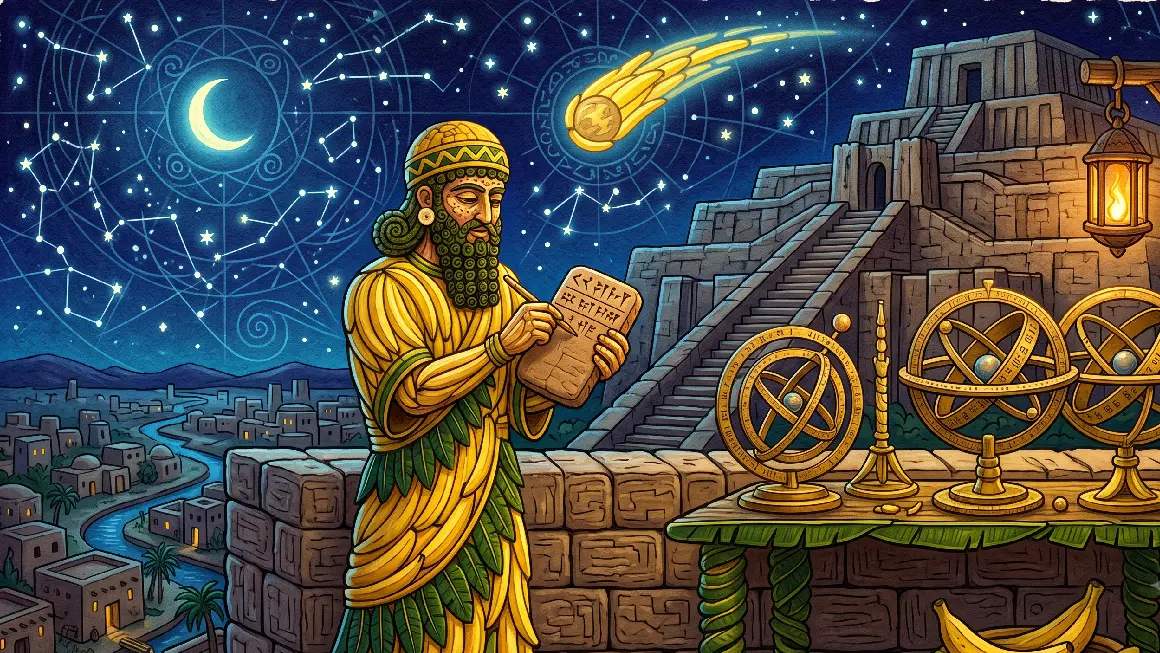
For centuries, astrology served as a serious state tool before modern physics replaced it, leaving behind familiar terms and celestial names. This audio explores how ancient cultures once read the night sky to guide kings and empires. Build your native English listening fluency and master subtle rhythms through regular Shadowing of this text.
Long before astrology was reduced to a column at the back of a magazine, it functioned as a branch of state accounting. In the Mesopotamian cities of the second millennium BCE, scribes recorded the phases of the moon, the drift of the planets, and the alarming arrival of eclipses. Such observations were never idle curiosity. A king’s fortune was believed to depend on them, and the priests who assembled the great omen collection known as Enuma Anu Enlil were employed as something closer to risk analysts, working with the only archive that could not be falsified: the night sky.
The Logic of the Almanac
The reasoning behind this enterprise was less irrational than it now appears. Farming societies had observed something undeniable, namely that the heavens kept time. The return of certain stars announced the flooding of rivers, and the sun’s slow migration along the horizon divided the year into seasons of planting and harvest. From this correlation an inference was drawn. If the sky regulated the wheat, why would it not also regulate the man who ate it?
Babylon Meets the Greek Cosmos
Astrology’s decisive transformation occurred when Babylonian record-keeping encountered Greek geometry. Hellenistic thinkers inherited the zodiac, a belt of twelve equal divisions marking the sun’s annual path, and fused it with a cosmological model in which a motionless Earth sat at the center of nested spheres. Each planet was assigned a sphere of its own, and each sphere was thought to exert influence downward upon the world below. In second-century Alexandria, Ptolemy composed both the Almagest, which calculated where the planets would be found, and the Tetrabiblos, which interpreted what those positions implied. The two books were regarded as complementary halves of one project.
The system then traveled. Greek horoscopic astrology reached India by roughly the second century CE, where it was absorbed into older traditions and adapted to a lunar scheme of twenty-seven divisions. China, meanwhile, had developed an independent apparatus centered on imperial legitimacy, in which an unexpected comet functioned as a public verdict on the emperor’s conduct. Different cultures, working from different premises, arrived at the same conviction: the sky was a text, and somebody qualified ought to be reading it.
This is what modern readers most often miss. Astronomy and astrology were not rivals; they were one discipline wearing two faces, and for more than a millennium the arrangement held. What eventually dismantled it was not doubt about horoscopes but a change of address. Once Copernicus had displaced the Earth from the center, and Newton had explained planetary motion through gravity rather than influence, the physical mechanism that made astrology plausible quietly evaporated.
The vocabulary survived anyway. Our weekdays still carry the names of planetary gods, and the twelve signs remain fixed in popular imagination, even though precession has shifted them measurably against the constellations they were named for. What has been inherited, then, is not a working science but a fossil: the residue of humanity’s earliest and most ambitious attempt to read the future in something larger than itself.
Vocabulary · Key Words from the Article
| # | Word | Definition | Example Sentence |
|---|---|---|---|
| 1 | drift noun | a slow, gradual movement of something from one position to another, usually without a clear or forceful cause | “Editors watched the slow drift of public opinion away from the party over several months.” |
| 2 | undeniable adjective | so clearly true that nobody could reasonably argue against it | “Her technical skill is undeniable, even if her management style divides the team.” |
| 3 | correlation noun | a connection between two things in which they tend to change or occur together | “Researchers found a strong correlation between sleep quality and academic performance.” |
| 4 | verdict noun | an official or authoritative judgment about whether someone is right or wrong, or good or bad | “The critics' verdict on the new production was surprisingly generous.” |
| 5 | displace verb | to force something or someone out of the position or role they previously held | “Streaming services have largely displaced the rental shop as the way people find films.” |
| 6 | evaporate verb | to disappear completely, especially something that once seemed solid or certain | “Any confidence the investors had left evaporated the moment the figures were published.” |
|
Tip: Click any vocabulary row to find the word in the article. Export this list to your favorite flashcard apps like Quizlet or Anki. |
|||
Usage Notes & Synonyms
Common collocations: a gradual drift, a steady drift, the drift towards something. As a noun it suggests movement that is unhurried and hard to stop; it also has an abstract sense in 'I catch your drift' (I understand your general meaning).
Synonym: movement, shift
Frequently used to concede one point before disagreeing with another: 'The evidence is undeniable, but the conclusion drawn from it is not.' Note the adverb form 'undeniably', which is used to strengthen an adjective: undeniably brilliant.
Synonym: indisputable, unquestionable
Collocates with strong, weak, close, direct, positive and negative. The standard warning in academic writing is that correlation does not prove causation, which is exactly the error the ancient astrologers made.
Synonym: connection, link
Originally legal (a jury returns, reaches or delivers a verdict) but very common in figurative use: the verdict of history, the public verdict on a policy. Use 'verdict on' rather than 'verdict about'.
Synonym: judgment, ruling
Often passive: thousands were displaced by the flooding. Distinguish it from 'replace': 'displace' emphasizes the removal of what was there before, while 'replace' emphasizes the new thing taking over the function.
Synonym: replace, oust
The literal meaning concerns liquid turning to vapor, but the figurative use is far more frequent in journalism, typically with abstract nouns: support, trust, enthusiasm, hope and profits all evaporate. It is intransitive in this sense, so avoid 'the news evaporated their confidence'.
Synonym: vanish, disappear
Grammar in Context
Grammar in Context
Historical and academic prose repeatedly removes the agent from the sentence, either because the agent is unknown, irrelevant, or too diffuse to name. The essay relies on this throughout: 'astrology was reduced to a column', 'each planet was assigned a sphere', 'Greek horoscopic astrology was absorbed into older traditions', 'what has been inherited'. Notice the range of forms: past simple passive (was drawn), modal passive (could not be falsified, would be found), and present perfect passive (has been inherited). A second, more advanced pattern appears when a reporting verb takes a passive subject followed by an infinitive: 'a king's fortune was believed to depend on them', 'each sphere was thought to exert influence', 'the two books were regarded as complementary halves'. This construction lets the writer report a belief that entire societies held without attributing it to any named person, and it quietly signals distance: the writer describes what was believed without endorsing it. Compare the active alternative, 'Babylonians believed that a king's fortune depended on them', which shifts attention onto the believers rather than the belief itself.
Listening Comprehension Questions
Listening Comprehension Questions
Why does the writer describe the Babylonian priests as 'something closer to risk analysts'?
The comparison follows directly from the statement that 'a king's fortune was believed to depend on them'. The priests were compiling systematic data in order to forecast danger to the state, which is the function of a risk analyst. The text says nothing about merchants, doubt on the priests' part, or their invention of Greek mathematics; the Greek contribution is presented separately as geometry.
According to the essay, what made the leap from agricultural observation to personal prediction seem reasonable?
The second section builds the argument as a chain: the heavens kept time, the stars signaled floods, the sun marked the seasons, and 'from this correlation an inference was drawn'. The rhetorical question that closes the paragraph makes the extension explicit. Greek geometry arrives later and organizes the system rather than proving it, so the fourth option misrepresents the sequence.
In the phrase 'a change of address', what is the writer referring to?
The phrase is immediately explained by the clause that follows it: 'Once Copernicus had displaced the Earth from the center'. The writer is using a domestic metaphor, treating the Earth as an occupant who moved house, to describe a cosmological relocation. Precession is mentioned in the final paragraph as a separate and much smaller adjustment.
Which statement best captures the overall argument of the essay?
The essay is structured as the rise and hollowing out of a single system: it was rational given its premises, it was unified with astronomy for more than a millennium, its physical mechanism collapsed with Copernicus and Newton, and what remains is 'not a working science but a fossil'. The first option contradicts 'less irrational than it now appears'; the third contradicts 'one discipline wearing two faces'; and the fourth overstates the case, since the essay describes shared conviction alongside 'different premises'.
The writer insists that early astrology was 'less irrational than it now appears'. Explain what standard of rationality this claim depends on, and whether you find the defense convincing.
Sample Answer
The claim depends on judging a belief system by the reasoning available inside it rather than by later knowledge. Given the evidence an ancient observer actually possessed, the argument was sound: the heavens visibly governed floods, seasons and planting, so the working hypothesis that they also governed human affairs was an extension of an observed regularity, not an invention. The essay reinforces this by noting that astrology sat inside a physical model of nested spheres exerting influence downward, which supplied a mechanism as well as a pattern. I find the defense largely convincing as historical explanation, since a theory that generates predictions and rests on a mechanism deserves to be called science even when it is wrong. It is less convincing as a defense of the practice, because the crucial weakness, the leap from correlation to causation, was available for criticism at the time and the system tended to absorb failed predictions rather than revise its assumptions.
Teacher's Note
A strong answer must separate two standards of judgment, internal coherence versus external truth, and recognize that the writer is applying the first. It should cite specific textual evidence, ideally the correlation between stars and floods and the nested spheres supplying a mechanism. The evaluation should take a clear position and support it, and the strongest answers will identify the specific logical vulnerability (correlation treated as causation, or the absence of falsifiability) rather than dismissing the whole tradition as superstition.
The final paragraph calls modern astrology 'a fossil'. Discuss what this metaphor suggests about why discredited ideas continue to circulate in cultures long after their foundations disappear.
Sample Answer
A fossil is a durable trace of something that no longer lives: the shape survives while the organism does not. Applied to astrology, the metaphor suggests that what persists is form rather than function, the twelve signs, the planetary weekdays and the vocabulary of influence, none of which now do the explanatory work they were built for. The image also implies passivity; fossils are inherited rather than chosen, which matches the essay's observation that the signs remain fixed in popular imagination even after precession has moved them measurably against the constellations they were named for. More broadly, it suggests that ideas embed themselves in language, calendars and social ritual, and these carriers are far more resistant to revision than the theories that produced them. A culture can therefore go on speaking a system it no longer believes, because the cost of abandoning the words exceeds any benefit from accuracy.
Teacher's Note
The answer must unpack the metaphor rather than restate it, identifying at least the distinction between surviving form and lost function. Credit the use of specific evidence from the text, such as weekday names or the precession point. Strong answers extrapolate beyond astrology to a general mechanism of cultural persistence, for example embedding in language or ritual, identity and entertainment value, or the low practical cost of holding an inaccurate belief, and they should do so without collapsing into simple mockery of people who read horoscopes.
Speaking Practice & Discussion Questions
Speaking Practice & Discussion Questions
Discussion Questions
-
1
According to the article, what did Babylonian scribes record night after night?
-
2
Do you know your own zodiac sign, and does it appear anywhere in the conversations or media around you?
-
3
Imagine you lived in a society where no calendar existed. What signs in the natural world would you use to decide when to plant, travel or celebrate?
-
4
Why do you think horoscopes still occupy space in newspapers and apps when almost no scientist defends them?
-
5
Will astrology still be part of popular culture in a hundred years, or will something else take over the same role? Explain your prediction.
Further Discussion
-
1
Every era believes it has finally separated genuine knowledge from illusion. What might a future society regard as our own version of astrology?
-
2
Suppose a widely held belief is factually false but reliably gives people comfort, structure and a sense of meaning. Is there any obligation to correct it, and who would have the right to decide?
-
3
As predictive systems become more powerful and more opaque, from climate models to algorithms that forecast individual behavior, what distinguishes trusting them from the trust an ancient king placed in his astrologers?
Download the Worksheet for Offline Practice
Download the official C1 Advanced English worksheet (PDF). Review key vocabulary such as ‘verdict’ and ‘evaporate’, answer selected comprehension questions, and check your answers with the included answer key.
Leave a Reply