
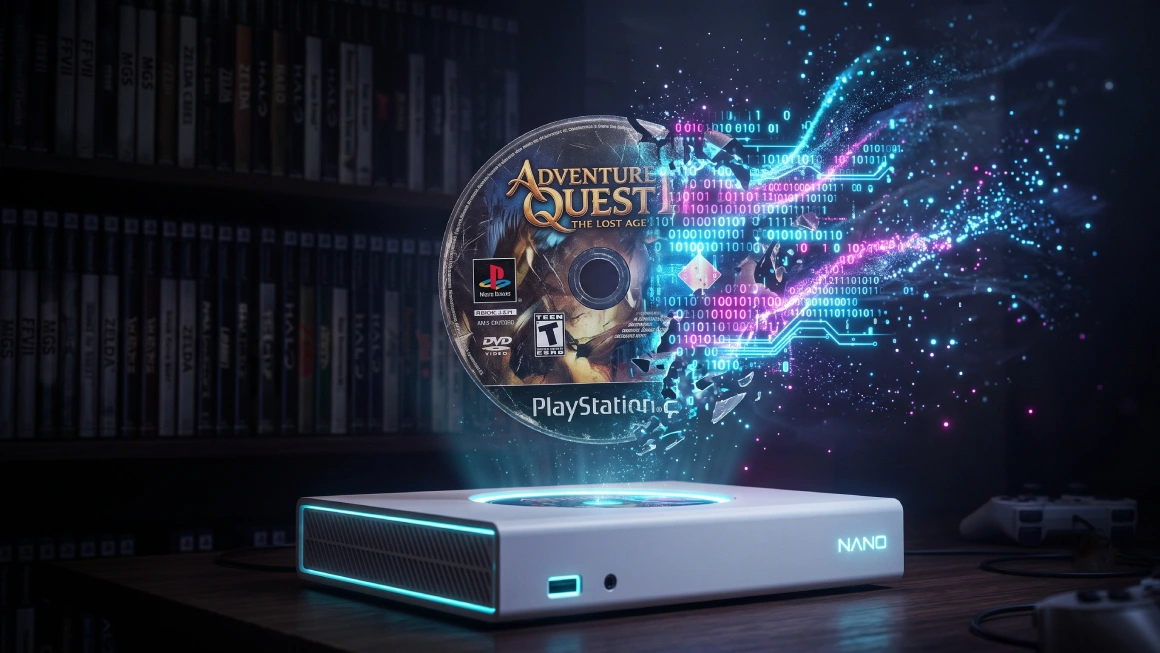
Sony created the PlayStation after a failed deal, moving players from physical discs to digital downloads. While digital games are convenient, many fans worry about losing true ownership and facing higher store prices. You can master connected speech and B1 English listening by using this fascinating audio for your daily Shadowing.
The story of PlayStation is really the story of an angry man who wanted revenge. In the early 1990s, Sony agreed to build a CD player add-on for Nintendo. Then, at the last moment, Nintendo cancelled the deal. One Sony engineer, Ken Kutaragi, was furious. He convinced his bosses that Sony should build its own game machine instead. He was right.
The first PlayStation arrived in 1994 and changed everything. Older machines used small plastic cartridges, but the PlayStation used CDs. This was cheaper for companies, and it gave games more space for music and video. More than 100 million people bought one. Six years later, the PlayStation 2 became the best-selling console in history. Part of its success was clever: it could also play DVD films, so families bought it for two reasons.
Sony kept pushing forward. The PlayStation 3 added Blu-ray, and the PlayStation 4 focused on players who simply wanted great games. Then, in 2020, the PlayStation 5 arrived with a super-fast drive and a new wireless controller that could shake in your hands. Today, gaming is one of the biggest entertainment businesses on Earth, larger than film and music together.
But something important has changed in recent years, and not everyone is happy about it.
For a long time, players bought games as physical discs. You could hold the box, put it on a shelf, and truly own it. If you finished a game, you could sell it, lend it to a friend, or take it to a shop and trade it for something new. This second-hand market kept prices lower, because shops had to compete for customers.
Now the industry is moving toward digital downloads. Instead of a disc, you buy a code and download the game onto your machine. This is fast and easy, and many younger players have never bought a disc at all. Sony and other companies clearly prefer this model, partly because it costs them less money.
However, many players worry about what they are losing. When you buy a digital game, you do not really own it in the same way. You cannot sell it, lend it, or give it away. If a company closes its online store, or removes a game from its service, you may lose something you paid for. This has already happened with some films and shows, and it has made people nervous.
Fans also argue that digital-only shopping is bad for competition. With discs, many shops sold games, and they lowered prices to attract buyers. With downloads, one company often controls the only store, and it can set any price it wants.
Nobody knows exactly how this will end. Some people believe physical games will slowly disappear, just as music CDs did. Others think companies have pushed too fast and will face a strong reaction from angry customers. Either way, the quiet plastic disc, once the heart of every gaming room, is fading away, and a new digital world is taking its place, ready or not.
Vocabulary · Key Words from the Article
| # | Word | Definition | Example Sentence |
|---|---|---|---|
| 1 | convince verb | to make someone believe that something is true, or agree to do something, by giving them good reasons | “It took me an hour to convince my parents to let me buy the new console.” |
| 2 | wireless adjective | working without wires or cables, using radio signals to connect | “I bought a wireless keyboard so my desk would look tidier.” |
| 3 | trade noun | the activity of buying, selling, or exchanging goods or services | “There is a busy trade in second-hand phones in our city.” |
| 4 | worry verb | to think about problems or bad things that might happen, in a way that makes you feel unhappy or afraid | “Many people worry about how much time their children spend online.” |
| 5 | argue verb | to give reasons why you think something is true or right, especially to persuade other people | “Scientists argue that the change is happening faster than expected.” |
| 6 | competition noun | a situation in which companies or people try to be more successful than others, for example by offering lower prices | “Strong competition between airlines has made flights much cheaper.” |
Tip: Click any vocabulary row to find the word in the article. Export this list to your favorite flashcard apps like Quizlet or Anki. | |||
Usage Notes & Synonyms
Often followed by 'someone to do something' (convince him to stay) or 'someone that...' (convince her that it was safe). Do not confuse with 'convict', which is about crime.
Synonym: persuade
Common with 'wireless controller', 'wireless network', and 'wireless headphones'. In casual speech, home internet is often just called 'wifi'.
Synonym: cordless
'Trade' is also a verb ('trade it for something new'). Note the phrase 'trade in', which means giving your old item to reduce the price of a new one.
Synonym: exchange
Usually followed by 'about' (worry about money). 'Don't worry' is a very common friendly phrase to calm someone down.
Synonym: be concerned
'Argue that + sentence' is used for giving an opinion with reasons. 'Argue' can also mean to disagree angrily ('they argued about money'), so context matters.
Synonym: claim
In business, we often say 'competition keeps prices down'. The word can also mean a contest you can win, like a singing competition.
Synonym: rivalry
Grammar in Context
Grammar in Context
The present perfect is formed with 'have' or 'has' plus the past participle, for example 'has changed' or 'have never bought'. We use it to talk about a change that started in the past and is still important now, without saying exactly when it happened. The article uses it to describe how gaming is different today: 'something important has changed in recent years' and 'this has already happened'. It also appears with 'never' to talk about life experience up to now: 'many younger players have never bought a disc at all'. This tense connects the past to the present moment, which is exactly why it fits an article about a change that is happening right now.
Listening Comprehension Questions
Listening Comprehension Questions
According to the article, why did Ken Kutaragi want Sony to build its own game machine?
The article opens by calling this 'the story of an angry man who wanted revenge'. It explains that Nintendo 'cancelled the deal' at the last moment, that Kutaragi 'was furious', and that he then 'convinced his bosses that Sony should build its own game machine'. The anger caused by the cancelled deal is clearly the reason, so the second option is correct.
What does the article say was one clever reason the PlayStation 2 sold so well?
The text states that 'Part of its success was clever: it could also play DVD films, so families bought it for two reasons.' The wireless controller belonged to the PlayStation 5, and cartridges were used by older machines, so only the DVD option matches the PlayStation 2.
In the sentence 'shops had to compete for customers', the word 'compete' is closest in meaning to:
The surrounding sentences explain that the second-hand market 'kept prices lower' because shops wanted the same customers. This context shows that to 'compete' means to try to attract buyers by being better or cheaper, which links directly to the vocabulary word 'competition'.
What is the main idea of the second half of the article?
After the history section, the article shifts to say 'something important has changed'. It describes the move to 'digital downloads', the loss of the second-hand market, and the fact that 'many players worry about what they are losing'. This concern about the shift away from discs is the central idea of the second half.
Explain in your own words why some players believe digital-only games are worse for buyers than physical discs.
Sample Answer
Players believe digital games give them less control and fewer choices. With a physical disc, you truly own the game: you can sell it, lend it to a friend, or trade it in a shop, and this second-hand market keeps prices lower because shops compete. With a digital game, you only buy a code, so you cannot sell or share it. If the company closes its store or removes the game, you can lose something you paid for. Also, one company often controls the only store, so it can set high prices without competition.
Teacher's Note
A strong answer should mention at least two clear disadvantages from the text, such as not being able to sell or lend the game, the risk of losing access if a store closes, and higher prices caused by a lack of competition. The best answers connect these points to the idea of ownership and choice, using the student's own words rather than copying full sentences from the article.
The article compares game discs to music CDs. Do you think physical games will disappear in the same way? Give reasons for your opinion.
Sample Answer
I think physical games will slowly disappear, but more slowly than music CDs did. Music became digital very quickly because songs are small and easy to download, and streaming services made owning CDs feel unnecessary. Games are much larger and some players still enjoy collecting boxes and reselling discs, so there is more reason to keep them. However, companies prefer digital sales because they cost less, so they will probably push customers in that direction. In the end, discs may become a small, special product for fans rather than the normal way most people buy games.
Teacher's Note
A good answer should take a clear position and support it with logical reasons, ideally referring to the article's comparison with music CDs. Strong responses will consider both sides, for example the convenience and lower cost of digital versus the collecting and reselling that discs allow, and may make a reasonable prediction about the future rather than simply saying 'yes' or 'no'.
Speaking Practice & Discussion Questions
Speaking Practice & Discussion Questions
Discussion Questions
-
1
In which year did the first PlayStation arrive, and what did it use instead of cartridges?
-
2
Do you prefer buying things digitally or as physical objects you can hold? Why?
-
3
Imagine your favourite game or film was suddenly removed from an online store. How would you feel, and what would you do?
-
4
Is it fair for one company to control the only shop where you can buy its games? Why or why not?
-
5
Do you think owning things digitally will completely replace owning physical objects in the future? Share your opinion.
Further Discussion
-
1
When you pay for something digital, should you own it forever, or is it fair that a company can take it back later?
-
2
If a company could earn much more money by removing customer choice, should it be allowed to do so? Defend your answer.
-
3
How do you think the way people buy and own entertainment will change over the next twenty years?
Download the Worksheet for Offline Practice
Download the official B1 Intermediate English worksheet (PDF). Review key vocabulary such as ‘trade’ and ‘competition’, answer selected comprehension questions, and check your answers with the included answer key.
Leave a Reply