
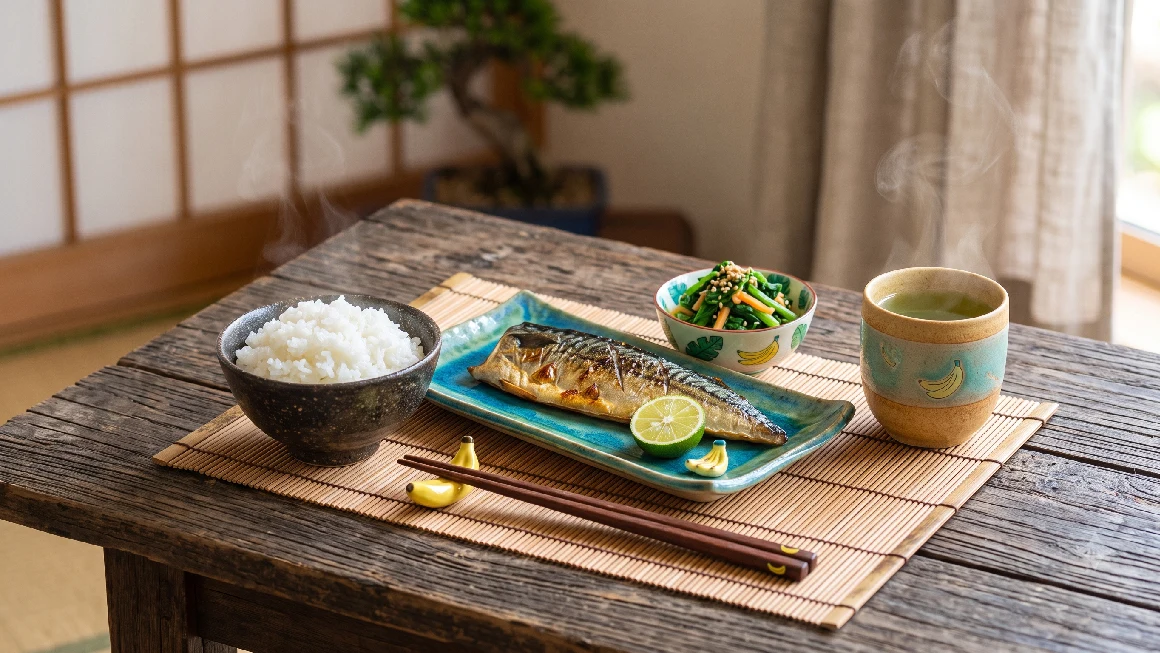
Studies show that a traditional Japanese diet of fish and vegetables supports brain health. Healthy social habits like sharing meals and stopping when eighty percent full also improve well-being. Develop your English listening and intermediate English listening skills with this audio using Shadowing.
Japan is famous for many things, such as beautiful temples, fast trains, and very long lives. For years, scientists have studied why Japanese people often live longer than people in other countries. The answer is not just good medicine. A big part of the answer sits on the dinner plate.
A traditional Japanese diet is simple and fresh. It usually includes rice, vegetables, soybeans, green tea, and a lot of fish. People in Japan eat much less red meat and fewer sweet foods than people in Western countries. Now, a growing number of studies suggest that this way of eating does more than protect the body. It may also protect the mind.
Food And Feelings
For a long time, doctors believed that food and mood were not connected. Today, that idea has changed. Scientists have discovered a strong link between the stomach and the brain. The food we eat can affect how we think and feel every day.
The Japanese diet is rich in seafood, which contains special fats called omega-3. These fats are very important for a healthy brain. Some research has shown that people who eat more fish often suffer less from sadness and worry. Vegetables and soybeans also give the brain useful vitamins. Green tea, which Japanese people drink every day, can help a person feel calm and relaxed.
In one large study, researchers looked at the eating habits of thousands of Japanese workers. They found that people who followed the traditional diet reported better mental health than those who ate more Western fast food. The difference was clear.
More Than Just Food
However, scientists believe the secret is not only about the food itself. The Japanese way of eating also includes important social habits. In many homes, families still cook and share meals together. This time around the table builds a strong relationship between family members. People feel less lonely, and this also helps the mind.
There is another helpful idea called “hara hachi bu.” It means that you should stop eating when you are about eighty percent full. People do not eat until they feel heavy and tired. This simple habit keeps the body in good balance and gives people more energy through the day.
Of course, life in modern Japan is changing fast. In big cities, many young people are now eating more burgers, pizza, and processed snacks. Some doctors worry that these new habits could harm both their bodies and their minds in the future.
Still, the lesson from the traditional Japanese kitchen is useful for everyone. You do not need to move to Tokyo or eat only Japanese food. You can start with small steps. Try to eat more fish and vegetables, drink more water or tea, and enjoy meals slowly with the people you love.
What we put on our plates matters. The traditional Japanese diet shows us that good food can feed the body and the mind at the same time. A healthy meal might be one of the simplest ways to build a happier life.
Vocabulary · Key Words from the Article
| # | Word | Definition | Example Sentence |
|---|---|---|---|
| 1 | diet noun | the kind of food that a person or group usually eats. | “The doctor told him that a healthy diet should include more fruit and vegetables.” |
| 2 | seafood noun | fish and other animals from the sea that people eat. | “The restaurant by the beach is famous for its fresh seafood.” |
| 3 | suffer verb | to feel pain, sadness, or another bad experience. | “Many people suffer from stress when they have too much work.” |
| 4 | mental adjective | connected with the mind or with thinking and feelings. | “Getting enough sleep is very good for your mental health.” |
| 5 | relationship noun | the way that two or more people feel about and behave towards each other. | “She has a close relationship with her sister and they talk every day.” |
| 6 | balance noun | a good or healthy situation in which different things are kept at the right level. | “It is important to find a balance between work and rest.” |
Tip: Click any vocabulary row to find the word in the article. | |||
Usage Notes & Synonyms
Common phrases: 'a healthy/balanced diet' and 'go on a diet' (to eat less to lose weight). Do not confuse these two meanings.
Synonym: eating habits
This is an uncountable noun, so we say 'some seafood', not 'a seafood' or 'seafoods'.
Synonym: shellfish
Often used with 'from': 'suffer from a cold', 'suffer from depression'. Remember the double 'f'.
Synonym: experience pain
Very common in the phrase 'mental health'. The opposite area is 'physical' (about the body).
Synonym: psychological
Use 'a relationship with' a person and 'a relationship between' two people. Note the spelling: relation + ship.
Synonym: connection, bond
Common phrases: 'a good balance', 'keep your balance', and 'work-life balance'. It can also be a verb (to balance).
Synonym: stability
Grammar in Context
Grammar in Context
The present perfect is formed with 'have' or 'has' plus the past participle (for example, 'have studied', 'has changed', 'have discovered', 'has shown'). We use it to talk about past actions or research that are still important now, when the exact time is not the main point. In this article it connects past scientific work to the present situation: scientists 'have studied' the question for years, and that idea 'has changed' today. This shows the reader that the past and the present are linked, which is very common in news and science writing.
Listening Comprehension Questions
Listening Comprehension Questions
According to the article, what is the main reason Japanese people often live longer?
The text says 'The answer is not just good medicine. A big part of the answer sits on the dinner plate.' This clearly tells us that food, not only medicine, is a major reason for their long lives.
Why are the omega-3 fats in seafood important, according to the text?
The article states that seafood 'contains special fats called omega-3' and that 'These fats are very important for a healthy brain.' This directly links the fats to brain health.
What does the idea of 'hara hachi bu' tell people to do?
The text explains 'hara hachi bu' directly: 'It means that you should stop eating when you are about eighty percent full.' The other options describe the opposite or unrelated behaviour.
What is the writer's main message at the end of the article?
In the final paragraphs the writer says 'You can start with small steps' and that the lesson 'is useful for everyone.' The message is about simple changes, not about moving to Japan or eating only fish.
The article says the Japanese diet is good for the mind for reasons that are 'not only about the food itself.' In your own words, explain what these other reasons are.
Sample Answer
Besides the food, the article points to important social and behavioural habits. Families often cook and share meals together, which builds a strong relationship between them and makes people feel less lonely. There is also the habit of 'hara hachi bu', stopping eating at about eighty percent full, which keeps the body in good balance and gives people more energy. So the benefits come from how people eat and who they eat with, not just from what is on the plate.
Teacher's Note
A strong answer should mention at least two non-food factors: (1) sharing meals with family and the social relationship or reduced loneliness this creates, and (2) the 'hara hachi bu' habit of not overeating. The best answers use the student's own words and connect these habits to mental wellbeing, not just physical health.
The writer notes that young people in big Japanese cities are changing their eating habits. Why might this be a problem, and could the same thing happen in other countries?
Sample Answer
The writer says many young people now eat more burgers, pizza, and processed snacks, and some doctors worry this could harm both their bodies and their minds in the future. If the traditional diet protects mental health, then losing it could mean more sadness, worry, or health problems for the next generation. The same change is likely in many other countries, because fast food is cheap, quick, and popular everywhere, and busy modern life leaves less time to cook fresh meals at home.
Teacher's Note
A good answer must identify the problem (a move towards processed Western fast food and the doctors' worry about harm to body and mind) and then extend the idea to other countries with a clear reason, such as the global spread of fast food or the lack of time in modern life. Look for logical reasoning rather than only repeating the text.
Speaking Practice & Discussion Questions
Speaking Practice & Discussion Questions
Discussion Questions
-
1
What kind of foods are part of a traditional Japanese diet, according to the article?
-
2
How does your own daily diet compare to the Japanese diet described in the text?
-
3
Imagine you tried 'hara hachi bu' for one week and stopped eating at eighty percent full. How do you think you would feel?
-
4
Do you think eating meals together with family or friends is important today? Why or why not?
-
5
Some doctors worry that fast food is harming people's health around the world. Do you think this problem will get better or worse in the future?
Further Discussion
-
1
How much should a government try to control what people eat in order to keep them healthy, and where should personal freedom begin?
-
2
If a cheap, unhealthy meal is the only food a busy worker can afford, is it fair to ask them to 'choose' a healthier diet? Defend your view.
-
3
As more cultures share the same fast food and eating habits, what might the world lose, and is this change a good or bad thing for human health overall?
Download the Worksheet for Offline Practice
Download the official B1 Intermediate English worksheet (PDF). Review key vocabulary such as ‘seafood’ and ‘balance’, answer selected comprehension questions, and check your answers with the included answer key.
Leave a Reply