
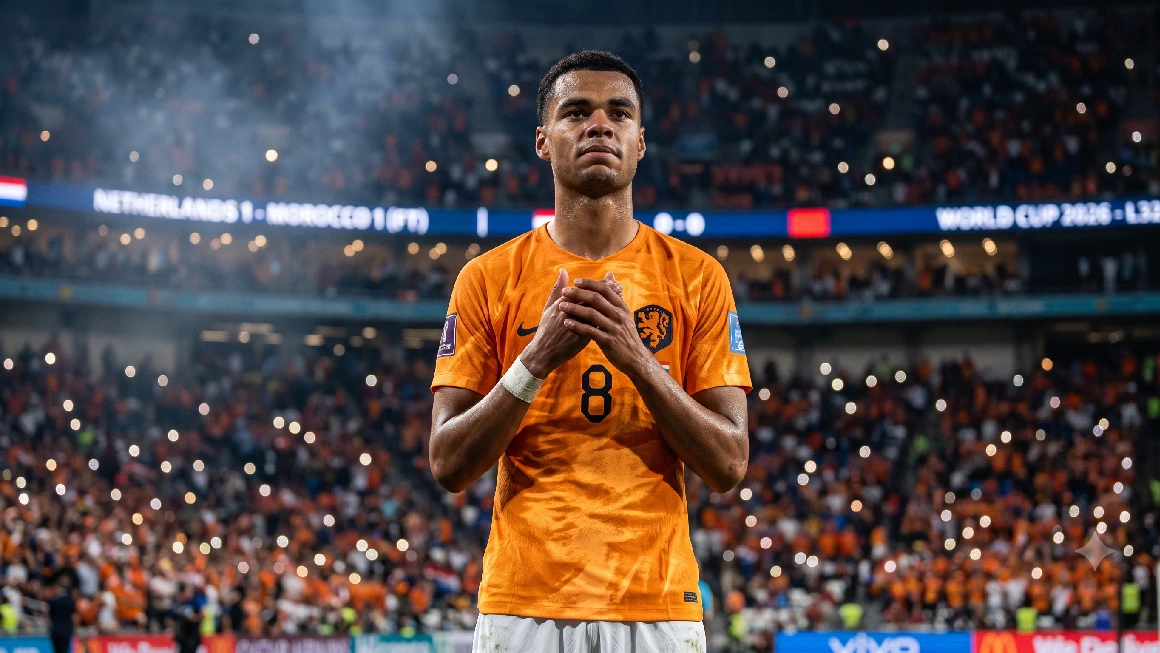
Cody Gakpo showed great courage while playing for the Netherlands in 2026 despite facing deep personal pain. The talented Liverpool forward scored a vital goal before his team unfortunately lost on penalties. Try our daily English listening audio to practice Shadowing and discover how this inspiring athlete became a major national star.
For Cody Gakpo, football has always been more than a game. It has been a long journey of hard work, patience, and quiet strength. On 30 June 2026, the world saw both sides of that journey in a single night: the joy of scoring for his country and the pain of losing.
That evening, the Netherlands played Morocco in the last 32 of the World Cup at the Monterrey Stadium. The match was tense, and the orange supporters watched every moment with hope. In the 72nd minute, Gakpo scored. The game was now 1-1, and for a short time it felt like the Dutch could win. But after extra time, the match went to penalties. Morocco won 3-2, and the Netherlands went home.
What made the night so special was Gakpo himself. Only two days earlier, he had shared that he and his family had lost their baby. He was living through a deeply painful time, yet he still chose to play. His performance on the pitch was calm and brave, and many people around the world admired his courage. He played not just for the team, but, it seemed, for his own heart.
From a Small Boy to a National Star
Gakpo’s story did not begin in 2026. He started young, joining the PSV Eindhoven youth system when he was only eight years old. Step by step, he learned to develop his skills, first in the reserve team and later in the first team. Between 2018 and 2023, he played 159 official matches for PSV and scored 55 goals. His talent was clear, and he was chosen as the Dutch player of the year.
In January 2023, Liverpool paid about 44 million pounds to sign the talented winger and forward. In England, he won the Premier League title and the League Cup with his new club. His contract runs until June 2030, and his market value is around 69 million euros today.
A Difficult Season and an Uncertain Future
The 2025/26 season, however, was harder than expected. Gakpo played 36 Premier League matches but scored only seven goals. Some fans hoped for more. Even so, the club did not want to lose him. Under the new manager, Andoni Iraola, Liverpool reportedly planned to keep the player unless a very special offer arrived.
Other clubs were watching. The English press said that Tottenham Hotspur, led by Roberto De Zerbi, saw Gakpo as a key target. Reports suggested they were ready to offer about 60 million pounds to bring more variety to their attack. Whether he stays or moves, his future remains a popular topic.
At 27 years old, Gakpo has already played at the highest level for two big clubs and for his national team. He took part in the 2022 World Cup, EURO 2024, and the 2026 World Cup, becoming one of the most important attackers for the Dutch side.
His career still has many years ahead. But that one night in Monterrey will be remembered for a long time. It will prove, perhaps more than any trophy, what kind of person Cody Gakpo truly is.
Vocabulary · Key Words from the Article
| # | Word | Definition | Example Sentence |
|---|---|---|---|
| 1 | supporter noun | a person who likes a particular team, player, or group and wants them to succeed. | “Thousands of supporters travelled to the stadium to cheer for their team.” |
| 2 | painful adjective | causing physical or emotional pain; making you feel hurt or very sad. | “Saying goodbye to her old school was a painful experience.” |
| 3 | performance noun | how well a person does an activity, especially in sport, work, or on stage. | “The young striker gave his best performance of the season on Saturday.” |
| 4 | develop verb | to grow or to make something grow and become better or more advanced over time. | “Young players need time and good coaching to develop their skills.” |
| 5 | talented adjective | having a natural ability to do something very well. | “She is a talented musician who started playing the piano at the age of four.” |
| 6 | prove verb | to show clearly that something is true or that someone has a particular quality. | “He worked hard all year to prove that he deserved a place on the team.” |
Tip: Click any vocabulary row to find the word in the article. | |||
Usage Notes & Synonyms
Common with sport and politics: 'a football supporter', 'a strong supporter of the plan'. The verb is 'support' and the action is 'to support someone'.
Synonym: fan
Can describe the body ('a painful knee') or feelings ('a painful memory'). The opposite is 'painless'. The noun is 'pain'.
Synonym: hurtful, distressing
Useful collocations: 'a strong/poor performance', 'to give a performance'. It can also mean a show in a theatre. The verb is 'perform'.
Synonym: showing, display
Often used with skills, ideas, and businesses: 'develop a skill', 'develop a plan'. The noun is 'development'. Be careful with spelling: there is no 'e' at the end (not 'develope').
Synonym: improve, build
Often followed by 'at' or used before a noun: 'talented at drawing', 'a talented player'. The noun is 'talent'. In the story you also meet the noun form: 'His talent was clear.'
Synonym: gifted, skilful
Two common patterns: 'prove that + clause' and 'prove + noun' ('prove a point'). Note the irregular forms: prove, proved, proven (or proved).
Synonym: show, demonstrate
Grammar in Context
Grammar in Context
The present perfect connects the past to the present. We form it with 'have' or 'has' plus the past participle of the verb, for example 'has been', 'has played', and 'has already played'. In this article it describes things that started in the past and are still true or important now. When the text says football 'has always been more than a game' or that Gakpo 'has already played at the highest level', it shows experiences and situations that continue to matter today, without giving an exact finished time. This is different from the simple past (for example 'he scored', 'Liverpool paid'), which we use for finished actions at a clear point in the past, such as the match on 30 June 2026. Noticing this contrast helps you understand why a writer chooses one tense instead of the other.
Listening Comprehension Questions
Listening Comprehension Questions
Why does the writer say the night of 30 June 2026 showed 'both sides' of Gakpo's journey?
The first paragraph directly explains the two sides: 'the joy of scoring for his country and the pain of losing'. The match details later confirm both parts: he scored in the 72nd minute, but the Netherlands lost the penalty shoot-out 3-2. The other options are not supported by the text.
What made Gakpo's decision to play in the match especially difficult?
The third paragraph says that 'Only two days earlier, he had shared that he and his family had lost their baby' and that he was living through 'a deeply painful time'. This personal loss is what made his choice to play so hard and so brave, which is why so many people 'admired his courage'.
In the sentence 'Step by step, he learned to develop his skills', the word 'develop' is closest in meaning to:
The phrase 'step by step' shows a slow process of improvement, first in the reserve team and 'later in the first team'. 'Develop' here means to grow and improve his abilities gradually, which matches 'to make better over time'. The other options change the meaning of the sentence.
What is the main idea of the section about the 2025/26 season and the transfer reports?
The text says the season 'was harder than expected' with only seven goals, yet 'the club did not want to lose him', and Tottenham reportedly saw him as 'a key target'. So the section balances a difficult season against continuing interest. The other options are too extreme or are not stated; nothing says he had decided to leave or refused to play.
Using your own words, explain why many people 'admired his courage' on that night. What does his choice tell us about him as a person?
Sample Answer
People admired his courage because he chose to play in a very important match only two days after losing his baby. Instead of staying away, he stepped onto the pitch and gave a calm, strong performance during a deeply painful time. This shows that he is determined and emotionally strong, and that he cares about his team and his country even when his own life is very hard. It suggests he can stay focused under great pressure and use football as a way to deal with his pain.
Teacher's Note
A good answer should connect two facts from the text: the personal loss ('lost their baby') and the decision to play with a 'calm and brave' performance. Strong answers go beyond the facts to make a judgement about his character (for example: determined, brave, emotionally strong) and explain the reasoning. The student should use their own words rather than copying full sentences from the article.
Gakpo started at a youth academy when he was only eight years old. In your opinion, what are the good and difficult parts of starting a sports career so young? Give reasons.
Sample Answer
Starting young has clear benefits. A child has many years to develop their skills, learn the game, and get used to playing with a strong team, as Gakpo did at PSV. Early training can also build good habits and confidence. However, there are difficult parts too. A young player may have less time for normal childhood activities and school, and there is a lot of pressure to succeed. Many children who join academies never reach the first team, which can be very disappointing. So while starting young can create great players, it also asks a lot from a child and their family.
Teacher's Note
A strong answer should give a balanced view with at least one advantage and one disadvantage, each supported by a reason. It can connect to the article (for example, Gakpo's long path from the youth system to the first team) but should also add the student's own ideas, such as pressure, missed childhood, or risk of not succeeding. Clear organisation and reasons matter more than advanced vocabulary at this level.
Speaking Practice & Discussion Questions
Speaking Practice & Discussion Questions
Discussion Questions
-
1
In which competition did Cody Gakpo play on 30 June 2026, and which country did the Netherlands play against?
-
2
Do you have a favourite football team or player? Why do you support them?
-
3
Imagine you could meet Cody Gakpo for five minutes. What one question would you ask him, and why?
-
4
Some people think sports stars should keep their private life completely private. What do you think, and why?
-
5
Do you believe a difficult or emotional life experience can make an athlete stronger, or does it only make their job harder? Explain your opinion.
Further Discussion
-
1
Why do you think so many people around the world feel a strong personal connection to football and to famous players they have never met?
-
2
If a star player is going through a serious personal problem, is it right for clubs and fans to still expect a great performance? Defend your view.
-
3
How do you think the lives and careers of professional footballers might change over the next twenty years, for example because of money, technology, or social media?
Download the Worksheet for Offline Practice
Download the official B1 Intermediate English worksheet (PDF). Review key vocabulary such as ‘performance’ and ‘talented’, answer selected comprehension questions, and check your answers with the included answer key.
Leave a Reply