
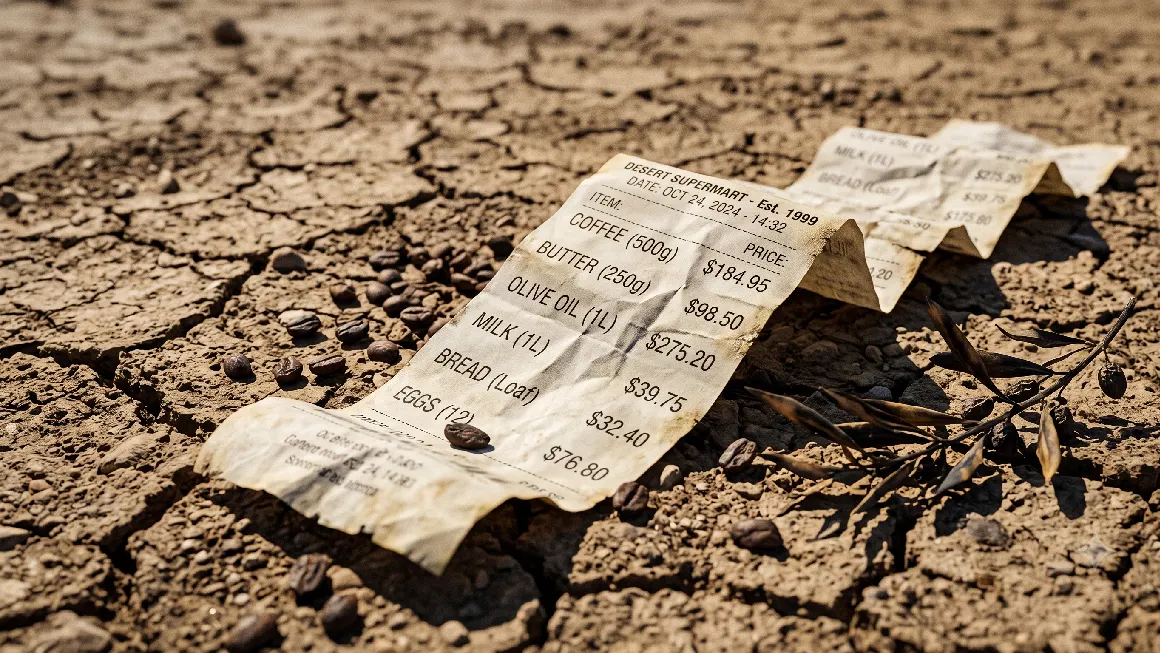
Climate change is permanently driving up the cost of sensitive agricultural staples like coffee and chocolate. Engage with this sophisticated Advanced English listening audio to challenge your listening comprehension on a vital global issue. Finally, apply Shadowing to the material to effectively refine your English intonation and adapt to native pacing.
For most of modern history, food prices rose and fell for reasons that felt distinctly human: wars, oil shocks, trade disputes. Today a quieter force is reshaping the checkout receipt, and it answers to no negotiator. Economists have started calling it climateflation, the steady upward pressure that a warming planet exerts on the cost of feeding ourselves. What once read like a distant forecast now arrives with every weekly shop.
The mechanism is brutally simple. When drought scorches southern Europe, olive groves wither and prices double within a single season. When rainfall collapses in Brazil, the world’s coffee crop suffers, and one recent year saw global coffee prices climb by more than half. A single failed harvest in one region can now empty supermarket shelves on the other side of the planet, because wealthy importing nations have quietly grown dependent on farmland that is acutely exposed to a changing climate.
The Numbers Behind the Squeeze
The scale is difficult to overstate. Research published in the journal Nature suggests that rising temperatures could add between one and three percent to global food prices every single year until 2035. Should current warming trends hold, the cumulative climate-driven increase by that date may reach thirty to fifty percent. Britain offers a preview: between 2021 and mid-2026, food prices rose by roughly a third, and the heaviest burden fell on the poorest households, who now spend nearly thirteen percent of their disposable income on food.
Not every product moves at the same speed. According to a 2026 analysis, the five most climate-sensitive staples, including butter, beef, milk, coffee and chocolate, are inflating six times faster than the average of all other food and drink. These are not luxuries; they are the ingredients of an ordinary weekly menu.
A Cost That Compounds Itself
Climate change does not merely shrink the crop in the field. It also inflates the cost of growing it. As extreme weather erodes the fertility of the soil, farmers must reach for more water and more chemical or organic input, precisely as those inputs become expensive. The World Bank expects fertiliser prices to rise by an average of thirty-one percent in 2026, pushing affordability to its lowest point since 2022. Every squeeze on the margin of a farm eventually reaches the price tag on the shelf.
Governments have added their own weight. Post-Brexit border checks, new packaging rules and fresh regulation have, according to the food industry, become leading drivers of inflation now that energy and raw agricultural costs have steadied. Meanwhile the World Bank warns of a probable new El Niño event stretching into 2027, threatening rice and sugar output across Asia and tightening global stocks further still.
The consequence is a subtle rewiring of daily life. More than half of British adults now keep a formal budget, and most say they do so simply to cover essentials. What looks like a temporary shock is hardening into a permanent feature of the commodity economy, one in which insurance costs climb, transport routes buckle under floods, and prices no longer soar only in a crisis. They simply stay high, quietly, permanently, at the bottom of every receipt.
Vocabulary · Key Words from the Article
| # | Word | Definition | Example Sentence |
|---|---|---|---|
| 1 | harvest noun | the crop that is gathered from the land in a single season, or the act of gathering it. | “A poor grain harvest in the region forced the country to import wheat for the first time in a decade.” |
| 2 | burden noun | a heavy responsibility, cost, or difficulty that is hard to bear. | “The rising rent placed an unbearable financial burden on young families in the city.” |
| 3 | erode verb | to gradually wear away, weaken, or destroy something over time. | “Years of rising prices slowly eroded the purchasing power of ordinary wages.” |
| 4 | regulation noun | an official rule made by a government or authority to control how something is done. | “New safety regulations forced the factory to redesign its entire production line.” |
| 5 | commodity noun | a raw material or basic product that can be bought and sold, such as grain, oil, or metal. | “When the price of essential commodities rises, the effect is felt by nearly every household.” |
| 6 | soar verb | to rise or increase very quickly to a high level. | “Demand for air conditioning soared as the summer heatwave intensified.” |
Tip: Click any vocabulary row to find the word in the article. Export this list to your favorite flashcard apps like Quizlet or Anki. | |||
Usage Notes & Synonyms
Common collocations: 'a good/poor/failed harvest' and 'to bring in the harvest'. It functions as both a noun and a verb ('to harvest wheat').
Synonym: crop, yield
Often paired with 'financial', 'tax', or 'administrative'. You 'bear', 'carry', 'ease', or 'shoulder' a burden. Note the phrase 'the burden falls on someone'.
Synonym: load, strain
Used both literally (soil or rock erodes) and figuratively (trust, confidence, or value erodes). The related noun is 'erosion'.
Synonym: wear away, undermine
Frequently plural ('regulations'). Common collocations: 'strict/tight regulation', 'to comply with regulations', and 'to tighten/relax regulation'.
Synonym: rule, control
Often used in 'commodity prices' and 'commodity markets'. It refers to standardised, tradeable goods rather than finished or branded items.
Synonym: product, good
Typically used for prices, temperatures, costs, or numbers rising sharply. The opposite for a sharp fall is 'plummet'. It is stronger than 'rise'.
Synonym: surge, rocket
Grammar in Context
Grammar in Context
The text repeatedly uses conditional structures to model cause and effect in an uncertain future. Zero and first conditionals describe reliable or likely outcomes ('When drought scorches southern Europe, olive groves wither'; 'A single failed harvest can now empty supermarket shelves'). More formally, the essay employs inverted conditionals, where 'if' is dropped and the auxiliary is moved to the front: 'Should current warming trends hold, the cumulative increase may reach thirty to fifty percent' means the same as 'If current warming trends hold...'. This inversion is a marker of academic and journalistic register, adding precision and a measured, hypothetical tone that suits a piece forecasting probable but not certain economic consequences.
Listening Comprehension Questions
Listening Comprehension Questions
What central distinction does the writer draw between traditional food price rises and 'climateflation'?
The opening paragraph contrasts prices that once rose for 'distinctly human' reasons with a 'quieter force' that 'answers to no negotiator'. This framing of an impersonal, non-negotiable driver is the essay's core distinction, making the second option correct while the others reverse or contradict the text.
According to the essay, why can a single failed harvest in one region affect shoppers on the other side of the world?
The second paragraph states that a failed harvest 'can now empty supermarket shelves on the other side of the planet, because wealthy importing nations have quietly grown dependent on farmland that is acutely exposed to a changing climate.' This dependence on vulnerable overseas farmland is the stated cause.
In the sentence 'Every squeeze on the margin of a farm eventually reaches the price tag on the shelf', what does 'margin' most nearly mean?
The paragraph describes rising input and fertiliser costs squeezing farmers. In this economic context, 'margin' refers to the profit remaining after expenses. The sentence links pressure on that profit directly to higher shelf prices, so the financial meaning is correct rather than the spatial or physical ones.
Which statement best captures the overarching argument of the essay?
The final paragraph concludes that what 'looks like a temporary shock is hardening into a permanent feature' of the economy, where prices 'simply stay high'. This idea of a lasting structural cost, rather than a passing crisis, unifies the whole piece and rules out the other options.
The essay argues that climateflation 'compounds itself'. Explain in your own words how climate change raises food prices through more than one channel at the same time.
Sample Answer
Climate change drives up food prices through at least two reinforcing channels. First, on the supply side, extreme weather such as drought or flooding directly reduces the size of harvests, so scarcity itself lifts prices. Second, on the production-cost side, the same conditions erode soil fertility, forcing farmers to buy more water and more fertiliser at a time when those inputs are becoming more expensive. Higher production costs then squeeze farm profit margins, which are passed on to shoppers. Because supply shrinks while the cost of growing food rises simultaneously, the two effects stack on top of each other, producing a stronger and more persistent price increase than either would alone.
Teacher's Note
A strong answer must identify at least two distinct mechanisms (reduced yield/scarcity and higher input or production costs) and explain how they interact rather than listing them in isolation. Credit should be given for referencing specific textual evidence such as eroded soil fertility, rising fertiliser costs, or squeezed margins, and for using the idea of 'compounding' to show the effects reinforce one another.
The essay notes that the poorest households spend a larger share of their income on food. Discuss the broader social implications of climate-driven food inflation falling unequally across income groups.
Sample Answer
Because food is a non-negotiable expense, price rises hit poorer households far harder than wealthy ones, who can absorb the increase within a smaller share of their income. When low-income families spend nearly thirteen percent of disposable income on food, further inflation leaves little room to adjust, forcing cuts to nutrition, other essentials, or savings. Over time this can widen inequality, damage public health, and increase reliance on food aid, since the same climate shock effectively acts as a regressive tax that consumes more of a poor family's budget. This raises questions of fairness, because those least responsible for emissions may bear the heaviest cost, and it may create pressure for targeted government support or subsidies.
Teacher's Note
A good answer should recognise that food is an essential, inelastic purchase and therefore that inflation is regressive, weighing more heavily on the poor. Higher-level responses will extend beyond the text to broader consequences such as widening inequality, health effects, or the fairness dimension of those least responsible for climate change suffering most, and will use the thirteen-percent figure as supporting evidence.
Speaking Practice & Discussion Questions
Speaking Practice & Discussion Questions
Discussion Questions
-
1
According to the article, which five everyday foods are described as the most climate-sensitive and are rising in price fastest?
-
2
How have rising food prices changed the way you or your family shop and plan meals?
-
3
If the price of your favourite food or drink doubled in a single year, as olive oil did, how would you respond?
-
4
Do you think supermarkets, governments, or consumers should carry the greatest responsibility for dealing with rising food costs?
-
5
The article suggests high prices may become permanent rather than temporary. Do you agree, and how do you think shoppers will adapt over the next decade?
Further Discussion
-
1
To what extent should a society treat access to affordable food as a basic right rather than simply a product traded on the open market?
-
2
If wealthy nations are largely responsible for the emissions driving climate change, do they have an ethical duty to shield poorer, more vulnerable countries from the resulting food shortages, even at significant cost to themselves?
-
3
As climate pressures intensify, how might the global food system need to reinvent itself, and what trade-offs between efficiency, resilience, and fairness would such a transformation demand?
Download the Worksheet for Offline Practice
Download the official C1 Advanced English worksheet (PDF). Review key vocabulary such as ‘burden’ and ‘regulation’, answer selected comprehension questions, and check your answers with the included answer key.
Leave a Reply