
Apartheid built a rigid system of racial separation in South Africa that lasted for nearly fifty years. Nelson Mandela led the resistance, spending twenty-seven years in prison before becoming president in 1994. Try Shadowing this historic audio to improve your English pronunciation and learn more about this vital historical topic during your English listening time.
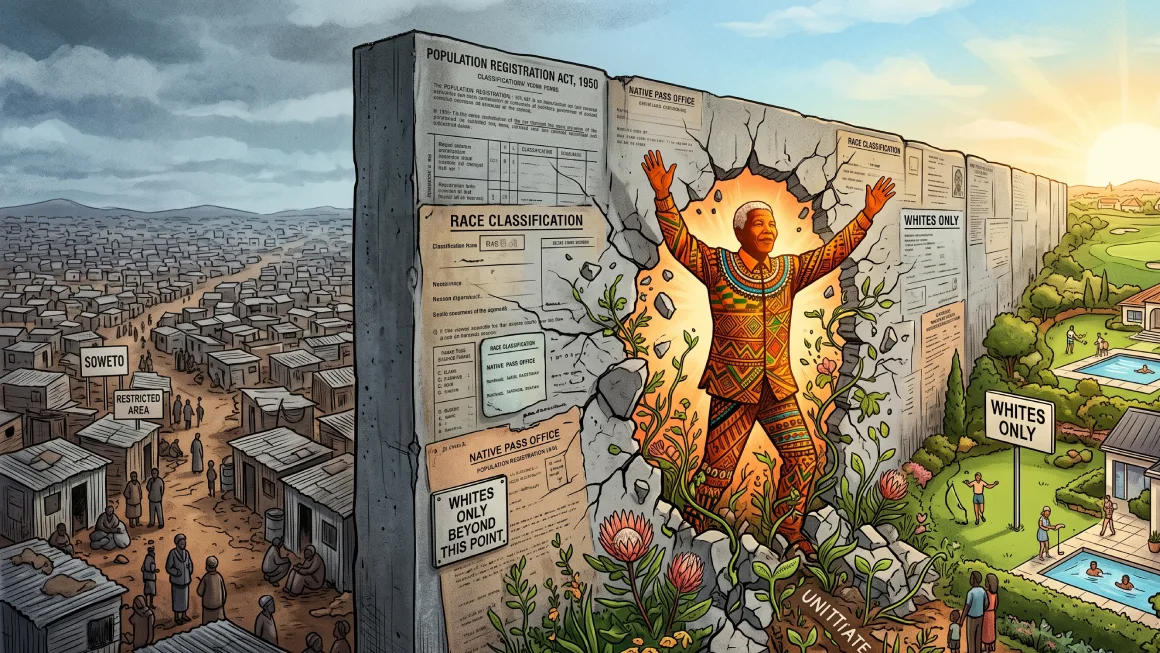
For nearly fifty years, South Africa ran one of the most rigid systems of racial separation the modern world has seen. It was called apartheid, an Afrikaans word meaning “apartness.” Beginning in 1948, the government did not simply allow discrimination to happen. It built it carefully, with laws, paperwork, and police.
The first step was to classify every person by race. Officials sorted people into categories such as white, black, colored, and Indian. This single act decided almost everything about a person’s life: where they could live, what jobs they could hold, whom they could marry, and which schools their children could attend. A thin line on a government form became a wall that ran through millions of lives.
The black majority, who made up most of the population, suffered the heaviest losses. They were forced out of their homes and pushed into separate areas. Many lost the right to vote in the country of their birth. The small white population kept the best land and most of the nation’s wealth, while passing that advantage down through families. Children grew up to inherit either privilege or poverty, depending only on the color of their skin.
Resistance and Its Price
Resistance grew steadily. Leaders, students, and ordinary workers protested, organized strikes, and demanded change. The state answered with arrests and force. One of apartheid’s fiercest opponents, Nelson Mandela, spent twenty-seven years in prison. Yet pressure kept building, both inside the country and abroad. Other nations refused to trade with South Africa or play sport against it. Slowly, the cost of keeping the system became too high.
In 1990, the government finally agreed to release Mandela. Over the next four years, both sides sat down to negotiate a peaceful path forward, even though anger and fear remained on every side. In 1994, South Africans of all races voted together for the first time. Mandela became the country’s first black president, and apartheid as a legal system came to an end.
The Shadow That Stayed
Dismantling the laws, however, did not erase their effects. The damage had been built over decades, and decades cannot be undone in a single election. Today, South Africa remains one of the most unequal countries on earth. Wealthy suburbs sit only a short drive from crowded townships where clean water and steady jobs are still hard to find. The neighborhoods that the old maps created have proved remarkably stubborn, refusing to fade even as the laws behind them disappeared.
There has been real progress. A new constitution promises equal rights to everyone, and a growing black middle class has emerged. Yet the gap between rich and poor continues to follow old racial lines more often than anyone would like.
The story of apartheid is a warning about how quickly injustice can be made into law, and how slowly its shadow lifts once that law is gone. South Africa tore down the wall, brick by brick. But the ground where it stood still carries the shape of what was there, reminding the world that ending a system is only the beginning of repairing the harm it caused.
Vocabulary · Key Words from the Article
| # | Word | Definition | Example Sentence |
|---|---|---|---|
| 1 | classify verb | to arrange people or things into groups according to shared qualities or characteristics | “Librarians classify books by subject so that readers can find them easily.” |
| 2 | majority noun | the larger number or part of a group; more than half | “The majority of students passed the exam, but a few had to retake it.” |
| 3 | wealth noun | a large amount of money, property, or valuable possessions | “The family built its wealth over three generations of careful investment.” |
| 4 | inherit verb | to receive money, property, or a quality from someone after they die, or to be born with something passed down from earlier generations | “She inherited her grandmother's house and her love of gardening.” |
| 5 | release verb | to set someone or something free, or to allow something that was held to go | “The court decided to release the prisoner early for good behaviour.” |
| 6 | stubborn adjective | determined not to change your behaviour, opinion, or position; also used for problems that are difficult to remove | “He is too stubborn to admit that he made a mistake.” |
Export this list to your favorite flashcard apps like Quizlet or Anki. | |||
Usage Notes & Synonyms
Often followed by 'as' or 'into': 'The species was classified as endangered' or 'workers classified into grades'. The related noun is 'classification'.
Synonym: categorise, sort
Its opposite is 'minority'. With a singular 'the majority of' plus a plural noun, the verb is usually plural: 'the majority of people are'.
Synonym: most, bulk
It is uncountable, so do not say 'a wealth' meaning money. Common collocations include 'create wealth', 'accumulate wealth', and 'the distribution of wealth'.
Synonym: riches, fortune
You inherit something 'from' someone. It is also used for problems or situations a new leader takes over: 'The new manager inherited a struggling team.' The noun is 'inheritance'.
Synonym: be left, receive
Used for people ('release a hostage'), products ('release a new phone'), and information ('release a statement'). The same word can be a noun: 'the release of the report'.
Synonym: free, let go
For people it can be negative (unwilling to compromise). For things it means hard to get rid of: 'a stubborn stain' or 'stubborn unemployment'. The adverb is 'stubbornly'.
Synonym: inflexible, persistent
Grammar Focus
Grammar Focus
The passive voice is formed with the verb 'to be' plus the past participle, for example 'were forced', 'was called', and 'had been built'. We use it when the action matters more than who performed it, or when the doer is obvious, unknown, or deliberately left out. This text relies on the passive heavily because apartheid was a system that acted upon people: citizens 'were forced out of their homes' and 'were pushed into separate areas'. Putting the victims in the subject position keeps the focus on those who were harmed, while the past perfect passive 'had been built' shows that the damage was completed before a later past event, the end of apartheid.
Reading Comprehension
Reading Comprehension
According to the article, why does the author describe the racial classification system as the 'first step' of apartheid?
The text states that classification 'decided almost everything about a person's life: where they could live, what jobs they could hold, whom they could marry, and which schools their children could attend.' It is called the 'first step' because every other restriction flowed from it, making it the foundation on which the rest of the system was built.
What does the article suggest finally pushed the South African government to end apartheid?
The article describes resistance growing 'both inside the country and abroad', notes that 'other nations refused to trade with South Africa or play sport against it', and concludes that 'the cost of keeping the system became too high.' No single ruling or event is credited; it is the combined pressure that the text identifies as decisive.
In the final two sections, the word 'stubborn' is used to describe the old neighbourhoods. What does this word choice tell the reader?
Although 'stubborn' usually describes a person who will not change, here it is applied to neighbourhoods that 'have proved remarkably stubborn, refusing to fade even as the laws behind them disappeared.' This use of the word stresses that the geographic divisions are hard to remove, even after the laws that made them are gone.
Which statement best expresses the main idea of the whole article?
The closing paragraph states that apartheid shows 'how slowly its shadow lifts once that law is gone' and that 'ending a system is only the beginning of repairing the harm it caused.' This idea, that legal change and real change are not the same thing, runs through the whole piece and best captures its central argument.
The article uses the image of a 'wall' throughout. Explain how this image helps the reader understand both the building and the lasting effects of apartheid.
Sample Answer
The wall works as a metaphor for separation that was deliberately constructed and is hard to take down. At the start, the author shows the wall being built, saying a 'thin line on a government form became a wall that ran through millions of lives', which makes an abstract policy feel solid and physical. At the end, the author says South Africa 'tore down the wall, brick by brick', yet 'the ground where it stood still carries the shape of what was there.' This contrast captures the article's key point: the laws (the wall) could be removed, but the marks they left in society (the shape in the ground) remain. The image therefore links the careful construction of injustice to the slow, incomplete work of repairing it.
Teacher's Note
A strong answer should identify 'wall' as a metaphor for racial separation, quote or paraphrase at least one example of the wall being built and one of it being removed, and explain the contrast between removing the laws and erasing their effects. Top answers will connect the image directly to the article's main argument about lasting harm rather than treating it as mere decoration.
The article notes that South Africa today 'remains one of the most unequal countries on earth' despite real progress. Using the text and your own reasoning, explain why dismantling unjust laws may not be enough to create a fair society.
Sample Answer
Laws can be changed in a day, but the conditions they create take far longer to undo. The article points out that 'the damage had been built over decades, and decades cannot be undone in a single election.' Even after apartheid ended, wealth and good land stayed in the hands of those who had inherited them, while many black South Africans began with far fewer resources. The text shows 'wealthy suburbs' sitting close to 'crowded townships', and notes that 'the gap between rich and poor continues to follow old racial lines.' In my own view, a fair society also needs investment in education, jobs, and housing to give disadvantaged groups a real chance to catch up. Without that, equal rights on paper sit on top of deep practical inequality, so genuine fairness requires active repair, not just the removal of old rules.
Teacher's Note
A good answer must distinguish between formal legal equality and real material equality, drawing on textual evidence such as the persistence of townships, inherited wealth, or the rich-poor gap following racial lines. Stronger responses will add reasoned suggestions of their own (for example education, economic support, or housing) and explain why removing laws alone leaves earlier disadvantages in place.
Speaking & Discussion
Speaking & Discussion
Discussion Questions
-
1
In what year did South Africans of all races vote together for the first time, according to the article?
-
2
Have you ever visited or learned about a country where the past still strongly shapes daily life today? What did you notice?
-
3
Imagine you could ask Nelson Mandela one question after his twenty-seven years in prison. What would you ask him, and why?
-
4
The article says other countries refused to trade with South Africa or play sport against it. Do you think pressure from outside a country is a fair way to push for change?
-
5
Do you believe a deeply divided society can ever become fully equal, or will some effects of the past always remain? Explain your view.
Further Discussion
-
1
Is it ever possible to fully repair an injustice once it has shaped several generations, or can a society only manage and reduce its effects over time?
-
2
Suppose a government today wanted to correct a historical wrong by giving extra support or advantages to a group that was harmed in the past. Would that be fair to people alive now who took no part in the original injustice? Defend your position.
-
3
Looking ahead fifty years, do you think the way societies remember and teach about past injustices will help prevent similar systems, or do you think people tend to repeat the same mistakes regardless?
Download the Worksheet for Offline Practice
Download the official B2 Upper-Intermediate English worksheet (PDF). Review key vocabulary such as ‘wealth’ and ‘stubborn’, answer selected comprehension questions, and check your answers with the included answer key.
Leave a Reply