
Pip the mouse explored a dark kitchen at night. He ate cheese on the table and made a mess inside the fridge. The family found his footprints the next morning but they laughed. Use this fun audio for slow English listening practice. Use Shadowing to match the audio.
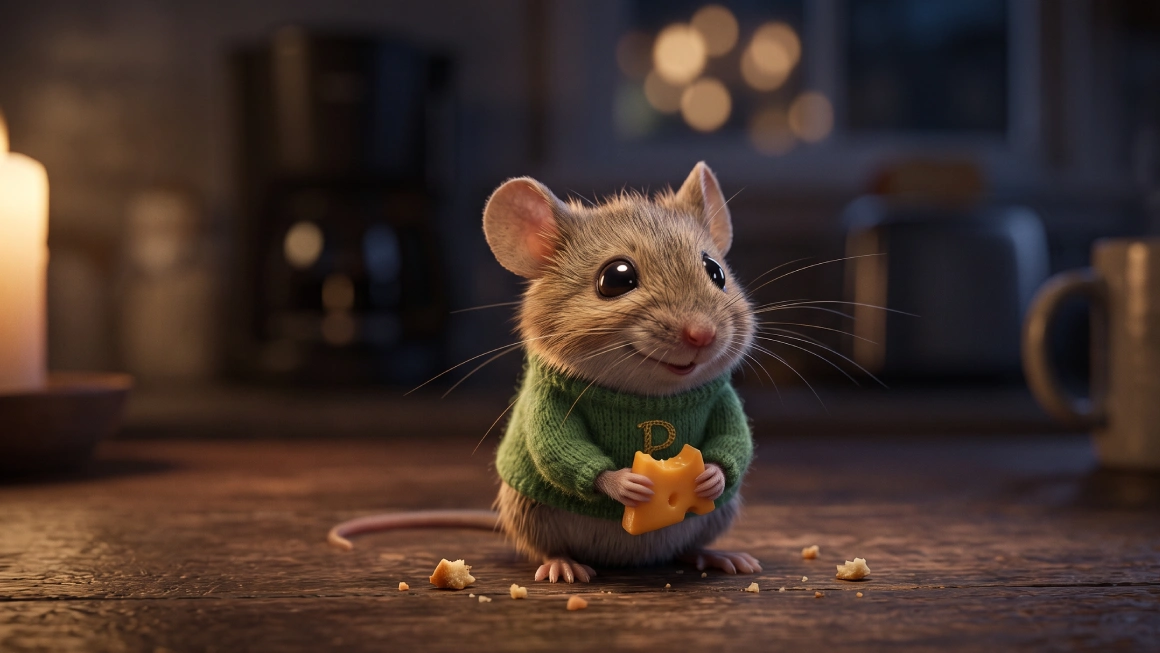
Late at night, the kitchen was dark and quiet. Everyone in the house was asleep. But behind the wall, a little mouse called Pip was wide awake. [inhales deeply] He was hungry, and he could smell bread, cheese, and something sweet. To Pip, the kitchen at night was the best playground in the whole world.
Pip pushed his nose through a small hole and looked around. The family that lived in the house was kind, but they did not like a mouse in their kitchen. So Pip had to be quick and careful. He waited, listened, and then ran fast across the cold floor.
First, he climbed up to the table. On the table, he found small crumbs of bread and a tiny piece of cheese. He sat down and began to enjoy his little meal. The cheese was soft and full of flavour. [chuckles] Pip was happy, but he was also a naughty mouse, and one small snack was never enough for him.
Next, Pip looked at the big white fridge in the corner. The door was open just a little. [thoughtful] “What a clever place to find food,” he thought. He had a wonderful idea. He jumped from the table, ran to the fridge, and slipped inside through the open door.
Inside, it was very cold, but there was milk, butter, and more cheese. Pip played his favourite game. He pushed a small grape off the shelf and watched it roll across the floor. Then he knocked over a tiny box of sugar. White sugar fell everywhere, like soft snow on the kitchen tiles.
Suddenly, Pip heard a noise. A light came on in the hall, and footsteps came closer and closer. [scared] Pip was scared. His little heart beat very fast. He could not stay in the fridge, because the cold air was too much for him.
Quietly, he jumped out and looked for a place to hide. He ran behind a chair, then under the cupboard, and finally back to his little hole in the wall. He stayed very still and did not make a single sound.
In the morning, the family came into the kitchen. They saw sugar on the floor, a grape near the door, and tiny footprints everywhere. [annoyed] “Oh no, the mouse again!” said the mother, but she was not really angry. She almost laughed. The children thought it was very funny.
Behind the wall, Pip listened and felt proud. For him, it was not a problem at all. It was a brilliant night and a brilliant game. He was tired now, so he closed his eyes and went to sleep.
That night, when the house was dark and quiet again, Pip woke up, smiled, and got ready for his next adventure. [happy] The naughty little mouse loved his secret kitchen games, and nothing in the world could stop him. Every night brought a new chance to play, to eat, and to be the cleverest little mouse in the whole house.
Vocabulary · Key Words from the Article
| # | Word | Definition | Example Sentence |
|---|---|---|---|
| 1 | enjoy verb | to get pleasure from something; to like doing or having something | “I really enjoy a hot cup of tea in the morning.” |
| 2 | fridge noun | a large machine in the kitchen that keeps food and drinks cold | “Please put the milk back in the fridge so it stays fresh.” |
| 3 | clever adjective | able to learn and understand things quickly; good at thinking of smart ideas | “My sister is very clever and always finds a good answer fast.” |
| 4 | idea noun | a thought or plan in your mind about what to do | “I have a good idea for your birthday party.” |
| 5 | suddenly adverb | very quickly and when you do not expect it | “We were walking home when suddenly it started to rain.” |
| 6 | scared adjective | feeling afraid because you think something bad may happen | “The little boy was scared of the big dog in the park.” |
Export this list to your favorite flashcard apps like Quizlet or Anki. | |||
Usage Notes & Synonyms
After 'enjoy' we use the '-ing' form of a verb, for example 'enjoy eating' or 'enjoy playing', not 'enjoy to eat'.
Synonym: like, love
'Fridge' is the short, everyday word. The longer, more formal word is 'refrigerator'. We often say 'in the fridge'.
Synonym: refrigerator
We can say a person is clever, but also a 'clever idea' or a 'clever plan'. In British English, 'clever' is very common.
Synonym: smart, bright
We usually say 'have an idea' or 'a good/bad idea'. Be careful: 'idea' starts with a vowel sound, so we use 'an idea'.
Synonym: thought, plan
'Suddenly' often comes at the start of a sentence in stories to show a surprise or a quick change.
Synonym: all at once, quickly
We say 'scared of' something, for example 'scared of the dark'. 'Scared' describes how a person feels.
Synonym: afraid, frightened
Grammar Focus
Grammar Focus
This story tells us about things that happened in the past, so it uses the past simple tense. Regular verbs add '-ed', like 'looked', 'pushed', 'climbed', 'played', and 'listened'. Many common verbs are irregular and change their form, like 'was', 'could', 'found', 'ran', 'jumped' (regular), 'heard', 'came', 'fell', 'went', and 'saw'. We use the past simple to talk about finished actions that happened at a clear time, here during one night. Notice how the verbs move the story forward, one action after another: 'He sat down and began to enjoy his little meal.' This is the most natural tense for telling a short story about past events.
Reading Comprehension
Reading Comprehension
Why did Pip have to be quick and careful in the kitchen?
The text says the family 'was kind, but they did not like a mouse in their kitchen. So Pip had to be quick and careful.' The word 'so' shows us that this is the reason for his careful behaviour.
What happened just before Pip got scared?
The story says, 'Suddenly, Pip heard a noise. A light came on in the hall, and footsteps came closer and closer. Pip was scared.' The noise, the light, and the footsteps all happen right before he feels scared.
In the sentence 'What a clever place to find food,' the word 'clever' tells us that Pip thought the fridge was:
'Clever' means smart or good at thinking. Pip is saying the fridge is a smart, good choice because it is full of food like milk, butter, and cheese. The next sentences show he was right.
What is the main idea of the whole story?
From the start to the end, the story is about Pip, a 'naughty mouse', who enjoys his 'secret kitchen games'. The last paragraph says he 'loved his secret kitchen games' and got ready for his next adventure, which shows this is the main idea.
How do we know that the family was not really angry about the mess? Use words from the story.
Sample Answer
We know the family was not really angry because of how the mother and children acted. The story says the mother 'was not really angry' and 'she almost laughed'. It also says the children 'thought it was very funny'. They saw the sugar and the footprints, but they reacted with humour, not with anger. This shows the family found the little mouse more funny than annoying.
Teacher's Note
A good answer must use clear evidence from the text, such as 'not really angry', 'almost laughed', or 'very funny'. The student should connect this evidence to the idea that the family's feelings were soft and amused, not angry. Simple, correct A2 sentences are enough.
Do you think Pip will go back to the kitchen again? Why or why not? Use the story to explain your answer.
Sample Answer
Yes, I think Pip will go back to the kitchen again. At the end of the story, he 'woke up, smiled, and got ready for his next adventure'. The story also says he 'loved his secret kitchen games' and that 'nothing in the world could stop him'. Pip is happy and proud after his game, not sorry. Because he enjoys the food and the fun so much, he will surely return on another night.
Teacher's Note
A strong answer should give a clear opinion (yes or no) and support it with evidence from the last paragraph, such as 'next adventure', 'loved his secret kitchen games', or 'nothing could stop him'. The student should show they understand Pip's happy and confident feelings. Logical reasoning at A2 level is enough.
Speaking & Discussion
Speaking & Discussion
Discussion Questions
-
1
What food did Pip find and eat in the kitchen?
-
2
Do you ever feel hungry late at night? What do you like to eat?
-
3
What would you do if you saw a little mouse in your kitchen?
-
4
Do you think small animals like mice are cute, or do they cause too many problems in a home?
-
5
Some people keep mice or small animals as pets. Is this a good idea? Why or why not?
Further Discussion
-
1
Why do you think people like stories about clever little animals?
-
2
Is it fair to call an animal 'naughty' when it is only looking for food? What do you think?
-
3
In the future, how do you think people will keep mice and other small animals out of their homes?
Download the Worksheet for Offline Practice
Download the official A2 Elementary English worksheet (PDF). Review key vocabulary such as ‘enjoy’ and ‘fridge’, answer selected comprehension questions, and check your answers with the included answer key.
Leave a Reply