
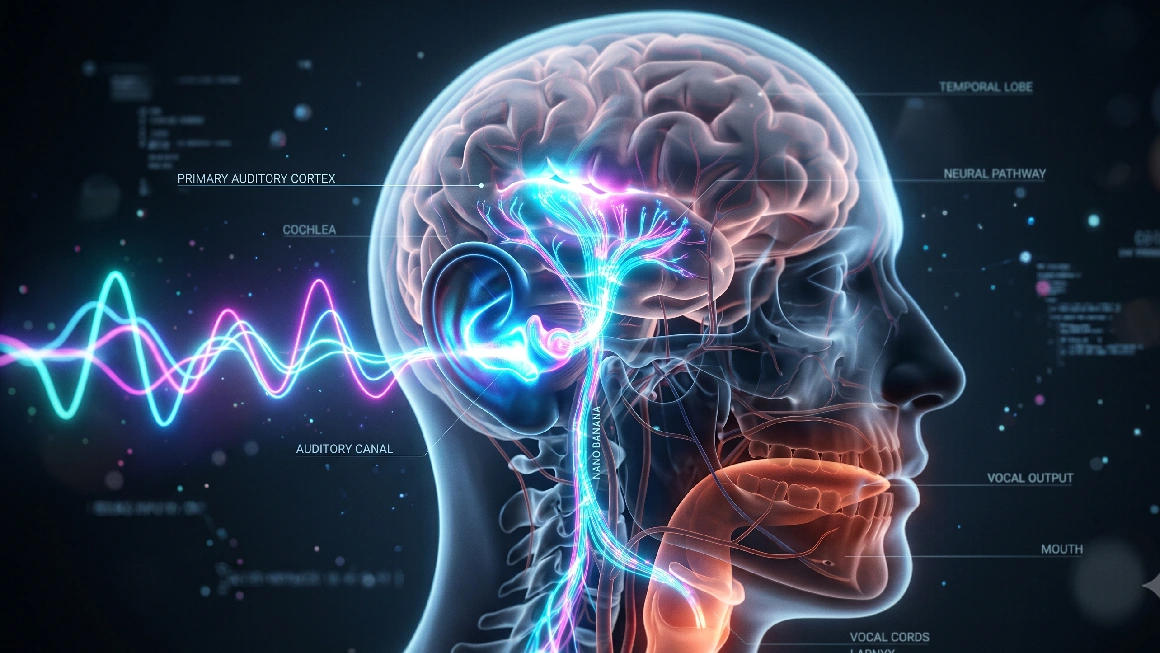
Researchers found that the brain maps a target sound before instructing the mouth to move. Since auditory memory drives pronunciation, mastering natural English rhythm requires more than mere repetition. Combine focused English listening with Shadowing to train your ears and improve your English word stress.
For most of the past century, scientists held a comfortable belief about how humans learn to speak. Producing a new sound, they argued, was mainly a matter of muscle: train the lips, tongue, and jaw to repeat an unfamiliar movement often enough, and the mouth would eventually obey. Speech, in this view, lived in the motor system, and practice meant physical rehearsal. A recent study from researchers at McGill University and the Yale School of Medicine has begun to overturn that idea, and its conclusion is quietly radical.
Their central hypothesis was that the brain does not really learn to move the mouth at all. Instead, it learns how a sound should be heard, then uses the mouth only as a tool to reach that acoustic goal. The ear, in other words, sets the target, and the tongue simply chases it.
Tricking the Listening Brain
To test this, the team used a method known as altered auditory feedback. As volunteers spoke, software instantly reshaped their voices, shifting the frequency of certain vowels before feeding the altered sound back through their headphones. The effect was almost invisible to the speakers, yet their brains noticed at once. Hearing a mismatch between what they intended and what they heard, participants unconsciously adjusted their mouths to correct the difference. This automatic adaptation happened without any conscious effort, and over time it reshaped how they pronounced the sound.
The most striking part of the experiment involved a magnetic device that can briefly interrupt activity in specific brain regions. When the researchers disturbed the areas responsible for processing sound, the newly learned pronunciations vanished by the following day, as if they had never been practiced. When they blocked the motor areas instead, the memory survived intact. The pattern was hard to argue with: the lasting record of a new sound lived in the listening brain, not the moving one.
Why Listening Might Matter More
These findings support modern computational accounts of speech, which describe learning as a constant loop. The brain first builds an accurate map of a target sound, then relies on the ears to check, moment by moment, whether the mouth has succeeded. Whenever the result falls short, the auditory system sends fresh commands to the muscles and helps refine the movement until it matches.
The practical consequences reach well beyond the laboratory. Language-learning apps might place far greater weight on careful, detailed listening rather than endless spoken repetition, training students to hear the fine differences between similar sounds. In medicine, the implications may be greater still. Therapy for patients who lose speech after a stroke or brain injury has traditionally focused on retraining the mouth. This research hints that repairing the brain’s auditory feedback system could matter just as much, or more.
The lesson is oddly reassuring for anyone struggling with a new language. Fluency may depend less on how boldly you speak, and more on how patiently you learn to listen.
Vocabulary · Key Words from the Article
| # | Word | Definition | Example Sentence |
|---|---|---|---|
| 1 | overturn verb | to completely change an accepted idea, decision, or system so that it no longer applies | “The new evidence could overturn decades of accepted medical advice about diet.” |
| 2 | hypothesis noun | an idea that is suggested as a possible explanation but has not yet been proven true | “Scientists designed the experiment to test a bold hypothesis about how memory forms.” |
| 3 | frequency noun | the rate at which a sound wave or signal vibrates, which the ear perceives as pitch | “A dog can hear sounds at a much higher frequency than a human can.” |
| 4 | adaptation noun | a change in behaviour or structure that helps something adjust to new conditions | “Sweating is the body's natural adaptation to rising temperatures.” |
| 5 | striking adjective | so noticeable or unusual that it immediately attracts attention | “There was a striking difference between the two groups' results.” |
| 6 | refine verb | to improve something gradually by making small careful changes | “The team spent months refining the software until it ran smoothly.” |
Tip: Click any vocabulary row to find the word in the article. Export this list to your favorite flashcard apps like Quizlet or Anki. | |||
Usage Notes & Synonyms
Often used with abstract objects such as 'a ruling', 'a theory', or 'a belief'. In everyday use it can also mean physically tipping something over, but in academic writing the figurative sense dominates.
Synonym: reverse, overthrow
The plural is 'hypotheses'. Common verbs are 'form', 'test', 'support', and 'reject' a hypothesis. It implies something still open to proof, unlike 'fact'.
Synonym: theory, proposition
In physics and acoustics it is countable and measured in hertz. Note the separate everyday meaning: 'how often something happens', as in 'the frequency of visits'.
Synonym: pitch, rate
Common collocations include 'gradual adaptation' and 'adaptation to'. Do not confuse it with 'adoption', which means choosing to take something on.
Synonym: adjustment, modification
Frequently pairs with 'difference', 'contrast', 'resemblance', and 'feature'. It signals something that stands out strongly, not merely something pleasant.
Synonym: remarkable, notable
Suggests incremental improvement rather than a total redesign. Common objects include 'a technique', 'a theory', 'a process', and 'a skill'.
Synonym: improve, polish
Grammar in Context
Grammar in Context
The article repeatedly compresses information using participle clauses instead of full relative clauses, a hallmark of dense, sophisticated C1 prose. Notice constructions such as 'Hearing a mismatch between what they intended and what they heard, participants unconsciously adjusted their mouths' and 'a magnetic device that can briefly interrupt activity.' In the first, 'Hearing a mismatch...' replaces a longer clause like 'When they heard a mismatch...'; the present participle links a cause to its result while keeping the sentence lean. Elsewhere, past participles do similar work: 'the altered sound' stands in for 'the sound that had been altered.' Writers use these reduced forms to pack several ideas into a single flowing sentence without repeating subjects or conjunctions, which lets complex scientific relationships stay readable. Recognising who or what the participle refers to is a key C1 reading skill, because the subject is often implied rather than stated.
Listening Comprehension Questions
Listening Comprehension Questions
What core assumption about learning to speak does the study challenge?
The opening paragraph states that scientists believed producing a new sound 'was mainly a matter of muscle' and that speech 'lived in the motor system'. The study begins to overturn precisely this motor-based assumption, making this the belief being challenged.
In the altered auditory feedback experiment, why did participants change the way they pronounced sounds?
The text explains that on 'hearing a mismatch between what they intended and what they heard, participants unconsciously adjusted their mouths.' The change was automatic and unconscious, not a deliberate or externally forced response.
What does the phrase 'the tongue simply chases it' suggest about the relationship between hearing and movement?
The sentence 'the ear sets the target, and the tongue simply chases it' uses the image of chasing to show that the auditory goal comes first and the physical movement follows in pursuit of it. This mirrors the article's central claim that hearing guides speech.
Which result most strongly supported the idea that new sounds are stored in the listening brain?
The article reports that interrupting the sound-processing areas made the learned pronunciations 'vanish by the following day', whereas blocking the motor areas left the memory 'intact'. This contrast is the key evidence that the memory resides in the auditory rather than motor system.
Explain how this research could change the design of language-learning apps, and why such a change might be effective.
Sample Answer
The research suggests apps should give far greater weight to careful, detailed listening rather than relying mainly on spoken repetition. If the brain learns a sound by first building an accurate auditory target, then training learners to hear fine differences between similar sounds would strengthen that target before they attempt to produce it. An effective app might therefore include exercises that ask users to distinguish subtle changes in pitch or vowel quality, helping the auditory system form precise models that the mouth can later match.
Teacher's Note
A strong answer should connect the study's core finding (that hearing guides speech) to a concrete design change (more listening-focused, discrimination-based tasks). It should explain the mechanism, namely that an accurate auditory target must exist before accurate production, rather than simply repeating that 'listening is important'. Reference to fine or subtle sound differences shows deeper understanding.
Consider the article's suggestion about speech therapy after a stroke. What contrast does it draw between traditional and proposed approaches, and what makes the proposed shift significant?
Sample Answer
Traditionally, therapy for patients who lose speech after a stroke or brain injury has focused on retraining the muscles of the mouth. The article proposes that repairing the brain's auditory feedback system could matter just as much or more, because if the memory of correct sounds lives in the listening brain, restoring that system may be essential to recovering speech. The shift is significant because it could redirect therapy toward rebuilding how patients hear and monitor their own speech rather than concentrating only on physical movement.
Teacher's Note
The answer must clearly identify both sides of the contrast: mouth-focused retraining versus repair of the auditory feedback system. Significance should be tied back to the study's central claim about where sound memory is stored. Higher-level responses will note that this reframes the goal of rehabilitation itself, not merely its techniques.
Speaking Practice & Discussion Questions
Speaking Practice & Discussion Questions
Discussion Questions
-
1
According to the article, which two universities carried out the research described?
-
2
When you learn a new word in another language, do you find it easier to hear it correctly or to say it correctly? Why?
-
3
Imagine an app could gently alter the sound of your own voice as you practised. Would you find that helpful or unsettling, and why?
-
4
Do you think schools focus too much on speaking practice and not enough on careful listening? What is your view?
-
5
In the future, could technology that trains the 'listening brain' make it possible to learn a language much faster than today? What do you predict?
Further Discussion
-
1
If much of what we learn is shaped by feedback we are not even aware of, how much of our skill and behaviour can we honestly claim to control?
-
2
Suppose a therapy could fully restore lost speech but required rebuilding how a person hears their own voice, leaving it permanently changed. Would that trade be worth it, and who should decide?
-
3
As machines grow better at analysing and correcting human perception, how might our understanding of what it means to 'learn' something naturally begin to change?
Download the Worksheet for Offline Practice
Download the official C1 Advanced English worksheet (PDF). Review key vocabulary such as ‘hypothesis’ and ‘adaptation’, answer selected comprehension questions, and check your answers with the included answer key.
Leave a Reply