

Built by respected farmers rather than enslaved people, the massive Great Pyramid required advanced planning and a powerful state. You can discover how wet sand helped move heavy stones during your daily English listening. This historical audio provides excellent intermediate English listening and Shadowing material to build vocabulary.
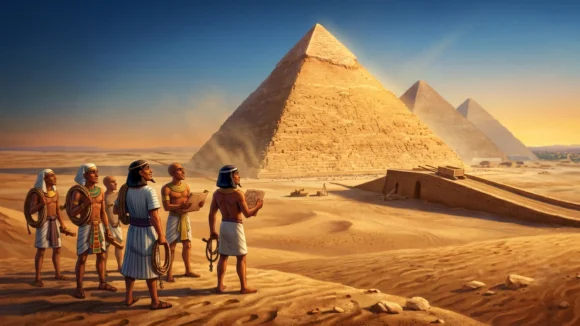
For centuries, the pyramids of Giza have puzzled visitors and scholars alike. Rising from the desert sands near modern Cairo, these enormous stone structures were built more than four and a half thousand years ago, during a period known as the Old Kingdom. The largest of them, the Great Pyramid, once stood nearly 147 metres tall and remained the tallest human-made object on Earth for almost four thousand years. How a society without iron tools, wheels for heavy transport, or modern machinery managed such a feat continues to fascinate researchers today.
The scale of these projects is difficult to imagine. Archaeologists estimate that the Great Pyramid contains around 2.3 million blocks of stone, some weighing as much as fifteen tonnes. Each block had to be cut, moved, and lifted into position with extraordinary precision. The sides of the pyramid are almost perfectly aligned with the four points of the compass, a level of accuracy that even the best engineers would respect. For a long time, people assumed that such a monument could only have been built through cruel force.
Rethinking an Old Story
A popular myth once held that armies of enslaved people were whipped into building the pyramids. Recent discoveries have overturned this idea. Not far from the pyramids, archaeologists uncovered the remains of a large town where the builders actually lived. They found bakeries, breweries, and areas for preparing food on a huge scale. The bones recovered from workers graves show injuries that had been carefully treated, suggesting these people received medical care. This was not a camp of prisoners but an organised community with a skilled and respected workforce.
The evidence points to a highly structured society. At the top sat the pharaoh, believed to be a living god whose status placed him above everyone else. Below him were priests, officials, and scribes who could read and write, giving them considerable influence. Beneath them stood craftsmen, farmers, and labourers. Most workers on the pyramids were probably ordinary farmers who offered their labour during the flood season, when the fields lay underwater and farming was impossible. In return, they were fed, housed, and paid in goods such as grain and beer.
Proof of a Powerful State
Building on this scale required careful planning. Officials had to organise the supply of food, tools, and materials for thousands of workers over many years. This was an ambitious undertaking that demanded a strong central government and enormous wealth. The pyramids, then, were not simply tombs for dead kings. They were proof of a state powerful enough to gather resources, direct people, and complete a project lasting decades.
Modern researchers continue to trace how the ancient Egyptians solved each problem. Experiments have shown that wet sand reduces friction, making it easier to drag heavy blocks on sledges. Ramps of various shapes may have been used to raise stones to great heights. Each new study adds a small piece to the puzzle. Yet part of the appeal remains untouched by science. Standing before these vast monuments, it is hard not to feel a deep respect for the people who imagined and built them so long ago.
Vocabulary · Key Words from the Article
| # | Word | Definition | Example Sentence |
|---|---|---|---|
| 1 | estimate verb | to guess or calculate the size, amount, or value of something, usually based on available information rather than exact measurement. | “Experts estimate that the repairs will cost around two million dollars.” |
| 2 | monument noun | a large structure, such as a statue or building, built to remember an important person or event, or an important historic building. | “The city built a stone monument to honour the soldiers who died in the war.” |
| 3 | myth noun | a widely held but false belief or idea; also, a traditional story about gods or heroes from ancient times. | “It is a common myth that we only use ten percent of our brains.” |
| 4 | skilled adjective | having the training, knowledge, and ability to do something well. | “The factory struggled to find enough skilled engineers to run the new machines.” |
| 5 | workforce noun | all the people who work for a particular company, in a particular industry, or in a country. | “The company reduced its workforce by two hundred people last year.” |
| 6 | status noun | a person's rank or position in society or in a group, especially compared with other people. | “In many cultures, owning land was once a clear sign of high social status.” |
Tip: Click any vocabulary row to find the word in the article. Export this list to your favorite flashcard apps like Quizlet or Anki. | |||
Usage Notes & Synonyms
Often followed by 'that' plus a clause: 'scientists estimate that...'. The noun has the same spelling but a slightly different pronunciation.
Synonym: calculate, reckon
Common collocation: 'a national monument', 'an ancient monument'. Do not confuse with 'moment' (a short period of time).
Synonym: memorial, landmark
Useful phrase: 'to bust a myth' or 'a popular myth' means a false idea many people accept. The adjective is 'mythical'.
Synonym: false belief, legend
Often used as 'skilled worker' or 'highly skilled'. The opposite is 'unskilled'. Use 'skilled at' or 'skilled in' before an activity.
Synonym: talented, expert
Usually treated as a single unit: 'the workforce is growing'. Common with numbers: 'a workforce of thousands'.
Synonym: staff, employees
Common collocations: 'social status', 'high/low status', 'status symbol'. It can also mean the current state of something, as in 'the status of the project'.
Synonym: rank, position
Grammar in Context
Grammar in Context
This article relies heavily on the passive voice, formed with the verb 'to be' plus a past participle (for example, 'were built', 'had to be cut', 'were fed, housed, and paid'). We use the passive when the action itself, or the thing acted upon, matters more than who performed it. In history writing this is extremely common: we often do not know exactly which individuals cut the stone or treated the injuries, so we focus on what happened rather than on a specific 'doer'. Notice how 'The largest of them was built' keeps our attention on the pyramid, not on the unnamed workers. The passive also lets writers sound objective and formal, which suits factual and academic texts. When the doer is important, English adds it with 'by' (for example, 'this idea was overturned by recent discoveries'), but very often that information is simply left out.
Listening Comprehension Questions
Listening Comprehension Questions
What is the main point the author makes by describing the town, bakeries, and treated injuries found near the pyramids?
The text states this evidence 'overturned' the myth of enslaved builders and directly concludes: 'This was not a camp of prisoners but an organised community with a skilled and respected workforce.' The food areas and treated injuries are given as proof that workers were supported and valued.
According to the article, why did ordinary farmers work on the pyramids during a certain part of the year?
The text explains that most workers 'offered their labour during the flood season, when the fields lay underwater and farming was impossible.' This timing allowed farmers to work on the pyramids without losing farming income they could not earn anyway.
In the final paragraph, the phrase 'part of the appeal remains untouched by science' most nearly means that:
The author contrasts scientific progress ('Each new study adds a small piece') with a feeling that cannot be measured. 'Untouched by science' means the emotional 'appeal' or wonder stays even when the practical methods are explained, supported by the closing line about feeling 'deep respect'.
What is the author's central argument about what the pyramids truly represent?
The article states directly: 'The pyramids, then, were not simply tombs for dead kings. They were proof of a state powerful enough to gather resources, direct people, and complete a project lasting decades.' This ties together the ideas of planning, wealth, and central government developed throughout the text.
Explain how the recent archaeological discoveries changed the older belief about who built the pyramids. Use your own words.
Sample Answer
Older beliefs claimed the pyramids were built by large numbers of enslaved people who were forced and beaten into working. However, when archaeologists found a nearby town with bakeries, breweries, and large food-preparation areas, along with worker graves showing injuries that had been medically treated, this picture changed. These findings suggested the builders were fed, housed, and cared for. As a result, historians now describe the builders as an organised and respected community of skilled and seasonal workers rather than mistreated prisoners.
Teacher's Note
A strong answer must contrast the old view (slavery and cruelty) with the new evidence, and must name at least two specific discoveries (for example, the town, the food areas, or the treated injuries). The best answers explain the logical link between the evidence and the conclusion, showing that care for workers implies they were not treated as slaves, and use original wording rather than copying the text.
The article shows a society organised in clear levels. In your own words, describe this structure and suggest why such organisation might have been necessary for a project as large as the pyramids.
Sample Answer
Egyptian society was arranged like a pyramid itself. At the very top was the pharaoh, seen as a living god with the highest status. Below him were priests, officials, and scribes, who held power partly because they could read and write. Beneath them came craftsmen, farmers, and labourers, who did the physical work. This clear structure was likely necessary because building a pyramid required thousands of workers and years of planning. Someone had to make decisions, keep records, and organise the constant supply of food, tools, and materials. A strong central government with defined roles made it possible to control resources and coordinate so many people effectively.
Teacher's Note
A good answer should correctly rank at least three social levels (pharaoh at the top, officials/scribes in the middle, workers at the bottom) and note the special role of literacy. To reach higher marks, the student must connect this hierarchy to practical needs of the project, such as coordination, record-keeping, and managing supplies for a huge workforce over a long period, showing analytical reasoning rather than simple description.
Speaking Practice & Discussion Questions
Speaking Practice & Discussion Questions
Discussion Questions
-
1
According to the article, roughly how many stone blocks does the Great Pyramid contain?
-
2
Have you ever visited a famous historic monument or ancient building? If so, how did it make you feel, and if not, which one would you most like to see?
-
3
Imagine you were an ordinary farmer in ancient Egypt during the flood season. Would you have preferred to work on the pyramids or find some other way to spend those months? Why?
-
4
The article shows that a popular 'fact' about slaves building the pyramids turned out to be a myth. Why do you think some historical myths stay popular even when the evidence is against them?
-
5
Some people argue that spending enormous resources on giant monuments is a waste, while others say such projects give a society pride and purpose. Which view do you agree with more, and why?
Further Discussion
-
1
What do the monuments a society chooses to build tell us about its deepest values, beliefs, and fears?
-
2
If a future government asked ordinary citizens to spend years of their lives on a huge national project that would only be finished long after they died, would it ever be right to expect this? Defend your position.
-
3
As technology like artificial intelligence and advanced machines takes over more physical and mental work, how might the great 'monuments' of our own age look different from the pyramids, and what might they say about us to people thousands of years from now?
Download the Worksheet for Offline Practice
Download the official B2 Upper-Intermediate English worksheet (PDF). Review key vocabulary such as ‘myth’ and ‘status’, answer selected comprehension questions, and check your answers with the included answer key.
Leave a Reply