
Artificial intelligence silently manages our alarms, music choices, and instant translations, making modern life easier but raising privacy concerns. You can build excellent listening comprehension by exploring this fascinating technology in audio format. Combine focused intermediate English listening with Shadowing to master new vocabulary naturally.

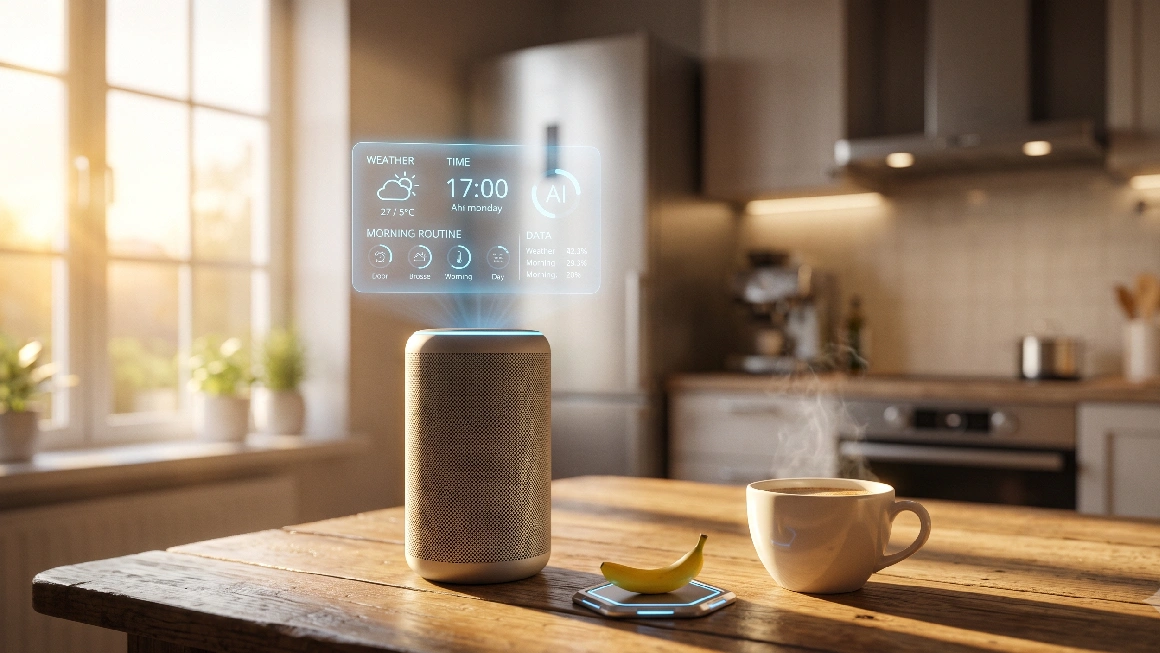
Not long ago, talking to a machine felt like something from a science fiction film. Today, millions of people do it before breakfast. They ask a small speaker about the weather, request a favourite song, or check the time while their hands are busy. Artificial intelligence, often shortened to AI, has quietly moved into ordinary homes, phones, and cars. Most of us use it many times a day without really noticing.
Think about a normal morning. Your phone wakes you with an alarm that learns your sleep pattern. As you scroll, a news app shows stories it thinks you will like. When you open a music service, it offers a recommendation based on songs you played last week. On the road, a map app studies live traffic and suggests a faster route. None of this happens by magic. Behind each choice sits a computer program that has studied huge amounts of data and learned to guess what you probably want.
Shopping has changed too. Online shops watch what you look at and make a prediction about your next purchase. Sometimes the guess is impressive; sometimes it is comically wrong. Banks use similar tools to spot unusual activity and warn customers about possible fraud. Doctors are beginning to use AI to read medical scans, and early results suggest it can be a reliable partner, helping busy staff notice problems they might otherwise miss.
A World Without Borders
Language is another area of rapid change. Free translation apps now let a traveller order dinner in a country whose alphabet they cannot read. A tourist can point a camera at a menu and see it appear in their own language within seconds. For many people, this feels comfortable and natural, almost like carrying a patient friend who speaks every language in the world.
Of course, not everyone is relaxed about these changes. Some people worry that machines collect too much private information. Others fear losing their jobs to software that never sleeps and never asks for a holiday. There are also harder questions. If a self-driving car causes an accident, who is responsible? If a program makes an unfair decision, how do we correct it? These are not simple problems, and honest experts admit they do not yet have every answer.
Finding the Balance
Still, it helps to imagine daily life without these quiet helpers. Many of us would feel lost without instant directions, quick translations, or the small reminders that keep our days organised. The technology is not perfect, and it should not be trusted blindly. Yet each year brings a clear improvement in how well these systems understand us.
Perhaps the wisest approach is balance. AI is a tool, powerful but not magical. It can save time and reduce stress, and therefore it deserves a place in modern life. However, it still needs human judgement, kindness, and common sense to guide it. The machines are learning fast, but the most important decisions, about how we live and treat each other, should stay firmly in human hands.
Vocabulary · Key Words from the Article
| # | Word | Definition | Example Sentence |
|---|---|---|---|
| 1 | recommendation noun | advice that tells someone what is good or what they should choose or do. | “The waiter gave us a helpful recommendation, so we ordered the fish.” |
| 2 | prediction noun | a statement about what you think will happen in the future. | “Her prediction about the weather was correct: it rained all afternoon.” |
| 3 | reliable adjective | able to be trusted to work well or to do what you expect. | “My old car is very reliable and has never broken down.” |
| 4 | comfortable adjective | feeling relaxed and free from worry, pain, or trouble. | “After a few weeks, she felt comfortable speaking English with her new colleagues.” |
| 5 | worry verb | to feel nervous or unhappy because you keep thinking about a problem. | “Parents often worry about their children when they travel alone.” |
| 6 | imagine verb | to form a picture or idea of something in your mind. | “Close your eyes and imagine a quiet beach with no people.” |
Tip: Click any vocabulary row to find the word in the article. Export this list to your favorite flashcard apps like Quizlet or Anki. | |||
Usage Notes & Synonyms
Often used with 'make', 'give', or 'follow': 'follow a recommendation'. The verb form is 'recommend'.
Synonym: suggestion, advice
Common with 'make': 'make a prediction'. The verb is 'predict'. Do not confuse it with 'promise'.
Synonym: forecast, guess
Used for people, machines, and information: 'a reliable friend', 'a reliable source'. The opposite is 'unreliable'.
Synonym: dependable, trustworthy
Note the spelling and stress on the first syllable. 'Comfortable with (doing) something' means you feel confident and relaxed about it.
Synonym: relaxed, at ease
Usually followed by 'about' plus a noun, or by 'that' plus a clause: 'worry about money', 'worry that it is late'.
Synonym: be anxious, be concerned
Can be followed by a noun or by a verb + -ing: 'imagine a holiday', 'imagine living abroad'. It is not usually used in continuous tenses.
Synonym: picture, suppose
Grammar in Context
Grammar in Context
The first conditional talks about real or likely situations and their results. We use 'if' plus a verb in the present simple to describe the condition, and then a result, often with 'will' or a present verb. In the article you can see this in sentences like 'If a self-driving car causes an accident, who is responsible?' and 'If a program makes an unfair decision, how do we correct it?' Here the writer imagines possible future situations that could really happen with AI, and then asks about the result. This structure is useful because it lets you discuss cause and effect and think about realistic 'what happens next' questions, which is exactly what people do when they talk about new technology.
Listening Comprehension Questions
Listening Comprehension Questions
According to the article, why do most people not notice that they use AI?
The first paragraph says AI 'has quietly moved into ordinary homes, phones, and cars' and that 'most of us use it many times a day without really noticing.' The word 'quietly' shows the change happened without people paying attention, which matches this answer directly.
What point does the writer make about AI's guesses in shopping?
The third paragraph states, 'Sometimes the guess is impressive; sometimes it is comically wrong.' This balanced sentence shows the writer thinks AI predictions are useful but not always correct, so the answer that mentions both sides is right.
In the sentence 'it can be a reliable partner, helping busy staff notice problems', what does 'reliable' suggest about the AI?
The context describes AI 'helping busy staff notice problems they might otherwise miss', which is positive. 'Reliable' means able to be trusted to work well, so it tells the reader that doctors can depend on the AI as a helper.
What is the main message of the final paragraph?
The last paragraph calls AI 'a tool, powerful but not magical' and says it 'still needs human judgement.' The final sentence states that important decisions 'should stay firmly in human hands.' This shows the writer wants balance, not a machine that decides everything.
The writer mentions several worries that people have about AI. Choose one of these worries and explain in your own words why some people feel this way.
Sample Answer
One common worry is about privacy. The writer says some people think machines 'collect too much private information.' People feel this way because AI tools watch what we buy, read, and search for, and they store this data. If a company keeps so much personal information, users cannot always control who sees it or how it is used. This makes some people feel that they are being watched and that they are losing their privacy, even when they are just doing simple daily tasks.
Teacher's Note
A strong answer must identify one specific worry named in the article (privacy, job loss, responsibility for accidents, or unfair decisions), explain it in the student's own words rather than copying, and give a clear reason why the worry makes sense. Look for one clear cause-and-effect link and level-appropriate language with correct present-simple verbs.
The writer says the wisest approach to AI is 'balance'. Do you agree that balance is the best approach? Give reasons for your opinion.
Sample Answer
I agree that balance is the best approach. AI clearly helps us in daily life. It gives fast directions, useful translations, and helpful reminders, so it saves time and reduces stress. However, the article is right that AI is not perfect and 'should not be trusted blindly.' Machines can make mistakes and cannot understand feelings the way people do. For this reason, we should use AI as a helper but keep human judgement for important choices, such as medical or legal decisions. Using both together seems safer than trusting only machines or refusing all new technology.
Teacher's Note
A good answer must take a clear position (agree, disagree, or partly agree) and support it with at least two reasons. Students should refer to ideas from the text, such as AI saving time or not being perfect, and add their own thinking. Reward logical structure, an opinion phrase like 'I think' or 'in my opinion', and correct use of linking words such as 'however' or 'because'.
Speaking Practice & Discussion Questions
Speaking Practice & Discussion Questions
Discussion Questions
-
1
According to the article, what are two things people ask a small speaker to do in the morning?
-
2
Which AI tools do you use in your own daily life, and which one is the most useful for you?
-
3
Imagine your phone and apps stopped using AI for one week. What would be the hardest part of your day?
-
4
The article says some people worry about privacy. Do you think we share too much personal information online? Why or why not?
-
5
Do you believe AI will make our lives better or worse in the next ten years? Explain your opinion.
Further Discussion
-
1
If a machine can do a job faster and more cheaply than a person, should companies always choose the machine? Why or why not?
-
2
When a self-driving car or an AI program makes a serious mistake, who do you think should be responsible: the company, the user, or the machine itself?
-
3
How might everyday life, work, and relationships change if AI becomes far more intelligent than it is today?
Download the Worksheet for Offline Practice
Download the official B1 Intermediate English worksheet (PDF). Review key vocabulary such as ‘reliable’ and ‘worry’, answer selected comprehension questions, and check your answers with the included answer key.
Leave a Reply