
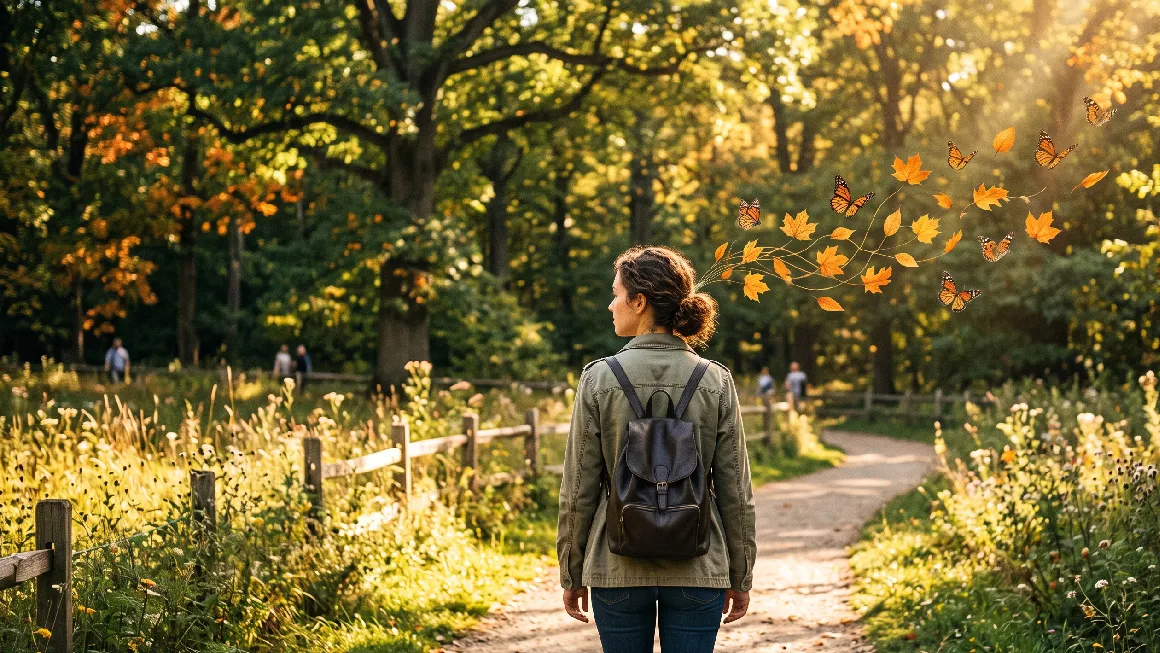
Research reveals that a gentle walk can relieve mental fatigue and spark creativity by increasing oxygen to the brain. This simple, free habit lowers stress levels and builds a calmer mind. Use this natural English rhythm to practice your advanced English listening and Shadowing today.
People have always known, in some vague way, that walking helps them think. Philosophers paced. Writers took long afternoon rambles when a sentence refused to come. Yet only recently have researchers begun to explain why a slow walk around the block can do what an hour at a desk cannot.
The findings are surprisingly consistent. In one widely cited study, people asked to solve creative problems performed markedly better while walking than while sitting, and the effect lingered even after they sat back down. What makes this compelling is not merely that movement helps, but how modest the movement needs to be. You do not have to run. You do not have to sweat. A gentle, unhurried pace appears to be enough to loosen the grip of a tired mind.
The Wandering Eye and the Wandering Mind
Part of the explanation lies in blood flow. Walking sends a steady supply of oxygen to the brain, which helps the regions responsible for memory and attention work more smoothly. But biology is only half the story. When you walk, your gaze softens and drifts. You are no longer staring at a screen, waiting for an answer to arrive. That gentle wandering of the eyes seems to invite a gentle wandering of thought, and it is often in that loosened state that a stubborn idea finally comes free.
There is a psychological side too. A walk can soothe a restless mind in a way that few other simple habits manage. People who walk regularly report lower levels of stress and a brighter mood, and the rhythm of steady footsteps has a calming, almost hypnotic quality. For anyone whose thoughts tend to circle endlessly around the same worry, the change of scene and the forward motion can quietly interrupt that loop.
Small Steps, Repeated
What matters most, the research suggests, is consistency rather than intensity. A single dramatic hike will not reshape your mind. A short walk taken most days, however, slowly changes how you feel and how you think. Over weeks and months, this humble habit appears to cultivate a calmer, sharper, more flexible way of engaging with the world.
The setting helps as well. A walk through a park or along a quiet street tends to be more restorative than the same distance covered on a treadmill, staring at a wall. Green spaces, in particular, seem to foster a kind of effortless calm, giving the mind something to rest on without demanding anything in return. The trees, the changing light, the ordinary sounds of a neighborhood: none of it asks you to concentrate, and that is precisely the point.
Perhaps the most striking thing about all of this is how accessible it is. There is no equipment to buy, no membership to renew, no skill to master. The benefits are available to almost anyone, at almost any age, at no cost at all.
So the next time your thoughts feel tangled, or a problem refuses to yield, consider leaving your desk. Put on your shoes and step outside. The oldest and simplest remedy for a crowded mind may be waiting for you just beyond the front door, one quiet step at a time.
Vocabulary · Key Words from the Article
| # | Word | Definition | Example Sentence |
|---|---|---|---|
| 1 | compelling adjective | So interesting, convincing, or powerful that it holds your attention or makes you believe something. | “The lawyer presented a compelling argument that convinced even the most doubtful members of the jury.” |
| 2 | soothe verb | To make someone feel calmer and less anxious, or to reduce pain or discomfort. | “She played soft music to soothe the crying baby back to sleep.” |
| 3 | consistency noun | The quality of always behaving or performing in the same way, or of doing something regularly over time. | “Success in learning a language depends far more on consistency than on occasional bursts of intense study.” |
| 4 | cultivate verb | To develop or improve a quality, skill, habit, or relationship gradually through care and effort. | “Over the years, he worked hard to cultivate a reputation for honesty and reliability.” |
| 5 | foster verb | To encourage the growth or development of something, especially a feeling, skill, or condition. | “Good managers try to foster a sense of trust and openness among their team members.” |
| 6 | striking adjective | So noticeable or unusual that it attracts strong attention or interest. | “There was a striking difference between the two paintings, even though the same artist had made both.” |
Tip: Click any vocabulary row to find the word in the article. Export this list to your favorite flashcard apps like Quizlet or Anki. | |||
Usage Notes & Synonyms
Often used with 'argument', 'evidence', 'reason', and 'story'. 'A compelling case for something' is a very common collocation.
Synonym: convincing, persuasive
You can soothe a person, soothe nerves, or soothe pain. The related adjective 'soothing' describes something that produces this calm, as in 'a soothing voice'.
Synonym: calm, comfort
Note the phrase 'consistency rather than intensity'. Be careful: 'consistency' can also mean the thickness of a liquid or mixture, as in 'a smooth consistency', so context matters.
Synonym: steadiness, regularity
Beyond its literal farming sense (to cultivate crops), it is often used figuratively: cultivate a habit, cultivate friendships, cultivate patience.
Synonym: develop, nurture
Commonly followed by abstract nouns such as 'creativity', 'cooperation', 'growth', or 'a sense of'. It also has a separate meaning: to foster a child means to care for one who is not your own.
Synonym: encourage, promote
Frequently used with 'difference', 'contrast', 'resemblance', and 'feature'. 'It is striking that...' is a useful way to highlight something surprising.
Synonym: remarkable, noticeable
Grammar in Context
Grammar in Context
Throughout the article, the writer repeatedly uses the passive voice to keep the focus on the research and its findings rather than on who performed the studies. Constructions such as 'people asked to solve creative problems', 'in one widely cited study' paired with passive reporting, and 'the benefits are available' shift attention away from the agent and onto the result or the affected thing. The passive is formed with the verb 'to be' plus a past participle (for example, 'is formed', 'was cited', 'are available'). Writers of academic and journalistic prose favour it when the doer is unknown, unimportant, or obvious, and when a neutral, authoritative tone is wanted. Notice how it lets the writer present claims as established knowledge without constantly saying 'scientists found' or 'a researcher did', which would sound repetitive and less objective.
Listening Comprehension Questions
Listening Comprehension Questions
According to the article, what is the most surprising aspect of the connection between walking and creative thinking?
The text states that what makes the finding compelling is 'not merely that movement helps, but how modest the movement needs to be', adding 'You do not have to run. You do not have to sweat.' This directly contradicts the idea that fast or tiring exercise is required, and the article notes the effect actually lingered after people sat down.
How does the article explain the link between the eyes and the mind while walking?
The article says that when you walk 'your gaze softens and drifts' and that 'that gentle wandering of the eyes seems to invite a gentle wandering of thought'. It is in this 'loosened state' that a stubborn idea 'finally comes free', which matches the third option.
In the sentence 'Green spaces, in particular, seem to foster a kind of effortless calm,' the word 'foster' most nearly means:
The surrounding context describes green spaces giving the mind rest 'without demanding anything in return', which is a nurturing, supportive effect. 'Foster' here means to encourage the growth or development of something, in this case a feeling of calm, rather than to destroy, measure, or hide.
Which statement best captures the overall argument of the article?
The article combines the cognitive evidence (better creative problem solving, improved memory and attention) with the psychological evidence (lower stress, brighter mood) and stresses that 'consistency rather than intensity' matters and that the practice is free and 'accessible' to almost anyone. This overarching point matches the second option and rules out the others.
The writer argues that 'consistency rather than intensity' is what truly benefits the mind. Explain what this distinction means and why it might make the advice in the article easier to follow than typical fitness advice.
Sample Answer
The distinction contrasts doing something regularly and repeatedly (consistency) with doing something powerfully but rarely (intensity). The writer claims that a short walk taken most days gradually reshapes how a person feels and thinks, whereas 'a single dramatic hike will not reshape your mind'. This makes the advice easier to follow than much fitness advice, which often demands hard, exhausting effort and can feel discouraging or unsustainable. Because gentle daily walking requires no equipment, no special skill, and very little energy, almost anyone can maintain it over weeks and months, and it is precisely this repeated, low-effort habit that produces the lasting mental benefits the article describes.
Teacher's Note
A strong answer must (1) correctly define both terms in contrast, linking consistency to regular repetition and intensity to occasional strong effort; (2) use textual evidence, such as the 'single dramatic hike' versus a 'short walk taken most days'; and (3) explain the practical implication, namely that a gentle, sustainable habit is more achievable and therefore more likely to be maintained than demanding exercise. Depth is shown by connecting sustainability to the article's emphasis on accessibility and low cost.
The article suggests that walking in green spaces is more restorative than walking on a treadmill. Drawing on the text and your own reasoning, discuss why the environment in which we move might matter as much as the movement itself.
Sample Answer
According to the article, a walk through a park or quiet street is more restorative than the same distance on a treadmill facing a wall, because green spaces give the mind 'something to rest on without demanding anything in return'. The trees, changing light, and ordinary neighborhood sounds gently occupy the attention without forcing effortful concentration, which allows the mind to relax. This implies that the environment shapes the psychological quality of the experience, not just the physical exertion. A treadmill provides identical movement but a dull, unchanging view that offers no relief from mental fatigue, whereas a natural setting continually supplies mild, pleasant stimulation. My own reasoning supports this: pleasant surroundings can lift mood, reduce the sense of boredom, and make a person more willing to repeat the activity, which ties back to the article's central point that consistency is what delivers lasting benefit.
Teacher's Note
A high-quality answer should (1) accurately paraphrase the article's claim about green spaces being restorative and cite the idea of the mind resting 'without demanding anything in return'; (2) explain the mechanism, contrasting the varied, undemanding stimulation of nature with the monotony of a treadmill; and (3) extend the argument with independent reasoning, such as the effect of environment on mood, boredom, or motivation. Analytical depth is demonstrated by linking the setting back to the wider theme of sustainable, repeated practice.
Speaking Practice & Discussion Questions
Speaking Practice & Discussion Questions
Discussion Questions
-
1
According to the article, do you need to walk fast and hard to gain the mental benefits, or is a gentle pace enough?
-
2
How much walking do you do in a typical day, and when do you feel most like going for a walk?
-
3
Imagine your town suddenly built a beautiful new park near your home. How might that change your daily habits?
-
4
Some people feel they are 'too busy' to go for a short walk. Do you think this is a real problem or mostly an excuse?
-
5
Looking ahead, do you think cities in the future will be designed more around walking, or will people rely even more on screens and cars?
Further Discussion
-
1
To what extent do you think modern life, with its focus on speed and productivity, has made us forget the value of slow, purposeless activities like walking?
-
2
If gentle daily walking really does improve mental health at almost no cost, do governments and employers have a responsibility to design cities and workplaces that make walking easier for everyone?
-
3
As artificial intelligence and remote work reduce the need to leave home, how might the human relationship with movement, nature, and physical space change over the next few decades?
Download the Worksheet for Offline Practice
Download the official C1 Advanced English worksheet (PDF). Review key vocabulary such as ‘compelling’ and ‘foster’, answer selected comprehension questions, and check your answers with the included answer key.
Leave a Reply