
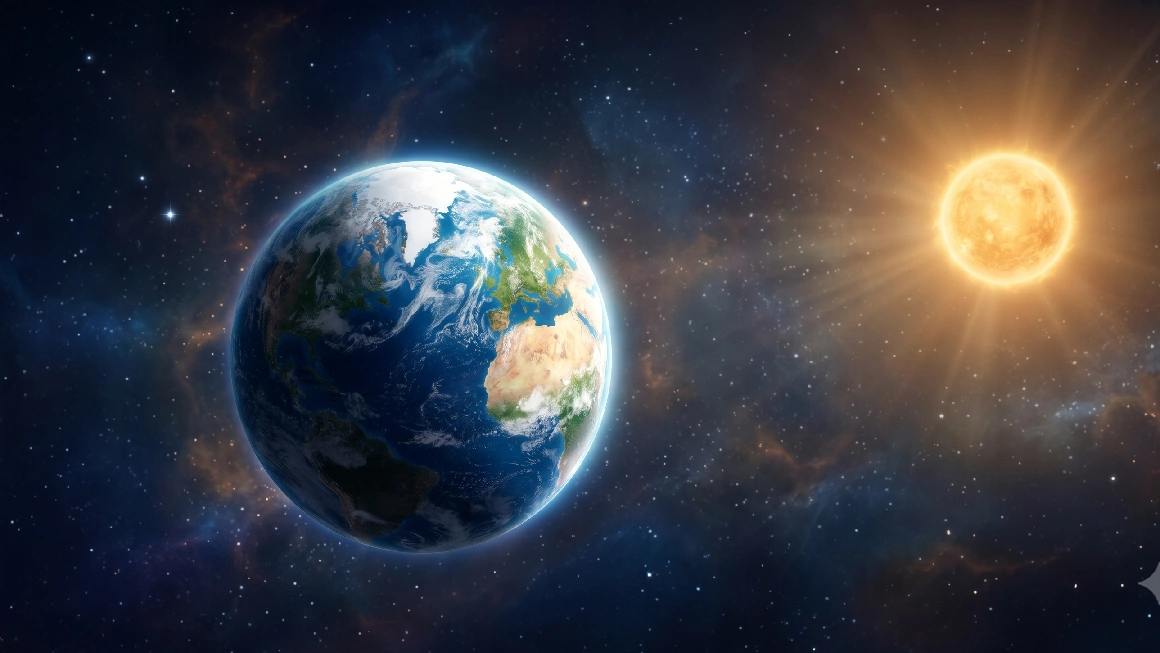
Earth reaches aphelion in July when it is furthest from the Sun, yet the Northern Hemisphere stays warm. This happens because the planet’s axial tilt drives seasonal weather changes far more than distance does. Through active shadowing, this audio lesson offers intermediate English listening to help you understand complex natural science concepts while improving your general English listening.
Each year in early July, Earth reaches a quiet milestone that almost nobody notices. Our planet arrives at aphelion, the single point in its yearly journey where it sits farthest from the Sun. At this moment, the gap between Earth and the Sun stretches to roughly 152 million kilometres, about five million kilometres more than in early January. You might expect the extra distance to bring cooler days. In the northern half of the world, the opposite happens.
This surprising fact points to a common myth about the seasons. Many people assume that summer arrives because Earth moves closer to the Sun, and that winter comes when it pulls away. If that were true, the whole planet would feel warm and cold at the same time. It does not. When it is summer in Europe, it is winter in Australia. Distance alone cannot explain this, so something else must be shaping our weather.
Why the Tilt Wins
The real driver is the angle at which Earth leans on its axis, a lean of about 23.5 degrees. This tilt stays steady as our planet travels around the Sun, so different regions receive direct sunlight at different times of the year. During a northern summer, the top half of the globe leans toward the Sun. Rays strike the ground more directly, and each patch of land can absorb far more energy. Longer days give that heat more hours to build.
Against this powerful effect, the change in orbit distance is remarkably small. The difference between aphelion in July and its opposite point in January alters the amount of sunlight Earth receives by only about seven percent. That gentle shift is easily overwhelmed by the tilt, which is why July stays hot in Madrid while it stays cold in Sydney.
A Small Effect That Still Counts
Seven percent may sound tiny, but it does leave a mark. Because the southern half of the planet holds far more ocean, and water is slow to heat and slow to cool, the aphelion effect is barely visible in daily life. Still, scientists have measured it. Southern summers, which happen near the closer point in the orbit, tend to be slightly more intense, while northern summers are a touch milder than pure geometry would suggest.
Over vast stretches of time, these orbital details matter enormously. The exact shape of Earth’s path is not fixed. It stretches and rounds again across cycles lasting tens of thousands of years. Many researchers believe these slow changes have helped push the planet into ice ages and pull it back out. To maintain a stable climate, Earth depends on a delicate balance of tilt, distance, and shape. Aphelion, then, is a small annual reminder of a much larger truth: our climate is a machine with many moving parts, and no single one tells the whole story.
Vocabulary · Key Words from the Article
| # | Word | Definition | Example Sentence |
|---|---|---|---|
| 1 | myth noun | An idea or belief that many people accept as true but which is actually false. | “It is a common myth that we only use ten percent of our brains.” |
| 2 | steady adjective | Staying the same over time; not changing suddenly or shaking. | “She spoke in a calm, steady voice even though she was nervous.” |
| 3 | absorb verb | To take in a liquid, gas, energy, or information gradually. | “Dark surfaces absorb heat more quickly than light ones.” |
| 4 | orbit noun | The curved path that a planet, moon, or object follows as it travels around another object in space. | “The satellite completed one orbit of the Earth every ninety minutes.” |
| 5 | barely adverb | Only just; almost not at all, or by a very small amount. | “The music was so quiet that I could barely hear it.” |
| 6 | maintain verb | To keep something in the same state or at the same level over time. | “Regular exercise helps you maintain a healthy weight.” |
Tip: Click any vocabulary row to find the word in the article. Export this list to your favorite flashcard apps like Quizlet or Anki. | |||
Usage Notes & Synonyms
Often used with 'common', 'popular', or 'widespread'. 'Myth' can also mean an old traditional story, so the meaning depends on context.
Synonym: false belief, misconception
Contrast with 'unsteady'. Common collocations include 'a steady job', 'a steady pace', and 'steady progress'.
Synonym: stable, constant
Used both physically (absorb water, absorb light) and mentally (absorb information). The related noun is 'absorption'.
Synonym: take in, soak up
Can also be a verb: 'The Moon orbits the Earth'. Common phrases include 'in orbit' and 'enter orbit'.
Synonym: path, circuit
'Barely' already carries a negative meaning, so do not add another negative word. Say 'I could barely see', not 'I couldn't barely see'.
Synonym: hardly, scarcely
Common collocations: 'maintain balance', 'maintain a relationship', 'maintain standards'. The related noun is 'maintenance'.
Synonym: keep up, preserve
Grammar in Context
Grammar in Context
The second conditional describes an imaginary or untrue situation and its likely result. It follows the pattern 'If + past simple, ... would + base verb'. In this article, the sentence 'If that were true, the whole planet would feel warm and cold at the same time' uses this structure to explore an idea the writer knows is false. Notice the use of 'were' rather than 'was' after 'if', which is standard in careful written English for hypothetical statements. This grammar is useful because it lets the writer test a wrong belief (that distance causes the seasons) and show its impossible consequence, guiding the reader toward the correct explanation.
Listening Comprehension Questions
Listening Comprehension Questions
According to the article, why does the northern half of the world experience summer even at aphelion?
The text states that 'the top half of the globe leans toward the Sun' during a northern summer, so 'rays strike the ground more directly' and the land can absorb more energy. The article directly rejects the idea that distance to the Sun causes the seasons, which rules out the first option.
What does the example of summer in Europe and winter in Australia prove?
The writer uses this contrast to show that if distance controlled the seasons, 'the whole planet would feel warm and cold at the same time.' Because the two regions have opposite seasons at once, the article concludes that 'something else must be shaping our weather.'
In the sentence 'the aphelion effect is barely visible in daily life', the word 'barely' is closest in meaning to:
'Barely' means 'only just' or 'almost not at all'. The surrounding text supports this: the effect exists and 'scientists have measured it', but it is so small that ordinary people would not notice it in everyday life.
What is the main idea the writer wants the reader to take away from the article?
The final paragraph describes climate as 'a machine with many moving parts, and no single one tells the whole story.' It lists tilt, distance, and shape working in 'a delicate balance', which confirms that no single cause, including aphelion, explains the climate on its own.
The article says the aphelion effect is 'barely visible in daily life' but still matters over long periods. Explain in your own words how something so small can have large consequences over time.
Sample Answer
A model answer would explain that a small yearly effect, such as the seven percent change in sunlight, has almost no impact on a single season because the tilt of the Earth is much stronger. However, when this small difference is repeated over tens of thousands of years, and combined with slow changes in the shape of Earth's orbit, it can gradually add up. The article suggests these slow orbital changes have helped push the planet into ice ages and pull it back out. So a tiny yearly signal becomes powerful when it acts steadily across an enormous span of time.
Teacher's Note
A strong answer should (1) recognise that the effect is small in the short term because the tilt dominates, (2) connect the idea to the long orbital cycles lasting tens of thousands of years mentioned in the text, and (3) refer to the ice-age example as evidence. Weaker answers only repeat that the effect is small without explaining the role of accumulated time.
Why do you think misunderstandings like the 'distance myth' about the seasons are so common, and how might better science education reduce them?
Sample Answer
A model answer would suggest that the myth feels logical because in everyday life, moving closer to a heat source, like a fire, makes us warmer, so people apply the same simple logic to the Sun. The idea is easy to imagine and rarely questioned. Better science education could reduce such myths by teaching people to test their beliefs against evidence, for example by asking why the two halves of the planet have opposite seasons at the same time. Encouraging this kind of questioning, rather than only memorising facts, would help people spot when a simple explanation does not fit reality.
Teacher's Note
A good answer should (1) offer a plausible reason for why the myth is intuitive, ideally with an everyday comparison, and (2) suggest a concrete educational approach, such as teaching critical thinking or using the opposite-seasons contrast as a test. Depth is shown by linking the psychology of the mistake to a practical solution, not just stating that education 'helps'.
Speaking Practice & Discussion Questions
Speaking Practice & Discussion Questions
Discussion Questions
-
1
At what time of year does Earth reach aphelion, its farthest point from the Sun?
-
2
What is the weather usually like where you live in July, and does the article change how you think about it?
-
3
Imagine Earth had no tilt at all. How do you think this would change the seasons in your country?
-
4
Do you think most people around you understand what really causes the seasons? Why or why not?
-
5
Some scientists study how slow orbital changes may cause ice ages far in the future. How much should we worry about events that are thousands of years away?
Further Discussion
-
1
How much of what people accept as 'common knowledge' do you think is actually accurate, and why do false ideas spread so easily?
-
2
If a scientific truth is difficult for ordinary people to feel or observe in daily life, does that make it harder for society to take it seriously? Defend your view.
-
3
As our understanding of Earth's long climate cycles improves, how might this knowledge change the decisions humans make about the planet over the coming centuries?
Download the Worksheet for Offline Practice
Download the official B2 Upper-Intermediate English worksheet (PDF). Review key vocabulary such as ‘steady’ and ‘absorb’, answer selected comprehension questions, and check your answers with the included answer key.
Leave a Reply