
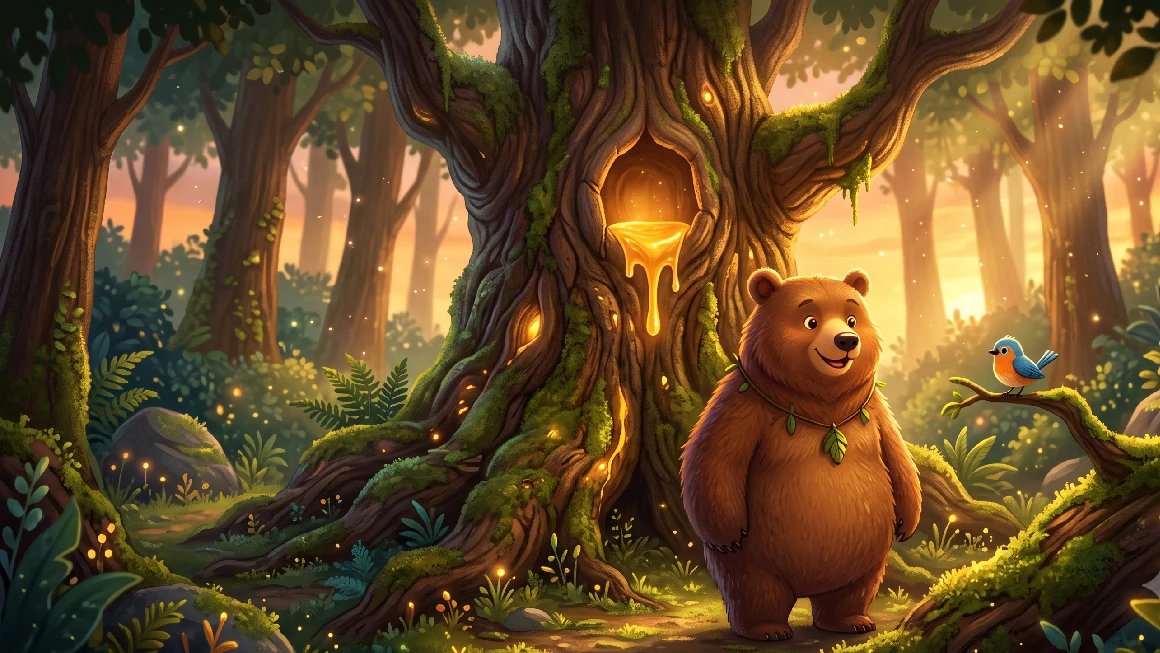
Barnaby the bear wants to find a secret honey tree. A little bird helps him, and the clever bear waits for the bees to go to sleep. He enjoys the sweet food and leaves some for his friends. Try Shadowing this audio story to enjoy your daily English listening practice.
Barnaby was a big brown bear. He lived in a green forest near a cold river. Every summer, Barnaby was very hungry. He wanted one special thing. He wanted sweet honey.
His mother told him a story when he was a small bear. “There is a secret tree in this forest,” she said. “It is old and tall, and it is full of gold honey. But you must be very careful, because the bees live there too.”
Now Barnaby was big and strong, and he wanted to find this tree. One warm morning, he started to walk. He walked past the river. He walked up a small hill. The sun was hot, and Barnaby was tired, but he did not stop.
A Little Bird Helps
Soon Barnaby met a little bird. “Hello, bird,” he said. “Do you know the secret honey tree?” The bird was happy to help. “Yes! Follow me,” she said. “But be careful. There is danger there. The bees are angry when you take their honey.”
The little bird was fast, so Barnaby walked quickly behind her. They went deep into the forest. The trees were tall and old. Barnaby could hear a soft sound. It was the sound of many, many bees. His heart was fast, and he was a little scared. But he wanted the honey very much.
The Old Tree
Then he saw it. The tree was very big, and high in the tree there was a hole. Gold honey was on the tree, and it looked sweet and beautiful. But Barnaby did not run to the tree. He was a clever bear, and he had a plan.
“I will wait,” he thought. “When the sun goes down, the bees will be quiet.” So Barnaby sat down under a different tree, and he waited. He was patient. He watched the bees fly home. Slowly, the forest became quiet.
In the evening, Barnaby walked to the old tree. He put his big paw into the hole. The honey was soft and warm. He ate a little, and then he ate more. It was the best food in all the world.
Barnaby did not take all the honey. He left some for the bees, and he left some for the little bird. “Thank you, bird,” he said. “You are a good friend.”
That night, Barnaby went home to the river. He was not hungry now. He was very happy, and he wanted to enjoy this good day for a long time. He knew the secret of the forest, but he kept it safe. The honey tree was his special place, and now it was a happy story too.
Vocabulary · Key Words from the Article
| # | Word | Definition | Example Sentence |
|---|---|---|---|
| 1 | forest noun | a large area of land with many trees growing close together. | “We saw many birds and small animals in the forest.” |
| 2 | careful adjective | giving your attention to what you do so that you do not have an accident or make a mistake. | “Please be careful when you cross the busy road.” |
| 3 | danger noun | the chance that something bad or harmful can happen to you. | “The sign says the water is deep, so there is danger here.” |
| 4 | scared adjective | feeling afraid or worried because you think something bad can happen. | “The little girl was scared of the big dog.” |
| 5 | clever adjective | able to learn and understand things quickly and make good decisions. | “My sister is very clever and always gets good marks at school.” |
| 6 | enjoy verb | to get pleasure from something; to like something and feel happy when you do it. | “I enjoy my coffee every morning before work.” |
Tip: Click any vocabulary row to find the word in the article. Export this list to your favorite flashcard apps like Quizlet or Anki. | |||
Usage Notes & Synonyms
We often say 'in the forest' or 'a thick forest'. Do not confuse it with 'desert', which is dry with no trees.
Synonym: wood, woods
Very common phrase: 'be careful'. The opposite is 'careless'. The adverb is 'carefully'.
Synonym: safe
Often used as 'in danger' or 'a lot of danger'. The adjective is 'dangerous'.
Synonym: risk
We say 'scared of' something: 'I am scared of spiders'. It describes a feeling, like 'happy' or 'tired'.
Synonym: afraid, frightened
Use for people and animals. 'A clever idea' means a good, smart idea. The opposite is 'stupid'.
Synonym: smart, bright
After 'enjoy' we use the -ing form: 'I enjoy reading'. Do not say 'I enjoy to read'.
Synonym: like, love
Grammar in Context
Grammar in Context
This story tells about the past, so it uses the simple past tense. Regular verbs add -ed, for example 'walk' becomes 'walked' and 'want' becomes 'wanted'. Many common verbs are irregular and change their form, for example 'is/are' becomes 'was/were', 'go' becomes 'went', 'eat' becomes 'ate', 'see' becomes 'saw', and 'have' becomes 'had'. We use the simple past to talk about finished actions and events, so it is perfect for telling a story about Barnaby's day. Notice that the verb form is the same for all people: 'he walked', 'they walked'.
Listening Comprehension Questions
Listening Comprehension Questions
Why did Barnaby want to find the special tree?
The story says, 'Every summer, Barnaby was very hungry' and 'He wanted sweet honey.' This tells us his reason clearly. The tree was special because it 'is full of gold honey.'
How did the little bird help Barnaby?
When Barnaby asked about the tree, the bird said, 'Yes! Follow me.' Then 'They went deep into the forest.' This shows she helped by taking him to the right place.
In the story, Barnaby was 'a clever bear, and he had a plan.' What was his clever plan?
Barnaby thought, 'I will wait. When the sun goes down, the bees will be quiet.' A clever plan here means a smart idea to stay safe. He waited instead of running to the angry bees.
What is the main lesson or message of this story?
Barnaby waited patiently to stay safe, and he also 'did not take all the honey' and shared it. He was happy at the end. This shows that patience and kindness are good, which is the main idea.
Barnaby left some honey for the bees and the bird. What does this tell us about Barnaby? Use your own words.
Sample Answer
This tells us that Barnaby is a kind and thoughtful bear. He does not think only about himself. He remembers his friend the bird and helps her. He also leaves food for the bees, so he is fair. He shares because he is happy and he wants others to be happy too. A good friend gives, and does not take everything.
Teacher's Note
A good answer should say Barnaby is kind, fair, or thoughtful, and should give a reason from the story (he shared with the bird and the bees). Look for at least one clear character word plus simple support from the text.
Barnaby's mother told him the tree was dangerous, but he still went. Do you think this was a good idea? Why or why not?
Sample Answer
I think it was a good idea because Barnaby was careful and he made a clever plan. He did not run to the angry bees. He waited for them to be quiet, so he was safe. He also got the honey he needed for food. But it can also be a little dangerous, so it was only a good idea because he was careful and patient.
Teacher's Note
There is no single correct answer. A strong response gives a clear opinion (good idea or not) and supports it with a detail from the text, for example his careful plan or the danger from the bees. Reward simple, logical reasoning.
Speaking Practice & Discussion Questions
Speaking Practice & Discussion Questions
Discussion Questions
-
1
What food does Barnaby want to find in the forest?
-
2
Do you like honey? What is your favourite sweet food?
-
3
If you were in a forest and met a talking bird, where would you ask it to take you?
-
4
Barnaby shared his honey with his friends. Do you think sharing food is important? Why?
-
5
Some people think wild animals like bears are dangerous, and some people love them. What do you think, and why?
Further Discussion
-
1
Why is nature, like forests and rivers, important for people and animals?
-
2
Sometimes we want something a lot, but it can be dangerous to get it. Is it always good to try, or is it better to stay safe?
-
3
In the future, do you think there will be more forests or fewer forests? What can people do to help wild animals?
Download the Worksheet for Offline Practice
Download the official A2 Elementary English worksheet (PDF). Review key vocabulary such as ‘forest’ and ‘scared’, answer selected comprehension questions, and check your answers with the included answer key.
Leave a Reply