
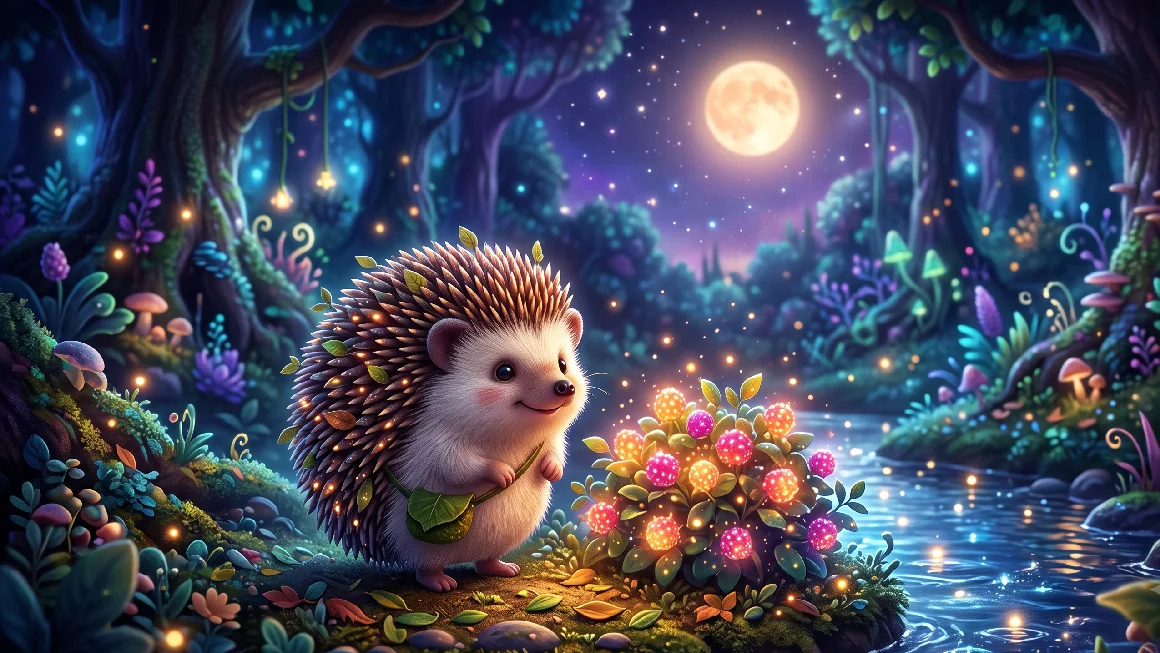
A small hedgehog named Spike meets a hungry owl in a dark forest, but he rolls into a sharp ball to stay safe. The hurt owl flies away into the night sky. This story provides slow English listening and clear audio for your regular English listening and Shadowing.
Spike was a small hedgehog. He lived under a big tree at the edge of a green forest. Spike was not very big, but he had many sharp spines on his back. His mother told him that his spines could protect him. “When you feel scared,” she said, “you can roll into a ball. Then no animal can hurt you.”
One evening, the sky turned dark and the moon came up. Spike wanted to find some food. He was very hungry. His mother was worried. “The forest is full of danger at night,” she said. “You must be very careful, Spike.”
Spike said yes and walked into the trees. The night was cold and quiet. He looked for worms and berries under the leaves. He found some sweet berries near a small river, and he was happy.
A Sound in the Dark
Then, suddenly, Spike heard a sound. It was a big, deep sound. He looked up and saw two yellow eyes in the dark. It was an owl! The owl was hungry too, and it wanted to eat the little hedgehog.
Spike was very worried. His heart was fast. He wanted to run home to his mother, but the owl was too close. He could not run away in time. “What can I do?” he thought.
Then Spike remembered his mother’s words. He did not run. He rolled into a small, tight ball. All his sharp spines pointed out, like many little needles. He stayed very still and closed his eyes.
The Brave Little Ball
The owl came down and tried to catch Spike. But when the owl touched him, the spines hurt its feet. “Ow!” cried the owl. It tried again, but the ball was too sharp. After a short time, the owl gave up. It opened its big wings and flew away into the night sky.
Spike waited a long time. He did not move. When the forest was quiet again, he slowly opened the ball. The owl was gone. Spike was safe.
He ran home as fast as he could. His mother was waiting under the tree. “You are back!” she said, and she gave him a warm hug. Spike told her all about the owl and the long night.
“I was so scared,” Spike said. “My legs were shaking.”
“But you did the right thing,” his mother said with a smile. “Being brave does not mean you are never scared. Being brave means you think clearly, even when you feel afraid.”
That night, Spike went to sleep under the stars. He was still a small hedgehog with sharp spines. But now he knew something new: he was brave, and his spines could always protect him.
Vocabulary · Key Words from the Article
| # | Word | Definition | Example Sentence |
|---|---|---|---|
| 1 | forest noun | a large area of land that is covered with many trees. | “We went for a long walk in the forest and saw some deer.” |
| 2 | protect verb | to keep someone or something safe from danger or harm. | “A good coat will protect you from the cold and the rain.” |
| 3 | danger noun | the chance that something bad or harmful may happen. | “The sign said the water was deep, so there was a danger of falling in.” |
| 4 | careful adjective | giving a lot of attention to what you do so that you do not have an accident or make a mistake. | “Please be careful when you cross the busy road.” |
| 5 | suddenly adverb | quickly and when you do not expect it. | “The dog was sleeping, but suddenly it jumped up and ran to the door.” |
| 6 | worried adjective | feeling unhappy or nervous because you think something bad might happen. | “She was worried about her test because she did not study.” |
Tip: Click any vocabulary row to find the word in the article. Export this list to your favorite flashcard apps like Quizlet or Anki. | |||
Usage Notes & Synonyms
We often say 'in the forest'. Do not confuse 'forest' (very big, with many trees) with 'garden' (a small green area near a house).
Synonym: woods
We often say 'protect someone/something from something', for example 'protect your eyes from the sun'.
Synonym: keep safe, guard
The adjective form is 'dangerous'. We often say 'in danger', for example 'The animal was in danger'.
Synonym: risk
We often say 'be careful' or 'careful with', for example 'Be careful with that hot cup'. The opposite is 'careless'.
Synonym: cautious
'Suddenly' is very common in stories to show a surprise. It usually comes at the start of a sentence or before the verb.
Synonym: all at once
We often say 'worried about something/someone'. The verb is 'worry', for example 'Don't worry!'
Synonym: anxious, nervous
Grammar in Context
Grammar in Context
This story tells about actions in the past, so it uses the past simple tense. Regular verbs add -ed (for example: walk becomes walked, want becomes wanted, look becomes looked). Many common verbs are irregular and change their form (for example: is becomes was, have becomes had, find becomes found, see becomes saw, run becomes ran, give becomes gave). We use the past simple to talk about finished actions and events that already happened. In this story, it helps us follow the order of what Spike did during one night: first he walked into the forest, then he heard the owl, and finally he ran home.
Listening Comprehension Questions
Listening Comprehension Questions
Why did Spike's mother tell him to be careful before he left home?
The text says his mother told him, 'The forest is full of danger at night.' This shows she was worried about the dangerous animals, like the owl, and wanted him to stay safe.
What did Spike do when the owl came close to him?
The story says, 'He rolled into a small, tight ball. All his sharp spines pointed out.' He could not run because the owl was too close, so he used the plan his mother taught him.
What does the word 'suddenly' tell us in this sentence: 'Then, suddenly, Spike heard a sound'?
'Suddenly' means something happens quickly and when you do not expect it. In the story, Spike was quietly eating berries, and then the owl's sound surprised him.
What is the main lesson of this story?
At the end, Spike's mother says, 'Being brave does not mean you are never scared. Being brave means you think clearly, even when you feel afraid.' This is the main idea of the whole story.
How did Spike's spines help him during the night? Explain in your own words.
Sample Answer
Spike's spines helped him protect himself from the owl. When the owl tried to catch him, Spike rolled into a ball, so all his sharp spines pointed out like needles. When the owl touched him, the spines hurt its feet. Because of this, the owl could not eat Spike and it flew away. His spines kept him safe.
Teacher's Note
A good answer should explain that the spines are sharp and that Spike used them by rolling into a ball. It should connect the spines to the result: the owl was hurt and gave up. The student should use their own words and show they understood cause and effect.
Do you think Spike was really brave? Why or why not? Use your own ideas.
Sample Answer
Yes, I think Spike was really brave. He was very scared and his legs were shaking, but he did not panic. He remembered his mother's words and stayed calm. He made a good plan and rolled into a ball. For me, being brave is not about having no fear. It is about doing the right thing even when you feel afraid, and Spike did that.
Teacher's Note
A strong answer should give a clear opinion (yes or no) and a reason. The best answers will show understanding of the story's message about courage: that fear and bravery can happen at the same time. Students should support their idea with an example from the text, such as his shaking legs or his clever plan.
Speaking Practice & Discussion Questions
Speaking Practice & Discussion Questions
Discussion Questions
-
1
What animal tried to catch Spike in the forest?
-
2
Do you feel worried when you are alone in a dark place? What do you do?
-
3
What would you do if you saw a wild animal close to you at night?
-
4
Do you think it is a good idea for parents to let their children do dangerous things to learn? Why?
-
5
Some people say that fear is a bad feeling, and other people say fear can help us. What do you think, and why?
Further Discussion
-
1
What does the word 'brave' really mean to you? Can a person be brave and scared at the same time?
-
2
Imagine a friend is afraid to do something important, like speak in front of many people. What advice would you give them, and why?
-
3
Do you think people today are more brave or less brave than people in the past? How might this change in the future?
Download the Worksheet for Offline Practice
Download the official A2 Elementary English worksheet (PDF). Review key vocabulary such as ‘danger’ and ‘careful’, answer selected comprehension questions, and check your answers with the included answer key.
Leave a Reply