
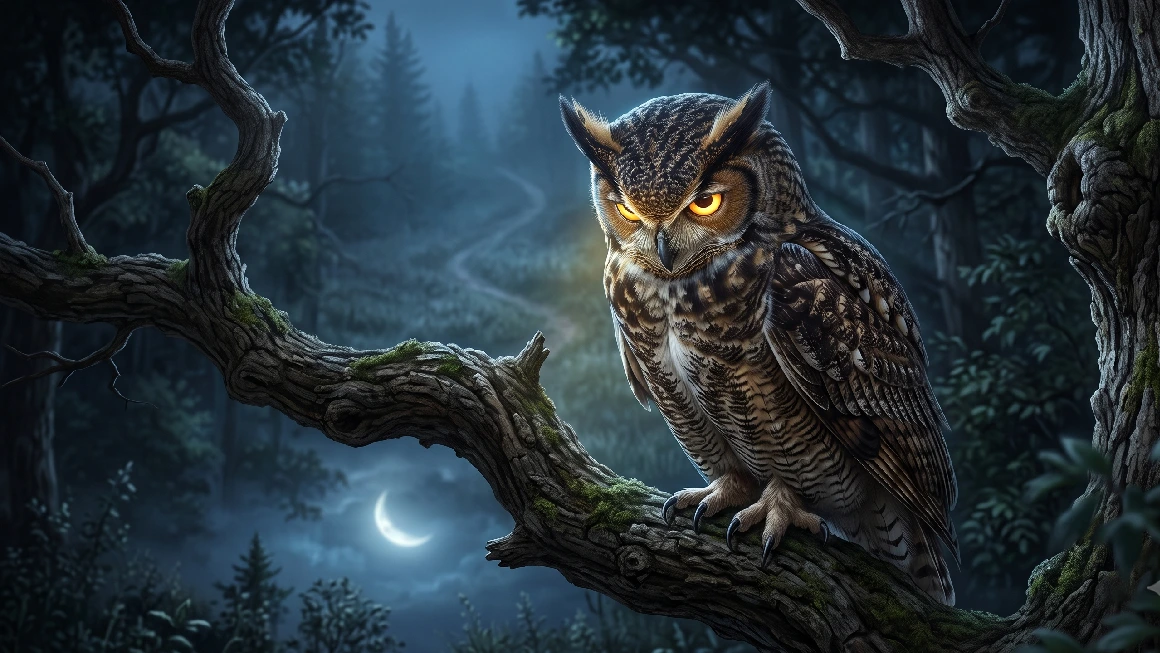
Hoot the owl uses his big eyes and strong ears to hunt mice quietly in the dark. Experience his story through slow English listening to learn how he flies without making a sound. Combine English listening and Shadowing with a listen and repeat method to build your audio skills today.
It is late at night. The town is quiet, and most people are in bed. But high in an old tree, one animal is wide awake. His name is Hoot, and he is an owl. Owls do not sleep at night like we do. The dark is their time. It is when they hunt.
Hoot sits very still on his branch. His round face turns slowly from left to right. He is looking down at the ground and the fields below him. To Hoot, the night is not really dark. His big yellow eyes can see very well in low light, much better than our eyes can. This is one reason why he is such a good hunter after the sun goes down.
Big Eyes and Sharp Ears
But eyes are not the only tool that Hoot has. He also has amazing ears. He cannot see them because they are hidden under his soft feathers, but they are very strong. Hoot can hear a tiny mouse moving in the wild grass, far away and in the dark. He turns his head to listen, first this way, then that way. When he knows exactly where the little animal is, he is ready.
Then, suddenly, Hoot opens his big wings and drops down from the tree. He flies straight to the mouse. And here is the most surprising thing of all: he makes almost no sound. Other birds are loud when they fly, but not Hoot. His feathers are very special and soft, so the air moves quietly around them. The mouse does not hear him coming. This is why the owl is a silent hunter.
A Bird of the Night
People have always thought that the owl is a very clever bird. In many old stories, the owl is wise and knows many secrets. This idea probably comes from his calm face and his big, thinking eyes. In truth, Hoot is not thinking about big questions. He is only thinking about food and about staying safe from danger.
Owls live in many parts of the world. Some live in cold places with snow, and some live in hot places. Many owls, like Hoot, live in the forest, where there are lots of trees and lots of small animals to eat. They are an important part of nature, because they eat mice and other small animals that farmers do not want in their fields.
When the morning comes, Hoot’s work is finished. The sky becomes light, and the other birds begin to sing. Hoot flies back to his tree, closes his big eyes, and goes to sleep. He will wait for the dark again. The night is his home.
Vocabulary · Key Words from the Article
| # | Word | Definition | Example Sentence |
|---|---|---|---|
| 1 | hunter noun | an animal or person that catches other animals for food | “The lion is a strong hunter and catches other animals for its dinner.” |
| 2 | wild adjective | living or growing in nature, not kept or controlled by people | “We saw many wild animals in the park, like deer and rabbits.” |
| 3 | suddenly adverb | quickly and when you do not expect it | “We were walking in the rain when suddenly the sun came out.” |
| 4 | clever adjective | able to learn and understand things quickly and easily | “My sister is very clever and always gets good marks at school.” |
| 5 | danger noun | the chance that something bad or harmful may happen to you | “The sign says the water is deep, so there is danger for small children.” |
| 6 | forest noun | a large area of land with many trees growing close together | “We took a long walk through the forest and heard many birds.” |
Tip: Click any vocabulary row to find the word in the article. Export this list to your favorite flashcard apps like Quizlet or Anki. | |||
Usage Notes & Synonyms
The verb is 'to hunt' and the activity is 'hunting'. We often say 'a good hunter' or 'a skilful hunter'.
Synonym: predator
Common phrases are 'wild animals', 'wild flowers', and 'in the wild', which means in nature.
Synonym: natural
'Suddenly' often starts a sentence to show a surprise. Do not confuse it with 'slowly', which means the opposite.
Synonym: all at once
We say 'clever at' something, for example 'clever at maths'. 'Clever' is more common in British English; 'smart' is common in American English.
Synonym: smart
Useful phrases are 'in danger' and 'out of danger'. The adjective is 'dangerous', as in 'a dangerous road'.
Synonym: risk
We usually say 'in the forest'. A 'forest' is bigger than a 'wood'. Do not confuse it with 'desert', which has no trees.
Synonym: wood
Grammar in Context
Grammar in Context
This story uses the present simple tense to talk about things that are always true or that happen again and again. We use it for facts about the owl and for its daily habits. For example, 'Owls do not sleep at night', 'Hoot can hear a tiny mouse', and 'They eat mice and other small animals'. Notice that with 'he', 'she', or 'it' we usually add -s to the verb, like 'Hoot sits' and 'He flies'. To make a negative, we use 'do not' or 'does not', as in 'The mouse does not hear him'. We choose the present simple here because the owl's way of hunting is a general truth, not something happening only once.
Listening Comprehension Questions
Listening Comprehension Questions
Why is the owl a good hunter at night?
The text says 'His big yellow eyes can see very well in low light' and later 'He also has amazing ears'. These two tools together help him find food in the dark, so this is the correct answer.
What is special about the way Hoot flies?
The story says 'he makes almost no sound' and explains that 'His feathers are very special and soft'. This is why the mouse 'does not hear him coming', so a silent flight is the special thing.
In the story, the word 'clever' is closest in meaning to which word?
'Clever' means able to understand things quickly. The best match here is 'smart'. The other words describe different ideas and do not mean the same as 'clever'.
What is the main idea of the whole story?
The whole text talks about how the owl wakes at night, sees and hears well, and flies silently to catch food. This main idea connects every part, while the other options are only small details or are not true.
The story says the owl is an important part of nature. Using your own words, explain how the owl helps farmers.
Sample Answer
The owl helps farmers because it eats mice and other small animals. The text says farmers do not want these small animals in their fields. When the owl catches and eats them at night, there are fewer of them to eat or damage the farmers' plants. In this way, the owl does useful work for the farmers without them asking.
Teacher's Note
A good answer must use the idea from the last-but-one paragraph that owls 'eat mice and other small animals that farmers do not want in their fields'. Look for a clear cause and effect: owls eat the small animals, so this helps the farmers. The student should use their own words and not only copy the sentence from the text.
The owl lives and works at night, while people live and work in the day. What do you think is one good thing and one hard thing about being awake at night?
Sample Answer
One good thing about being awake at night is that it is quiet and calm, because most people and animals are sleeping, so there is more peace and space. One hard thing is that it is dark and cold, so it can be more difficult to see and to find food or to feel safe. For an owl, the dark is helpful, but for a person it could feel a little lonely.
Teacher's Note
A strong answer needs two clear parts: one good point and one hard point, each with a short reason. Ideas can come from the text (the night is quiet, the dark helps the owl hunt) or from the student's own life. The most important thing is that the reasons make sense and are explained, not just listed.
Speaking Practice & Discussion Questions
Speaking Practice & Discussion Questions
Discussion Questions
-
1
What is the name of the owl in the story, and where does he sleep?
-
2
Do you like the night or the day more? Why?
-
3
Imagine you could see and hear as well as an owl for one night. What would you do?
-
4
Some people think night animals are a little scary. Do you agree, or do you think they are interesting?
-
5
Many wild animals are losing their homes because people cut down forests. What do you think people should do to help animals like the owl?
Further Discussion
-
1
Why do you think humans in many countries tell stories that say some animals are wise or clever? What does this tell us about people?
-
2
Is it right for people to build houses and roads in wild places where animals live, even when the animals have nowhere else to go? What would you decide, and why?
-
3
In the future, do you think there will be more wild animals or fewer wild animals near our cities? What will change life for these animals the most?
Download the Worksheet for Offline Practice
Download the official A2 Elementary English worksheet (PDF). Review key vocabulary such as ‘wild’ and ‘danger’, answer selected comprehension questions, and check your answers with the included answer key.
Leave a Reply