
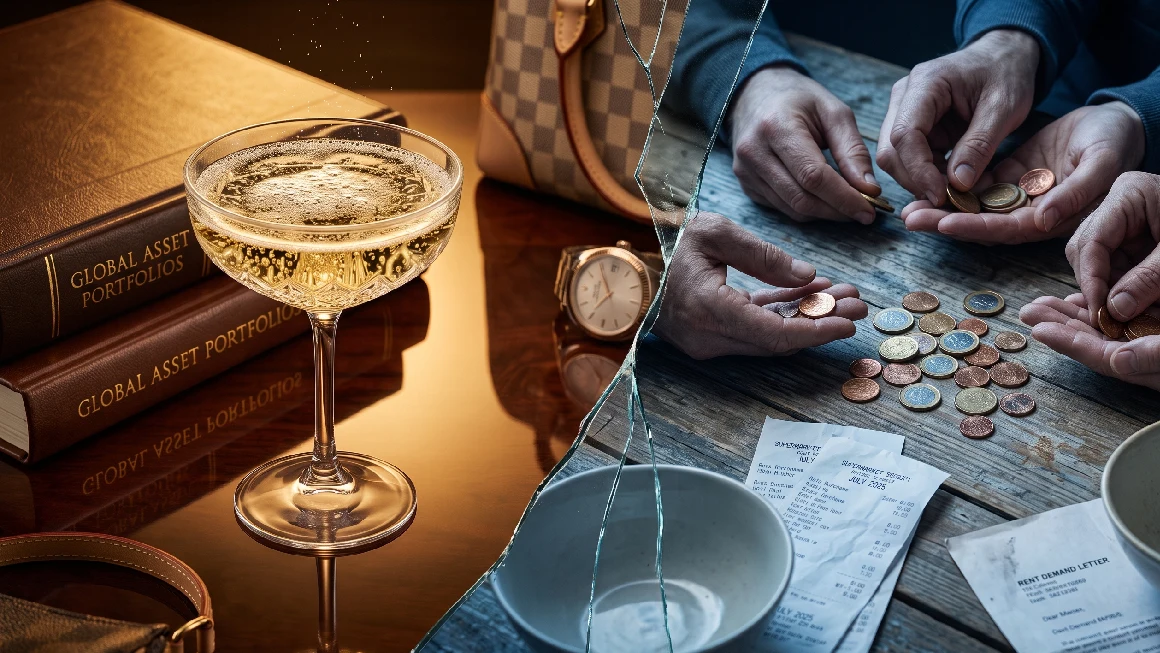
While billionaires protect their massive fortunes within financial assets, rising rents rapidly push everyday citizens into poverty and drastically shrink the middle class. Analyze this complex economic reality to challenge your English listening abilities. Shadowing the sophisticated vocabulary, connected speech, and English rhythm in this audio will naturally refine your accent.
The numbers tell a strange, contradictory story. In one of Europe’s wealthiest nations, roughly two million households, about 6.5 percent of the total, now hold net assets exceeding one million euros. Yet fewer than 181,000 households actually pay the country’s tax on property wealth, which applies only to those with real estate valued above 1.3 million euros. The gap between those two figures is not an accident. It reveals a simple truth about how the very rich protect what they own: they keep their fortunes in financial assets that the property tax cannot reach, rather than in the buildings and land that it can.
This is the quiet engineering of modern inequality, and the trend has accelerated for decades. Since 2003, the wealth of the richest 0.1 percent has quadrupled. The 500 richest families have seen their combined fortunes grow sixfold. At the very summit sits Bernard Arnault, the head of the luxury conglomerate LVMH and one of the richest people on the planet, whose fortune rises and falls with the global appetite for handbags, watches, and champagne. He and 144 other billionaires now call the country home.
The Widening Divide
If the top has soared upward, the bottom has been pulled in the opposite direction. According to statistics published in July 2025, more than 10 percent of the population lives below the poverty line, surviving on less than 1,288 euros a month. The pressure is not spread evenly. Single parents, large families, and students absorb the heaviest blows as the cost of everyday life continues to climb.
Housing has become the sharpest source of pain. In major cities, rents have reached punishing heights, forcing many people to make impossible choices between shelter and food. Charities that distribute free meals report record demand, and their dependence on donations has never been so fragile. For a growing number of citizens, hunger is no longer an abstract fear but an acute, daily reality.
A Shrinking Middle
Perhaps the most troubling change is happening in the space between these two extremes. Economists who monitor inequality argue that the middle class is steadily shrinking, and that the distance between the ultra-wealthy and those clinging to the poverty line has grown impossible to ignore. As prices rise faster than wages, the comfortable stability that once defined ordinary life continues to erode.
Politics offers no easy escape from these tensions. The decision, years ago, to abolish the broad tax on wealth and replace it with a narrower one covering only property remains bitterly contested. Critics on the left, along with trade unions, insist that the change rewarded those who could most easily accumulate riches while shifting the burden onto everyone else. Defenders counter that lower taxes keep investment and talent from fleeing abroad.
Whatever the merits of each side, the underlying picture is difficult to dispute. Two versions of the same country now exist side by side. One dines on champagne and watches its portfolios expand; the other counts coins at the supermarket and hopes the rent does not rise again next month.
Grammar in Context
Grammar in Context
This essay leans heavily on the present perfect to link past developments to their present consequences. Phrases such as "the trend has accelerated," "the wealth of the richest 0.1 percent has quadrupled," "the 500 richest families have seen their fortunes grow," and "has grown impossible to ignore" all describe changes that started in the past but remain relevant now. Writers reach for this tense when the exact date matters less than the ongoing result, which is why it dominates reports on trends and statistics. Notice how it pairs naturally with time markers like "since 2003" and "for decades" to trace a process that is still unfolding.
Speaking Practice & Discussion Questions
Speaking Practice & Discussion Questions
Discussion Questions
-
1
According to the article, how many billionaires live in the country, and who is named as the richest among them?
-
2
Have you noticed the cost of housing or food changing where you live? How has it affected your own choices?
-
3
Imagine you suddenly joined the richest 0.1 percent. Would you change where and how you keep your money, and why?
-
4
Do you think it is fair for a country to tax property but not other kinds of wealth, such as shares and investments?
-
5
Some people argue that high taxes on the rich drive talent and investment abroad, while others say low taxes deepen inequality. Which view do you find more convincing, and how might this divide change in the next ten years?
Further Discussion
-
1
Is a certain amount of economic inequality a natural and even useful feature of any society, or is it always a problem to be solved?
-
2
If a government could guarantee everyone a decent standard of living but only by sharply limiting how much wealth any individual could hold, would that trade-off be justified? Defend your position.
-
3
As automation and global markets concentrate wealth in fewer hands, how might the relationship between the ultra-rich and the rest of society change over the coming decades?
Download the Worksheet for Offline Practice
Download the official C1 Advanced English worksheet (PDF). Review key vocabulary such as ‘vocabulary’ and ‘expressions’, answer selected comprehension questions, and check your answers with the included answer key.
Leave a Reply