
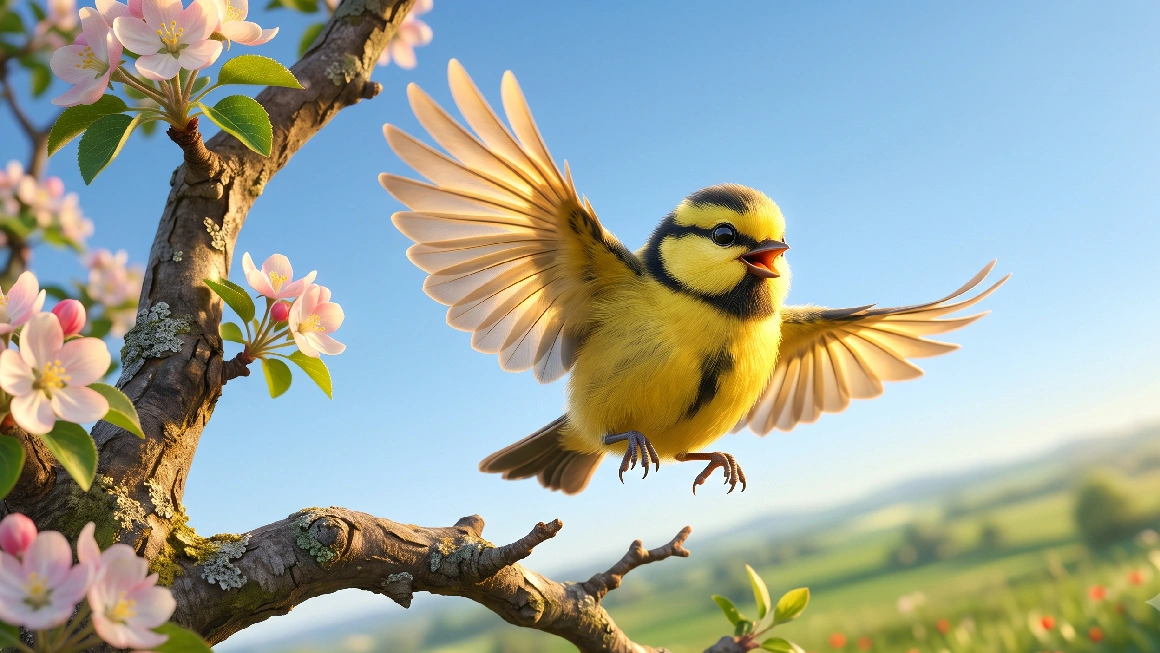
Pip is a small bird who feels afraid to leave his nest, but his mother helps him find the courage to fly. He jumps into the wind and quickly discovers the deep joy of flying above the beautiful garden. Enjoy this audio through slow English listening, and add Shadowing as you listen and repeat to improve your daily English listening routine.
Pip was a little bird. He lived in a small nest at the top of an old apple tree. The nest was warm and soft. His mother and his two sisters lived there too. Every morning, the sun came up and filled the nest with golden light. Pip loved his home very much.
But Pip had a problem. He could not fly. His sisters could already fly to other trees, but Pip was scared. The ground looked very far away. When he looked down, his little heart beat fast.
One morning, his mother said, “Today is the day, Pip. You must learn to fly. It is a big adventure, but you can do it.”
Pip looked at the wide blue sky. He wanted to fly more than anything. At night, he often had a dream about flying high over the green fields. In the dream, the wind was soft and the world was beautiful. But now, in the real world, he felt afraid.
“I cannot do it,” Pip said quietly. “What if I fall?”
His mother smiled. “Be careful, but be brave,” she said. “Open your wings and trust them. I will be here.”
Pip moved to the edge of the nest. His small feet held the branch tightly. He looked down one more time. Then he closed his eyes and opened his wings.
Suddenly, a soft wind lifted him into the air! For one frightening moment, he dropped. His mother called to him, “Move your wings, Pip! Move them now!”
Pip moved his wings up and down, again and again. And then something wonderful happened. He was not falling anymore. He was flying! The wind held him gently, just like in his dream.
Pip flew over the garden. He saw the red flowers and the tall grass below him. He flew past his sisters, who sang happily for him. The fear was gone now. He began to enjoy every second of it.
“I am flying!” he cried. “I am really flying!”
He flew higher and higher into the warm morning sky. The whole world looked different from up here. The houses were small, and the river looked like a thin silver line. Pip felt free and strong. This was better than any dream.
After some time, Pip felt a little tired. He turned around and flew slowly back to his nest. His mother was waiting for him with a big, proud smile.
“You did it!” she said. “I am so proud of you, my brave little bird.”
Pip landed softly next to her. His wings were tired, but his heart was full of joy. He was not scared anymore. He understood now that the most difficult things can become the most beautiful adventure.
That night, Pip looked up at the stars. Tomorrow he would fly again, and the day after that. The whole sky was now his home. And he was no longer afraid of the wide, open world below him.
Vocabulary · Key Words from the Article
| # | Word | Definition | Example Sentence |
|---|---|---|---|
| 1 | scared adjective | feeling afraid; frightened of something that might happen | “My little brother is scared of big dogs.” |
| 2 | adventure noun | an exciting experience where you do something new, often a little dangerous | “Travelling to a new country alone was a big adventure for me.” |
| 3 | dream noun | the pictures and stories in your mind while you are sleeping; also something you really want for the future | “I had a strange dream about flying last night.” |
| 4 | careful adjective | giving a lot of attention to what you do so that you do not make a mistake or have an accident | “Please be careful when you cross the road.” |
| 5 | suddenly adverb | quickly and when you do not expect it | “We were walking in the park when suddenly it started to rain.” |
| 6 | enjoy verb | to get pleasure from something; to like doing something | “I really enjoy listening to music after work.” |
Tip: Click any vocabulary row to find the word in the article. | |||
Usage Notes & Synonyms
We often say 'scared of' something: 'She is scared of the dark.' You can also be 'scared to do' something: 'He was scared to jump.'
Synonym: afraid, frightened
We often use 'go on an adventure' or 'have an adventure'. The adjective is 'adventurous', for a person who likes new and exciting things.
Synonym: journey, experience
Use the verb 'have' with this noun: 'have a dream'. 'Dream' can also be a verb: 'I dream about a big house.' A 'dream job' is the perfect job you want.
Synonym: vision, hope
The most common phrase is 'be careful'. The opposite is 'careless'. The adverb is 'carefully': 'She drove carefully in the rain.'
Synonym: cautious
'Suddenly' often starts a sentence to show a surprise in a story. The adjective is 'sudden': 'a sudden noise'.
Synonym: quickly, all at once
After 'enjoy', we use the -ing form of the next verb: 'enjoy reading', 'enjoy playing'. We do not say 'enjoy to read'. You can also 'enjoy yourself' to mean 'have a good time'.
Synonym: like, love
Grammar in Context
Grammar in Context
This story tells us about events that happened and finished in the past, so it uses the simple past tense. We make regular verbs by adding -ed, for example 'looked', 'moved', 'opened', and 'landed'. But many common verbs are irregular and we must learn them, for example 'was/were' (be), 'had' (have), 'said' (say), 'flew' (fly), 'saw' (see), and 'felt' (feel). We use this tense to put the actions in order, one after another: Pip 'closed' his eyes, 'opened' his wings, and then the wind 'lifted' him. When you read a story, look for these verb forms to understand what happened and when.
Listening Comprehension Questions
Listening Comprehension Questions
Why was Pip different from his two sisters at the start of the story?
The text says, 'His sisters could already fly to other trees, but Pip was scared.' This shows that the sisters could fly but Pip could not because of his fear, not because of any physical problem.
What helped Pip when he first dropped from the nest?
The story says, 'Suddenly, a soft wind lifted him into the air!' Although he dropped for a moment, the wind helped him, and then his mother told him to move his wings.
In the sentence 'The fear was gone now. He began to enjoy every second of it', what does the word 'enjoy' tell us about Pip's feelings?
The sentence before says 'The fear was gone now.' This tells us his bad feeling has ended. 'Enjoy' means to get pleasure from something, so Pip is now happy and likes flying.
What is the main lesson (message) of this story?
Near the end, the text says Pip 'understood now that the most difficult things can become the most beautiful adventure.' The whole story shows him changing from scared to happy and free, which teaches us about courage.
How do Pip's feelings change from the beginning to the end of the story? Use examples from the text.
Sample Answer
At the beginning, Pip is scared and afraid. His heart 'beat fast' when he looked down, and he said, 'I cannot do it.' He was nervous about falling. But after he learns to fly, his feelings change completely. He begins to 'enjoy every second of it' and he feels 'free and strong'. At the end, he is happy, proud, and 'no longer afraid'. So Pip changes from fear to joy and confidence.
Teacher's Note
A good answer must clearly show the contrast between two feelings: fear at the start and happiness or confidence at the end. The student should include at least one example from each part of the story (for example 'scared'/'beat fast' for the start and 'enjoy'/'free'/'proud' for the end) to support their idea.
Pip's mother said, 'Be careful, but be brave.' What do you think she meant by this? Do you think it was good advice?
Sample Answer
I think Pip's mother meant that Pip should pay attention and not do something silly or dangerous, but at the same time he must not let his fear stop him. 'Careful' means he should be safe and think about what he is doing, and 'brave' means he should try the new thing even when he is afraid. I think it was very good advice, because Pip needed both things: he needed to trust his wings (brave) and also to do it the right way (careful). In real life, this advice helps us try new and difficult things safely.
Teacher's Note
A strong answer should explain the meaning of both words ('careful' and 'brave') and show that they work together. The student should give their own opinion ('yes' or 'no') with a simple reason. Look for the idea of balancing safety with courage.
Speaking Practice & Discussion Questions
Speaking Practice & Discussion Questions
Discussion Questions
-
1
Where did Pip live, and who lived in the nest with him?
-
2
Are you scared of anything, like Pip was scared of flying? What is it?
-
3
Imagine you could fly like Pip for one day. Where would you go and what would you see?
-
4
Do you think Pip's mother was a good teacher? Why or why not?
-
5
Pip felt 'free and strong' when he learned something difficult. Do you think it is important to do scary or difficult things sometimes? Why?
Further Discussion
-
1
Why do you think people often feel afraid before they try something new for the first time?
-
2
Some people say it is good to be brave, and other people say it is better to be safe and careful. Which is more important, and when?
-
3
How do parents and teachers help children learn difficult things? Is it better to push someone to try, or to wait until they are ready?
Download the Worksheet for Offline Practice
Download the official A2 Elementary English worksheet (PDF). Review key vocabulary such as ‘adventure’ and ‘suddenly’, answer selected comprehension questions, and check your answers with the included answer key.
Leave a Reply