
This moving audio examines how global warming quietly evicts low-lying coastal communities. While some societies try to adapt to these rising waters, deep inequalities worsen the global crisis. Use this resource to enhance your advanced English listening skills. Practising accurate Shadowing with this material will significantly refine your natural English rhythm and timing.
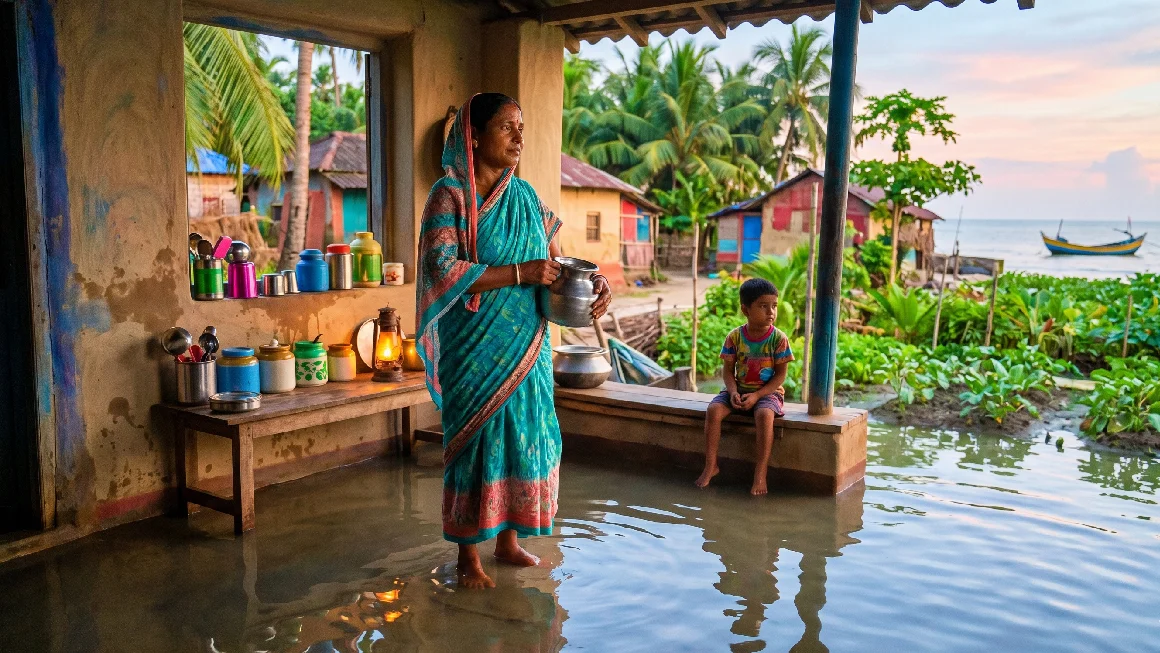
When the sea first reached her doorstep, Amina did not call it climate change. She called it Tuesday. For years, the residents of her low-lying village on the Bay of Bengal had measured the calendar by the tides, but the water that now slid across the floor of her kitchen obeyed no schedule she recognised. The salt it left behind killed the vegetables in her garden, and the well her family had drunk from for generations turned brackish and useless. What scientists describe in graphs and projections, she experiences as a slow eviction from the only home she has ever known.
Climate disruption is rarely the single, cinematic catastrophe that headlines prefer. More often it arrives as accumulation: a fraction of a degree, a few extra centimetres of ocean, a rainy season that begins late and ends early. Yet these modest figures conceal a brutal arithmetic. Coral reefs that took millennia to grow can bleach white within a single hot summer, and a coastline that stood firm for a century can erode in a decade. Once a natural system crosses a certain threshold, the damage often becomes self-reinforcing and difficult, sometimes impossible, to reverse.
The ecological wound and the human wound are inseparable. Drought does not merely wither crops; it empties bank accounts, pulls children out of school, and pushes desperate families toward overcrowded cities. Rising seas do not simply redraw maps; they displace whole communities, scattering them into places where they own nothing and belong to no one. The most fragile ecosystems and the most fragile economies tend to occupy the same vulnerable ground, which is why a storm that a wealthy nation absorbs as an expensive inconvenience can shatter a poorer one entirely.
This uneven distribution of suffering exposes the central injustice of the crisis. The countries that have burned the most fossil fuels are seldom the countries paying the steepest price. A farmer in the Sahel, whose lifetime carbon footprint would barely register beside that of an average European commuter, may lose everything to a warming he did almost nothing to cause. Climate change, in this sense, behaves less like a great equaliser and more like a magnifying glass, sharpening every existing inequality of wealth, geography, and power.
None of this means that humanity is helpless. Communities have always responded to a shifting world, and adaptation is now unfolding on every continent. Farmers are switching to salt-tolerant rice; engineers are designing floating schools; cities are restoring mangroves that blunt the force of incoming waves. Such measures cannot undo the warming already locked into the atmosphere, but they can soften its sharpest edges and buy precious time.
Still, adaptation has limits, and dignity has a price. For Amina, the question is no longer whether her village can be saved, but where her grandchildren will live when it cannot. Her story, multiplied across millions of coastlines and drylands, is the truest measure of what accelerated climate disruption really means. It is not an abstraction hovering in some distant future. It is already standing, quietly, in her kitchen.
Vocabulary · Key Words from the Article
| # | Word | Definition | Example Sentence |
|---|---|---|---|
| 1 | erode verb | to gradually wear away or destroy something, especially rock or soil, by the action of water, wind, or weather; it can also describe the slow weakening of something abstract. | “Decades of heavy rainfall had eroded the cliff until the path along its edge finally gave way.” |
| 2 | threshold noun | the level or point at which something starts to happen or to have an effect; beyond it, the situation changes significantly. | “Once unemployment passes a certain threshold, governments usually feel pressure to act.” |
| 3 | displace verb | to force people or things to move away from their usual or proper place, often permanently. | “The new dam project will displace thousands of villagers who have lived in the valley for centuries.” |
| 4 | fragile adjective | easily damaged, broken, or harmed; lacking the strength to survive shocks or pressure. | “After the war, the country's fragile economy could not survive another bad harvest.” |
| 5 | inequality noun | an unfair situation in which some people or groups have more money, opportunities, or power than others. | “The report warned that rising inequality between rich and poor regions could fuel social unrest.” |
| 6 | adaptation noun | the process of changing something, or of changing your behaviour, so that it works better in a new or difficult situation. | “Successful adaptation to remote work required new habits, better software, and a great deal of patience.” |
Export this list to your favorite flashcard apps like Quizlet or Anki. | |||
Usage Notes & Synonyms
Often used both literally (waves erode the shore) and figuratively (trust erodes, confidence erodes). The matching noun is 'erosion'.
Synonym: wear away, wear down
Common collocations: 'cross a threshold', 'reach a threshold', 'a pain threshold'. It can also literally mean the floor of a doorway.
Synonym: limit, turning point
Frequently used in the passive: 'families were displaced by the flood'. The related noun 'displacement' and the term 'displaced people' are common in news and reports.
Synonym: uproot, force out
Applies to physical objects (a fragile vase) and abstract things (a fragile peace, fragile health). The opposite is 'robust' or 'sturdy'.
Synonym: delicate, vulnerable
Often paired with words like 'wealth', 'income', 'gender', or 'social'. The opposite is 'equality'.
Synonym: unfairness, disparity
Comes from the verb 'adapt' (to adapt to something). In climate discussion, 'adaptation' is often contrasted with 'mitigation' (reducing the causes of warming).
Synonym: adjustment, modification
Grammar Focus
Grammar Focus
The text leans heavily on relative clauses to pack background information into single, flowing sentences without breaking them apart. Defining relative clauses identify exactly which noun is meant and cannot be removed without losing essential meaning, as in 'Coral reefs that took millennia to grow' or 'the countries that have burned the most fossil fuels'. Non-defining relative clauses, set off by commas, add extra, non-essential detail about a noun whose identity is already clear, as in 'A farmer in the Sahel, whose lifetime carbon footprint would barely register...'. Note how 'whose' shows possession, 'which' refers to a whole idea ('...can shatter a poorer one entirely, which is why...'), and 'where' introduces a clause about place ('places where they own nothing'). At C1 level, this structure lets a writer build dense, sophisticated sentences while keeping the logical relationships between ideas precise and easy to follow.
Reading Comprehension
Reading Comprehension
Why does the writer begin the article with Amina calling the flooding 'Tuesday' rather than 'climate change'?
The opening contrast sets up the article's central argument, confirmed in the final paragraph: climate disruption 'is not an abstraction hovering in some distant future. It is already standing, quietly, in her kitchen.' Naming the disaster 'Tuesday' makes it routine and personal, the opposite of the distant 'graphs and projections' scientists use. It does not imply ignorance, since she clearly understands the salt and the brackish well.
What does the writer mean by 'these modest figures conceal a brutal arithmetic'?
The sentence is immediately illustrated by examples of small inputs producing huge outcomes: reefs that 'bleach white within a single hot summer' and a coastline that 'can erode in a decade'. The contrast between 'modest figures' (a fraction of a degree, a few centimetres) and 'brutal arithmetic' shows that tiny measurements can add up to devastating, self-reinforcing results.
The writer compares climate change to 'a magnifying glass' rather than 'a great equaliser'. What idea does this comparison convey?
A magnifying glass enlarges what is already there, so the metaphor means the crisis is 'sharpening every existing inequality of wealth, geography, and power'. This directly rejects the idea of an 'equaliser', supported by the earlier example of the Sahel farmer who suffers from a warming he 'did almost nothing to cause' while wealthier nations contribute far more emissions.
Which statement best captures the writer's overall attitude in the article?
The writer balances bleak realism with measured hope. The fifth paragraph insists 'None of this means that humanity is helpless' and offers concrete adaptations (salt-tolerant rice, floating schools, mangroves). At the same time, the final paragraph admits 'adaptation has limits', so the tone is neither despairing nor naively optimistic but soberly hopeful.
Explain how the writer links environmental damage to social and economic harm. Use evidence from the text to support your answer.
Sample Answer
The writer argues that ecological and human harm are 'inseparable', showing that environmental damage rarely stops at nature. Drought, for example, 'does not merely wither crops; it empties bank accounts, pulls children out of school, and pushes desperate families toward overcrowded cities', so a natural shortage becomes a chain of social consequences. Rising seas similarly 'displace whole communities', stripping people of property and belonging. The writer then sharpens the point by noting that 'the most fragile ecosystems and the most fragile economies tend to occupy the same vulnerable ground', which explains why an identical storm is a mere 'inconvenience' for a wealthy nation but can 'shatter a poorer one entirely'. The link, therefore, is one of overlap and amplification: weak environments and weak economies sit together, so ecological shocks fall hardest on those least able to recover.
Teacher's Note
A strong answer must explicitly connect the two domains (environment and society/economy) rather than describing them separately. It should cite at least two concrete textual examples, such as the drought consequences or the displacement of communities, and ideally explain the writer's reasoning about overlapping vulnerability. Top responses will also note the contrast between wealthy and poorer nations to show why the harm is uneven, demonstrating inference rather than simple paraphrase.
The article raises a question of fairness in who suffers most from climate change. To what extent do you think wealthier, higher-emitting countries have a responsibility toward people like Amina? Justify your position.
Sample Answer
The article makes a powerful case for shared responsibility by exposing a mismatch between cause and consequence: the countries that 'have burned the most fossil fuels are seldom the countries paying the steepest price', while a Sahel farmer with a tiny 'carbon footprint' may 'lose everything'. From this, a strong argument can be made that high-emitting nations bear a clear moral responsibility, since they have gained the benefits of industrial growth while exporting much of its damage to others. This responsibility might take the form of funding adaptation projects, accepting displaced people, or cutting emissions faster. A more cautious position could acknowledge the injustice yet question how responsibility should be measured and shared fairly across generations and economies. Either way, a convincing answer would recognise the core tension the article identifies between those who cause the harm and those who endure it, and would defend a clear stance with reasons rather than leaving the question open.
Teacher's Note
Graders should look for a clearly stated position supported by reasoning, not merely a summary of the article. A high-level answer engages directly with the fairness argument in paragraph four (the gap between emitters and victims) and offers at least one specific form that responsibility could take. Stronger responses will weigh a counter-consideration, such as the difficulty of assigning blame or the costs to developing economies, showing balanced critical thinking appropriate to C1.
Speaking & Discussion
Speaking & Discussion
Discussion Questions
-
1
According to the article, what happened to Amina's well and garden after the seawater reached her home?
-
2
Have you ever experienced unusual weather, flooding, or extreme heat where you live? How did it affect your daily routine?
-
3
Imagine your own town had to deal with rising water or repeated droughts. What changes do you think people would have to make first?
-
4
The article says climate change often hits poorer communities hardest. Do you think this is something individuals can influence, or is it mainly up to governments?
-
5
Looking ahead, do you believe humanity will adapt successfully to a warming world, or are we acting too slowly? Explain your view.
Further Discussion
-
1
When a problem is caused by many people over many decades, how should a society decide who is responsible for fixing it?
-
2
If welcoming large numbers of people displaced by environmental disaster placed real strain on your own country's resources, would you still consider it an obligation? Defend your position.
-
3
Some thinkers argue that future generations have rights that should shape the decisions we make today. How far should the interests of people not yet born influence present-day policy?
Download the Worksheet for Offline Practice
Download the official C1 Advanced English worksheet (PDF). Review key vocabulary such as ‘fragile’ and ‘inequality’, answer selected comprehension questions, and check your answers with the included answer key.
Leave a Reply